Regenerative Medicine Scaffolds Market Size
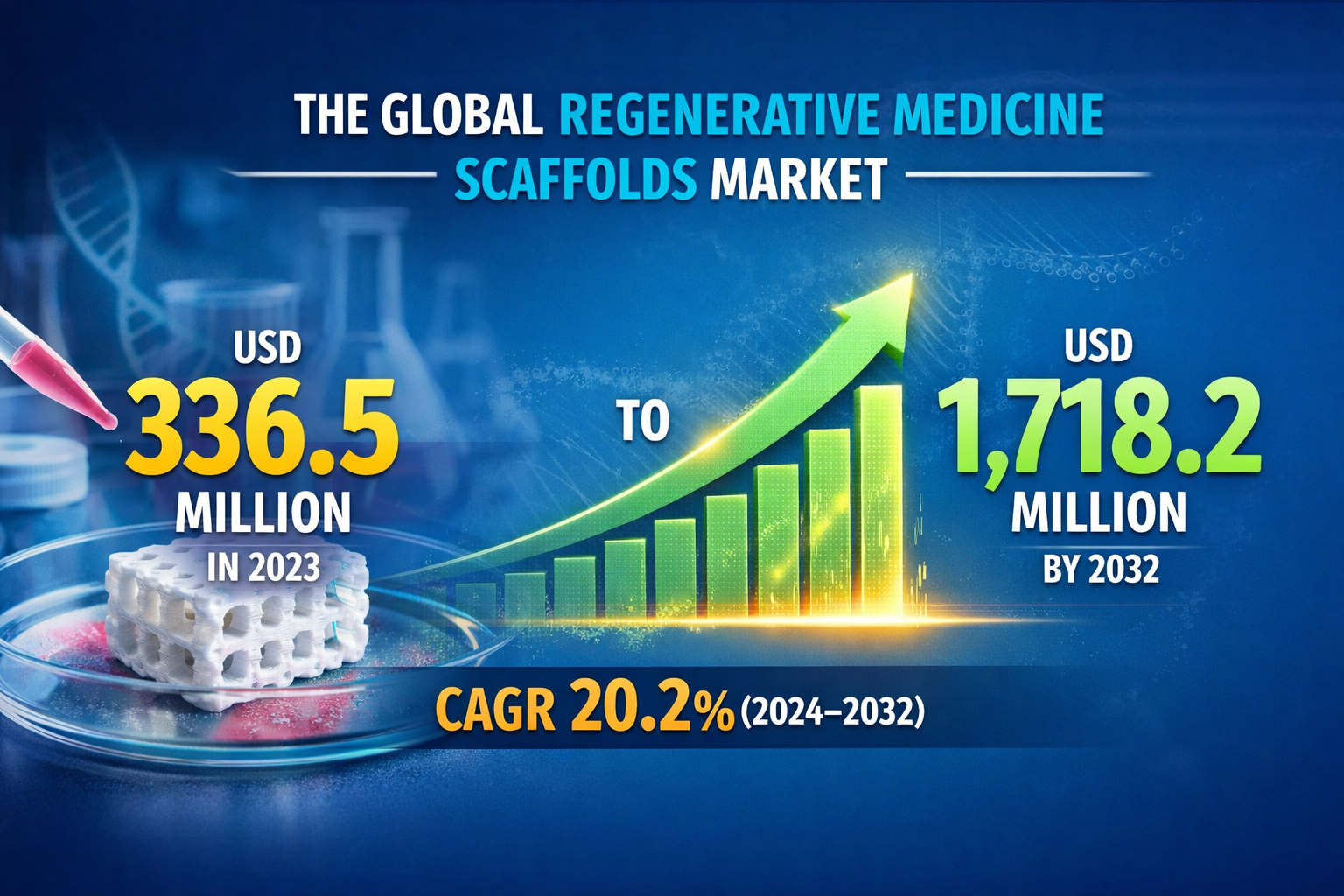
The global regenerative medicine scaffolds market was valued at approximately USD 336.5 Million in 2023 and is forecast to grow to around USD 1,718.2 Million by 2032, at a CAGR of 20.2% over the period from 2024 to 2032.
What is the Regenerative Medicine Scaffolds Market?
The regenerative medicine scaffolds market revolves around the development and commercial deployment of biocompatible scaffold structures — three‑dimensional matrices that mimic the body’s natural extracellular matrix. These scaffolds:
Provide a temporary structural support system for cells,
Facilitate cell attachment, proliferation, and differentiation,
And guide the formation of new, functioning tissue.
These scaffolds are made from a range of engineered materials such as biodegradable polymers, hydrogels, and bioactive ceramics, and serve as the foundation for regenerating multiple tissue types including bone, cartilage, skin, neural tissue, cardiovascular tissue, and muscles.
Scope & Significance:
Regenerative medicine scaffolds play a critical role in addressing chronic diseases, severe traumas, and degenerative conditions that traditional treatments often struggle to treat effectively. They offer promising alternatives to organ transplantation and grafting by enabling the body to heal and regenerate tissue with precision. With increasing prevalence of chronic illnesses and rising demand for personalized therapies, the market is poised for strong expansion.
Get a Free Sample: https://www.acumenresearchandconsulting.com/request-sample/3766
Market Trends
The regenerative medicine scaffolds market is evolving rapidly, driven by several notable trends:
1. Technological Advancements
Breakthroughs such as 3D bioprinting and nanotechnology are at the forefront of innovation. 3D bioprinting allows for precise, patient‑specific scaffold architectures, which significantly enhances tissue regeneration outcomes. Nanotechnology integration improves scaffold bioactivity and mechanical properties.
2. Personalized Medicine Focus
There is a growing preference for customized treatment solutions. Scaffold technologies enable tailoring structures to individual patient needs — an important trend as medicine moves toward precision therapies.
3. Expanded Applications
Initially focused on bone and cartilage regeneration, scaffold applications are extending to wound healing, cardiovascular repair, neural tissue engineering, and soft tissue reconstruction. This broadening application base is fueling adoption across hospitals, biopharma firms, and research institutes.
4. Investments in Research & Innovation
Escalating investments in tissue engineering and regenerative medicine — particularly in biomaterials research and scaffold design — are contributing to rapid market growth and expanded clinical potential.
Market Dynamics
Key Drivers
Growing prevalence of degenerative diseases and traumatic injuries is increasing demand for regenerative therapies that can restore function and improve quality of life.
Increased research spending in regenerative medicine and supportive regulatory frameworks are stimulating innovation and product development.
Restraints
The high cost of R&D and clinical trials presents a barrier to entry for new market players.
Strict regulatory requirements can delay product approvals and commercialization, reducing market agility.
Long‑term efficacy and safety concerns of new scaffold materials may impact their adoption in mainstream therapy.
Opportunities
Ongoing advancements in 3D printing technology support more effective scaffold creation with improved functional performance.
Patient‑specific treatment models and rising healthcare spending in emerging economies offer new growth avenues.
Regional Analysis
North America – Market Leader
North America dominated the regenerative medicine scaffolds market in 2023, driven by advanced healthcare infrastructure, strong R&D ecosystems, and high adoption of innovative medical technologies. The U.S. remains a major hub for biotechnology investment and clinical application of scaffold‑based therapies.
Asia‑Pacific – Fastest Growing Region
The Asia‑Pacific region is expected to record the fastest growth rate through 2032. This acceleration is attributed to increasing healthcare investments, expanding research capacities, rising awareness of innovative therapies, and supportive government initiatives in countries such as China, Japan, India, and South Korea.
Europe and Other Regions
Europe maintains steady growth through strong clinical research activity and robust healthcare systems. Latin America, the Middle East, and Africa are emerging markets with growing healthcare infrastructure and increasing focus on regenerative technologies.
Recent Developments
The global regenerative medicine scaffolds market is projected to grow from approximately USD 336.5 million in 2023 to USD 1,718.2 million by 2032 with a CAGR of 20.2%, underscoring strong commercial potential. The robust growth trajectory reflects significant investments in biomaterials, scaffold designs, and additive manufacturing technologies that support clinical adoption and product diversification.
Conclusion
The Regenerative Medicine Scaffolds Market is on the cusp of a transformative growth phase, powered by technological innovation, expanding clinical applications, and rising demand for personalized regenerative solutions. With strong regional momentum and evolving market dynamics, this industry represents a pivotal opportunity for healthcare innovators, biopharmaceutical players, and medical researchers seeking to redefine the future of tissue repair and regeneration.
To Get Detailed Overview, Contact Us: https://www.acumenresearchandconsulting.com/contact-us