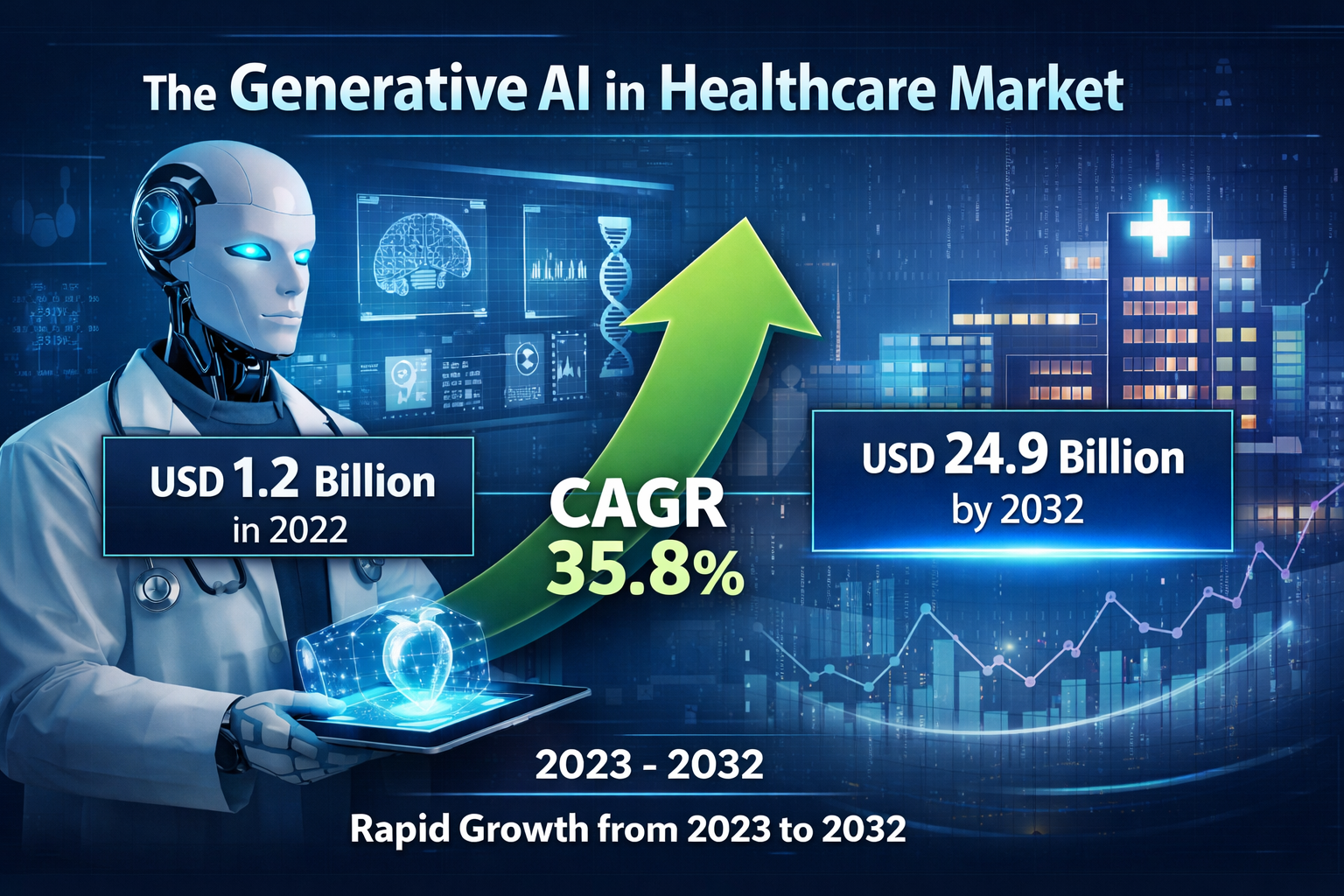
Generative AI in Healthcare Market Size
The Generative AI in Healthcare Market was valued at around USD 1.2 billion in 2022 and is expected to expand to approximately USD 24.9 billion by 2032, growing at a 35.8% CAGR over the forecast period.
What is the Generative AI in Healthcare Market?
The Generative AI in Healthcare Market refers to the application and commercialization of generative artificial intelligence technologies—such as generative adversarial networks (GANs), variational autoencoders (VAEs), and large language models—in the healthcare industry. These models can generate meaningful and realistic data, whether it’s synthetic medical images, simulated patient responses, or predictive diagnostic outputs. Unlike traditional AI systems that only classify or predict, generative AI creates new, useful content that enhances clinical and research workflows.
Generative AI tools are increasingly being used in areas like medical imaging, clinical decision support, drug discovery, and personalized medicine. The market’s significance lies in its ability to help healthcare organizations solve persistent challenges—such as data scarcity, diagnostic accuracy, and research productivity—while offering potential cost savings and better patient outcomes.
Market Trends
Several key trends are shaping the Generative AI in Healthcare Market:
Advanced Diagnostic & Imaging Capabilities
Generative AI is being widely adopted in medical imaging and diagnostics. It can synthesize realistic and diverse medical images, improve image quality, and enhance the sensitivity of diagnostic tools—especially where labeled data is limited.
Acceleration of Drug Discovery
Generative models can simulate molecular structures and potential drug interactions, enabling faster identification of therapeutic candidates. This capability is helping pharmaceutical companies reduce time and investment in early-stage drug research.
Personalized and Precision Medicine
There’s a growing need for customized treatment plans based on individual health profiles. Generative AI processes complex patient data to generate personalized insights that support clinical decision-making.
Integration with Existing Healthcare Systems
Healthcare organizations are embedding generative AI into electronic health records, clinical workflows, telemedicine platforms, and administrative systems to automate routine tasks and enhance patient care.
Demand for Data Generation
Generative AI helps overcome challenges related to limited real-world healthcare data by producing synthetic but clinically plausible datasets that preserve privacy while enabling model training.
Get a Free Sample: https://www.acumenresearchandconsulting.com/request-sample/3456
Market Dynamics
Understanding what drives—and what restrains—this market is essential for stakeholders:
Key Drivers
Rising demand for personalized healthcare.
Technological advancements in AI architectures and computing power.
Growing investments in AI tools by healthcare providers and technology companies.
Market Restraints
Data privacy and security concerns.
Regulatory challenges slowing implementation.
Opportunities
Drug development and R&D optimization.
Emerging use cases, including virtual nursing assistants and AI-assisted surgery.
Regional Analysis
Generative AI adoption differs across the globe, influenced by healthcare infrastructure, technology investment, and regulatory readiness:
North America
North America remains the dominant regional market due to established healthcare infrastructure, extensive R&D activities, and strong technological innovation.
Asia-Pacific
The Asia-Pacific region is projected to grow at the fastest rate. Countries like China, Japan, South Korea, and India are investing in digital healthcare solutions and AI research. This region’s rapidly expanding healthcare systems and growing tech ecosystems contribute to its strong growth potential.
Europe, Latin America & MEA
Europe continues to adopt generative AI solutions, particularly in clinical environments, while Latin America and the Middle East & Africa show growing interest as healthcare digitalization spreads.
Recent Developments Impacting the Market
Startup funding growth reflects investor confidence in automation and AI applications in healthcare.
Strategic shifts by major players focus on high-impact use cases like drug discovery and internal productivity tools.
AI adoption in clinical practice is increasing, with tools being used in consultations, documentation, and diagnostic support.
Healthcare is increasingly recognized as a priority sector for AI investment, particularly in genomics and robotics.
Conclusion
The Generative AI in Healthcare Market stands at the forefront of digital health innovation, offering a future where diagnostics, treatment planning, research, and patient care are more effective, efficient, and personalized. With robust growth forecasts, expanding regional opportunities, and a growing ecosystem of startups and established players, this market promises to redefine healthcare delivery in the years ahead. As technology evolves and adoption barriers are addressed, healthcare providers and patients alike will benefit from the transformative potential of generative AI.
To Get Detailed Overview, Contact Us: https://www.acumenresearchandconsulting.com/contact-us