AstraZeneca, Daiichi Sankyo and Summit Therapeutics have built a three-way oncology collaboration in which each company supplies its own drug, the costs are shared and nobody gives up rights, a structure that says as much about how cancer dealmaking is changing as the science does. Announced on 2 October 2026, the AstraZeneca Summit collaboration will test Datroway with ivonescimab across multiple solid tumours, starting with a Phase III study in first-line triple-negative breast cancer (TNBC). Here is how the deal is put together and what it signals.
Key Takeaways
- The three companies will evaluate Datroway (from AstraZeneca and Daiichi Sankyo) with ivonescimab (from Summit Therapeutics) in several solid tumours, with lung and breast cancers named.
- Each company contributes its own medicine, shares trial costs and keeps development and commercial rights to its own drug.
- The pact follows a $2 billion equity investment by AstraZeneca in Summit announced on 28 September 2026.
- No enrolment target, endpoint, start date or additional financial terms were disclosed in the announcements we reviewed.
- Ivonescimab is investigational in the United States and Europe, so the commercial case rests on future trial data.
How the Deal Is Built
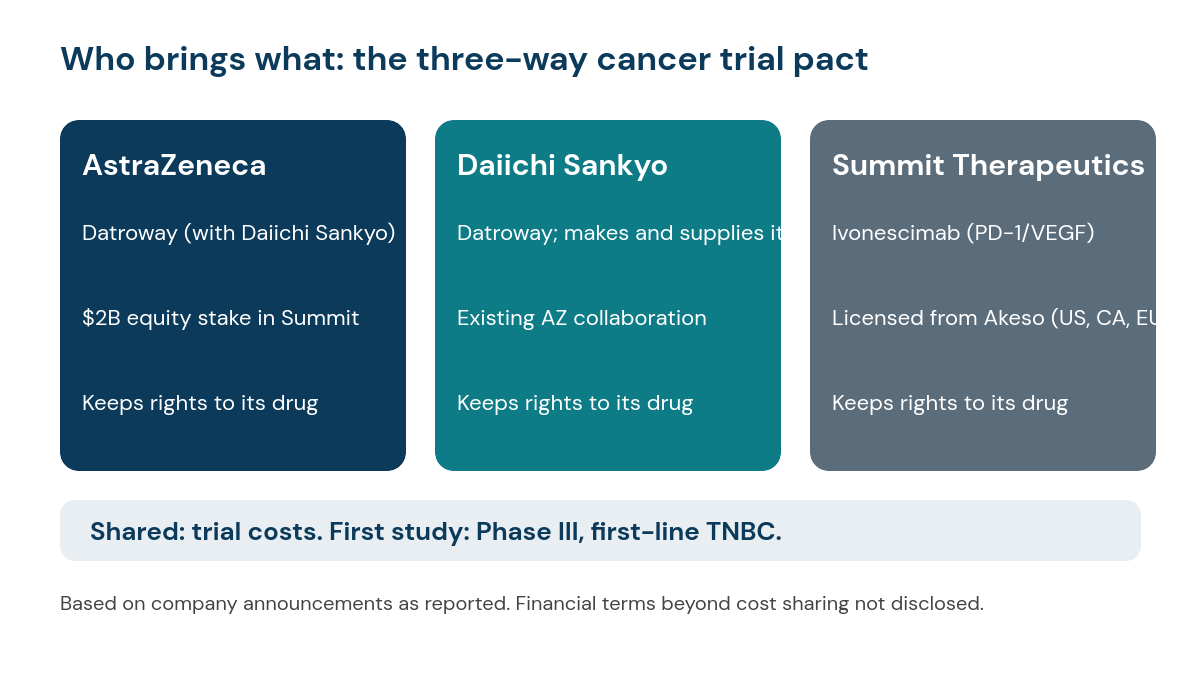
Rather than a licence or acquisition, this is a clinical collaboration. Each party brings an asset and keeps ownership of it. The costs of the combination trials are shared, which spreads the expense of large Phase III studies. Daiichi Sankyo manufactures and supplies Datroway under its existing collaboration with AstraZeneca.
| Party | Brings | Keeps |
|---|---|---|
| AstraZeneca | Datroway (with Daiichi Sankyo); $2B equity investment in Summit (28 Sept 2026) | Development and commercial rights to its own medicine |
| Daiichi Sankyo | Datroway; manufactures and supplies it under its existing AstraZeneca collaboration | Development and commercial rights to its own medicine |
| Summit Therapeutics | Ivonescimab, PD-1/VEGF bispecific antibody (licensed from Akeso for US, Canada, Europe, Japan) | Development and commercial rights to ivonescimab |
| All three | Shared trial costs; first study is Phase III in first-line TNBC | Each retains rights to its own drug |
This kind of arrangement lets large companies test combinations quickly without negotiating complex licences first. The trade-off is that the partners’ incentives are not fully aligned: each wants its own drug to benefit most, and the terms for sharing any joint results have not been made public.
Why Start With Triple-Negative Breast Cancer?
The choice of first-line TNBC builds on an existing result rather than a blank slate. In the TROPION-Breast02 trial, which the companies report enrolled 644 previously untreated patients not suited to immunotherapy, Datroway extended median overall survival by 5.0 months and cut the risk of progression or death by 43% compared with chemotherapy. Starting the combination where the ADC has already shown benefit lowers the scientific risk of the first study, although these figures are company-reported and the combination itself is untested.
Why AstraZeneca and Summit Are Moving Closer
AstraZeneca announced a $2 billion strategic equity investment in Summit on 28 September 2026, intended in part to support combination studies of ivonescimab with AstraZeneca medicines. A separate agreement pairing ivonescimab with AstraZeneca’s Claudin 18.2 antibody-drug conjugate sonesitatug vedotin in gastrointestinal cancers has also been reported, along with plans for further combinations. We have not verified those additional details against a primary source.
For Summit, the arrangement widens a development program that already includes several Phase III trials, including HARMONi, HARMONi-3, HARMONi-7 and HARMONi-GI3, according to its annual report. For AstraZeneca and Daiichi Sankyo, Datroway has a global program of more than 20 trials, including eight Phase III lung cancer trials and five in breast cancer. Adding a PD-1/VEGF partner opens another route for the drug in settings where immunotherapy is standard.
What the Deal Signals for Oncology Dealmaking
- Combinations across companies: big pharma is increasingly testing its drugs with partners’ assets rather than only its own.
- Equity plus collaboration: pairing a minority investment with trial cooperation ties partners together without a full acquisition.
- ADC and bispecific convergence: two fast-growing modalities, antibody-drug conjugates and bispecific antibodies, are being tested together. Our bispecific antibodies market outlook looks at one of them.
- Shared risk: dividing trial costs reduces exposure if a combination fails.
Risks and Open Questions
The main risk is scientific. A combination of a TROP2-directed ADC and a PD-1/VEGF antibody has not shown safety or benefit in a Phase III setting, and the added value over Datroway alone must be proven. Regulatory and commercial risks also remain: ivonescimab is not approved in Summit’s license territories, and the outcome of its separate regulatory review in EGFR-mutated lung cancer cannot predict how the breast cancer combination will perform.
- Financial terms of the trial collaboration beyond cost sharing were not disclosed.
- Which company will sponsor the TNBC study. Reports say either AstraZeneca or Daiichi Sankyo.
- How results and data will be shared and how any approvals would be coordinated.
- Timelines for lung cancer and other tumour settings.
What to Watch Next
- The registration of the TNBC study on ClinicalTrials.gov, which will show the design, comparator and endpoints.
- Progress of Datroway’s lung and breast trials, which will shape how much the combination is needed.
- Updates from Summit’s HARMONi program and its regulatory review.
- Any further agreements between AstraZeneca and Summit, including the reported gastrointestinal cancer pairing.
Our Assessment
In our assessment, the structure is a pragmatic way to start a costly Phase III program quickly while preserving each partner’s rights, and the $2 billion investment signals AstraZeneca’s commitment to ivonescimab. But the value of the pact depends entirely on trial results, and investors should read the announcement as an option on data, not a guaranteed pipeline. Company filings on SEC EDGAR filings are the best place to follow any disclosed financial terms.
Related Coverage
For more partnership news, read about the Rakovina and Celvion partnership and the Ensera alliance network.
Frequently Asked Questions
What is the AstraZeneca, Daiichi Sankyo and Summit collaboration?
A clinical trial collaboration to test Datroway with ivonescimab across multiple solid tumours, starting with a Phase III trial in first-line TNBC.
Who pays for the trials?
The three companies will share costs, according to the announcement, while each keeps rights to its own medicine.
How does it relate to AstraZeneca’s investment in Summit?
AstraZeneca announced a $2 billion equity investment in Summit on 28 September 2026, intended in part to support combination studies with its medicines.
Is the combination approved?
No. It is experimental, and ivonescimab is investigational in the United States and Europe.
What happens next?
The companies have not disclosed trial start dates or design details.
How we reported this: this article draws on company announcements and public information about the collaboration, the investment and the companies’ development programs. Some details are reported rather than confirmed and are labelled as such. Last updated 5 October 2026. This article is for information only and is not investment or medical advice.