
A new private equity name has entered pharmaceutical manufacturing: Samfara, a London-based firm focused on European life sciences, has bought Danish controlled-substance API maker Chr. Olesen Synthesis as its first deal. The completion was announced on 2 October 2026, with financial terms undisclosed. For a first buyout, the choice is telling. It shows how investors are targeting small, specialised manufacturers with regulatory barriers, and it offers a template for how Samfara private equity intends to build a platform.
Key Takeaways
- Samfara completed the acquisition on 2 October 2026 and describes it as its first investment. The price was not disclosed.
- The target makes APIs and advanced intermediates for controlled substances, including buprenorphine and lisdexamfetamine, near Copenhagen.
- The chief executive is investing alongside Samfara, and a former Unither chief executive is joining as board chair.
- Samfara says it will pursue organic growth and acquisitions, which suggests a buy-and-build plan.
- Key unknowns include valuation, customer concentration and the timing of any follow-on deals.
Who Is Buying and Who Is Selling?
Samfara is described as a private equity firm making majority investments in European life sciences companies in the lower mid-market. It is reported to be backed by institutional investors and family offices in Europe and North America. Partners Helena Malchione and James Cocker said the deal fits a strategy of finding winning companies in complex niches and supporting them with capital and strategic help.
On the sell side, one report says the previous owner was the Chr. Olesen group, a family-owned distribution business founded in 1885 that acquired the synthesis unit in 2011 and developed it with an investment partner, Signet Healthcare Partners. Other accounts do not give that history, so treat it as unconfirmed. Mads C. Olesen said the time was right for new owners to take the business forward.
Deal Structure and People
| Role | Party | Detail |
|---|---|---|
| Buyer | Samfara | London-based PE firm; first investment; lower mid-market European life sciences focus |
| Target | Chr. Olesen Synthesis | Hvidovre, Denmark; controlled-substance APIs; cGMP; in production since 2015 |
| Management | Thomas Moestrup (CEO) | Investing alongside Samfara |
| Board chair | Jean-Francois Hilaire | Former Unither Pharmaceuticals CEO |
| Seller | Chr. Olesen group (per one report) | Family-owned distribution business founded 1885; seller quoted: Mads C. Olesen |
| Price | Not disclosed | No financing details given |
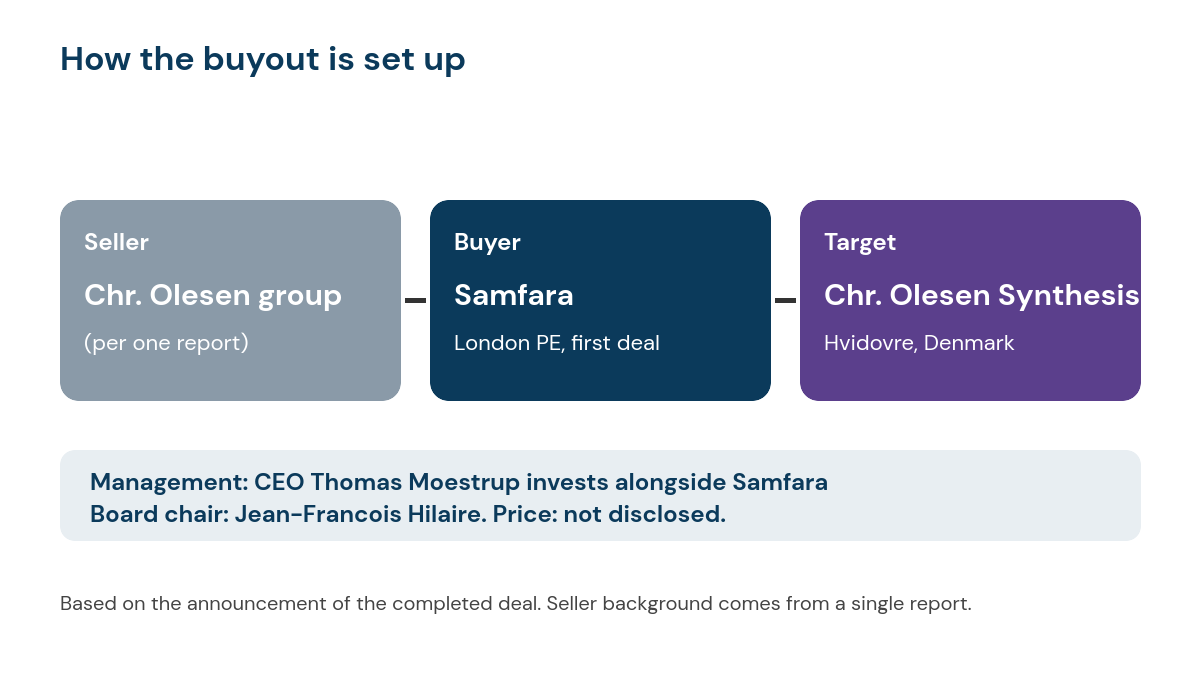
Management continuity is a recurring feature of lower mid-market buyouts: when the chief executive reinvests alongside the buyer, the investor gains a motivated operator and the seller gains reassurance that the business will keep running. The announcement lists a large group of advisers on both sides, including Addleshaw Goddard, Connaught, infotransactions, Lockton, Nivaro Law and RSM for Samfara, and LEK, Moalem Weitemeyer, Nielsen Norager, PwC, Sheppard Mullin and Stifel for the sellers.
Why Controlled-Substance APIs Appeal to Investors
The attraction is the combination of regulatory complexity and recurring demand. Specialist plants need licences, quality systems and inspection histories that take years to build, and customers value reliable supply. One commentator argues that meeting both US and European compliance requirements creates high switching costs and a defensible position. That is an opinion about the sector rather than a fact disclosed by the parties, and the licences held by this particular plant were not listed in the announcement.
Investors are also drawn to the contract development and manufacturing space more broadly. Our recent coverage of the Ensera alliance network and the AstraZeneca, Daiichi Sankyo and Summit pact shows how much of the industry depends on specialised partners, and our oligonucleotide synthesis market outlook looks at another synthesis-driven niche.
What Samfara Says It Will Do Next
The firm says it will keep developing Chr. Olesen’s capabilities, expand relationships with existing customers and enter new markets through organic growth and acquisitions. One outside observer suggested that the clearest signal of a build-up strategy would be a second contract development and manufacturing asset by the end of 2027. That is a commentator’s benchmark and not a commitment by Samfara.
Risks and Open Questions
- Concentration: the named products are two, and the plant is a single site, so disruption or customer loss would matter.
- Regulation: controlled-substance rules can change, and inspections by authorities such as the European Medicines Agency and national regulators can affect operations.
- Valuation: the price and leverage used were not disclosed.
- Integration: a first-time fund must show it can support growth, not only buy a business.
How Private Equity Is Reshaping Specialty Pharma
Industry bodies such as Invest Europe and the British Private Equity & Venture Capital Association publish data on private equity activity, and healthcare is a recurring target because of resilient demand. Small manufacturers with narrow expertise are attractive because they are often family-owned, under-capitalised and ready for succession. Whether that translates into better supply for pharmaceutical customers depends on how the new owners invest.
Our Assessment
In our assessment, the Samfara deal is as much a statement of strategy as an acquisition. A debut buyout in a controlled-substance niche signals a preference for defensible, specialised assets over scale. The real test will come in the next two years, when it becomes clear whether Samfara adds capacity or further platforms and how the business performs under private equity ownership.
Frequently Asked Questions
Who is Samfara?
A London-based private equity firm that focuses on majority investments in European lower mid-market life sciences companies. Chr. Olesen Synthesis is its first investment.
What does Chr. Olesen Synthesis make?
APIs and advanced intermediates for controlled substances, including buprenorphine and lisdexamfetamine.
How much did Samfara pay?
The financial terms were not disclosed.
Will the management stay?
Chief Executive Thomas Moestrup is investing alongside Samfara, and Jean-Francois Hilaire is joining as board chair.
Is more M&A planned?
Samfara says it will pursue growth organically and through acquisitions, but it has not announced further deals.
How we reported this: details come from the announcement of the completed deal on 2 October 2026 and related reports. Some background on the seller comes from a single report and is labelled as such. Observations about the sector are commentary rather than company statements. Last updated 5 October 2026. This article is for information only and is not investment advice.