The US Ebola travel declaration, due to start on 3 November 2026, is the latest layer in a series of US entry measures introduced during the 2026 Ebola outbreak. A CDC order dated 22 October requires passengers on flights to the United States to attest that they have not been in the Democratic Republic of Congo (DRC) in the previous 21 days, and it follows earlier bars on travellers from the DRC, Uganda and South Sudan.
Key takeaways: the US Ebola travel declaration in a timeline of rules
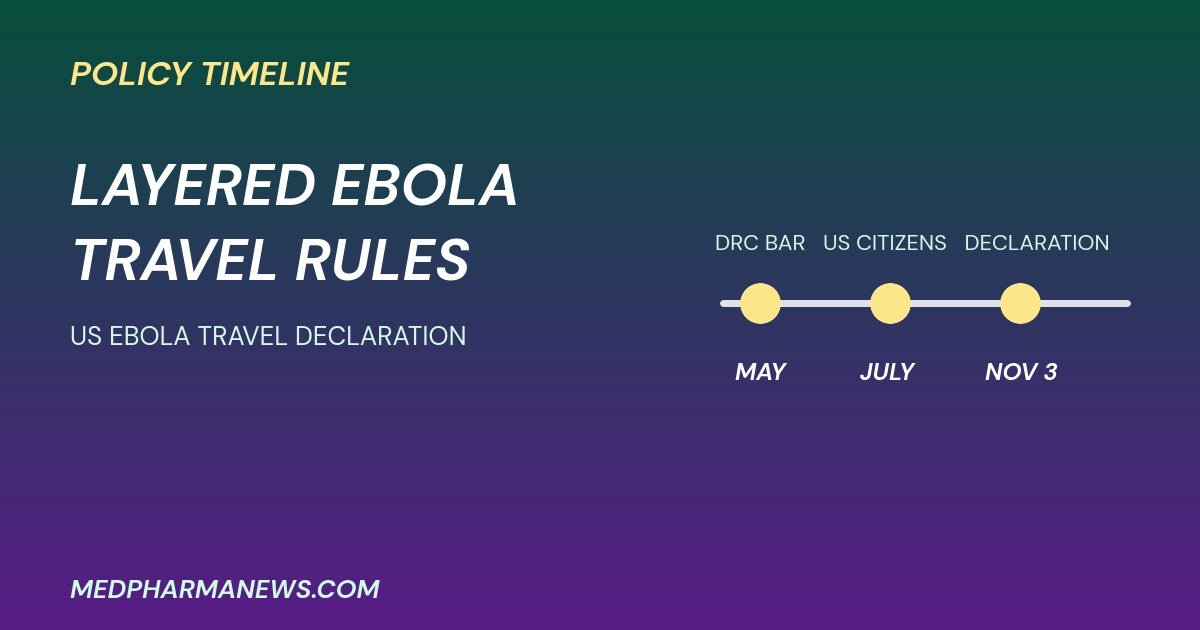
- May 2026: the CDC barred airline passengers who had been in the DRC in the prior three weeks, according to a wire report.
- July 2026: the bar was extended to US citizens, according to the same report.
- Earlier in 2026: foreign nationals who had been in Uganda or South Sudan in the prior three weeks were barred.
- 22 October 2026: the CDC issued the attestation order.
- 3 November 2026, 11:59 p.m. EST: the US Ebola travel declaration takes effect for flights departing a foreign country on or after that time.
Timeline of the US Ebola travel declaration and earlier rules
The sequence matters because each step adds a tool to an existing control. The May bar stopped passengers who had recently been in the DRC from boarding. The July extension removed the exception for US citizens. The October declaration does not block anyone by itself; it requires every US-bound air passenger to state that they have not been in the DRC in the preceding 21 days, with paper or electronic attestations accepted.
The CDC order is published on the CDC website. We could not open it in full, so the details here come from a summary of a carrier bulletin and a wire-service report that cites a CDC memo.
What the US Ebola travel declaration requires
- Scope: passengers on flights departing any foreign country for the US.
- Statement: no presence in the DRC during the previous 21 days.
- Format: paper or electronic.
- Start: 11:59 p.m. EST on 3 November 2026.
The sources do not say whether any passengers are exempt, or how airlines should verify answers.
The outbreak behind the US Ebola travel declaration
The outbreak involves the Bundibugyo strain of Ebola, which spread undetected for months before being declared in May, according to the wire report. It says the strain kills about half of those infected and has no approved treatment or vaccine. Africa CDC says the outbreak has killed about 4,700 people in Africa. Updates come from Africa CDC and the World Health Organization. The CDC says no Ebola cases associated with this outbreak have been reported in the United States.
Why the policy matters beyond travel
Travel rules affect supply chains and workforces as well as passengers. Health agencies, aid organisations and pharmaceutical firms that move staff or samples between the DRC and other countries will have to consider both the existing bars and the new declaration. The sources do not discuss exceptions for responders or researchers, so we cannot say how they will be handled.
Industry readers may also want to follow how the measure interacts with clinical-trial travel and outbreak-response logistics. That is our own point of attention and not a statement from the CDC. See our industry insights coverage.
Questions for travel and compliance teams on the US Ebola travel declaration
Organisations with staff who travel to the US will want a short internal procedure. These points are our own suggestions based on the reported facts, not CDC guidance:
- Record where staff have been in the 21 days before each US-bound flight, so the statement can be signed accurately.
- Check airline notices from 3 November for the form format and any online process.
- Treat the earlier entry bars as separate from the declaration; signing does not override them.
- Ask the airline how connecting itineraries are handled.
Twenty-one days is the upper end of the usual Ebola incubation period, but the sources do not explain the CDC’s reasoning, so that link is our inference.
General background: how entry rules are used in outbreaks
Governments combine several tools in outbreaks: entry bars, health screening, monitoring after arrival, and statements by travellers. Each has trade-offs for speed, cost and fairness. Declarations are cheap to introduce but depend on honesty and enforcement. Bars are stricter but affect more people. The mix chosen in the US so far leans on bars with the declaration as a supporting measure.
Our analysis: reading the US Ebola travel declaration in context
In our assessment, the US Ebola travel declaration is best read as a tidy-up of an existing policy and not a new escalation. The core restriction, no entry for people recently in the DRC, has been in place since May. The new step extends the paperwork to every US-bound passenger so that carriers and officials can document compliance.
The policy does not imply that Ebola has been found in the US. The CDC says it has not. We make no prediction about how long the requirement will last.
What is not disclosed about the US Ebola travel declaration
- Exemptions for responders, diplomats or researchers.
- Airline duties and liability.
- Penalties for false statements.
- The text of the form.
- When the requirement will be reviewed.
Risks and caveats
This article is based on secondary summaries of a CDC order that we could not read in full. Case counts and policy details can change quickly. This is news reporting and not travel or medical advice.
What to watch next
- Airline guidance after the CDC briefings.
- Any revision to the CDC order.
- Outbreak data from Africa CDC and the WHO.
- Whether other countries adopt similar declarations.
FAQ
What is the US Ebola travel declaration?
A statement, on paper or electronically, that a US-bound air passenger has not been in the DRC in the previous 21 days.
How does it differ from the earlier bars?
The bars stop certain travellers from boarding. The declaration is a statement every passenger makes, and it supports those bars.
Are there Ebola cases in the US from this outbreak?
The CDC says none have been reported.
How we reported this: we relied on the CDC order page, a carrier-bulletin summary and a wire-service report, and attributed every claim. Last updated 23 October 2026. This is news reporting and not advice.