For drug companies, the FDA prescription drug software guidance is a practical checklist: if you provide an app with a prescription medicine, the FDA now says in final guidance how it will treat the output, when the app belongs in the Prescribing Information, and what you need to submit. Reported on 20 October 2026 and published in the Federal Register on 21 October, the guidance finalises a September 2023 draft.
Key takeaways for sponsors from the FDA prescription drug software guidance
- End-user output from sponsor-provided software related to a drug product is treated as prescription drug labeling.
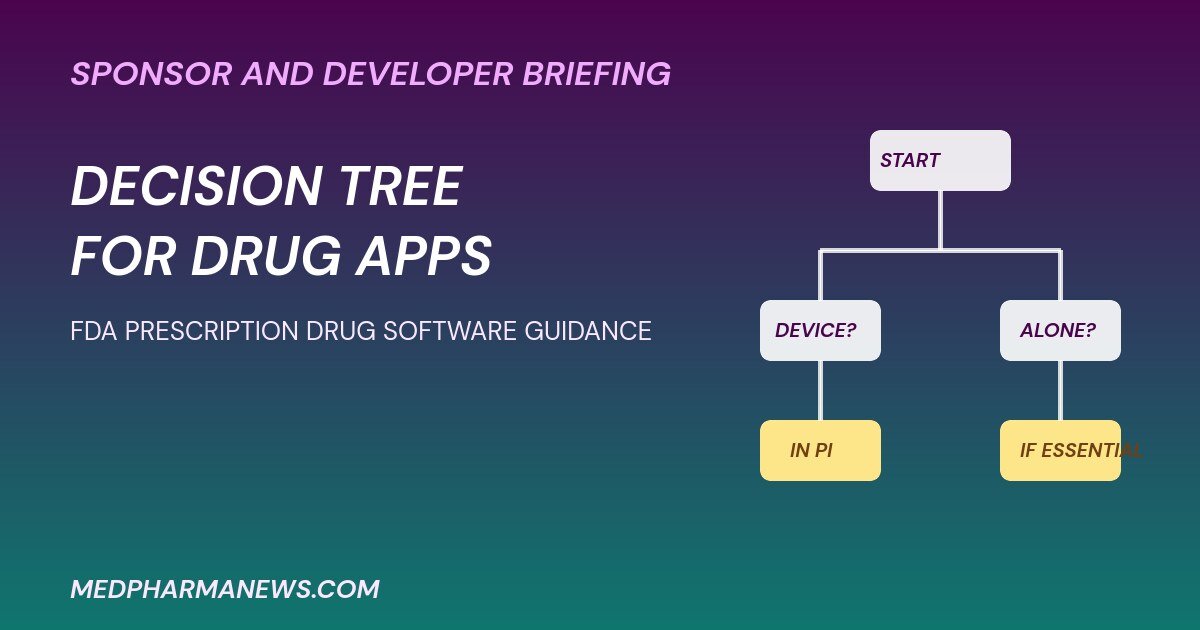
- Device-connected software should be included in the Prescribing Information; standalone software only if essential for safe and effective use or clinically meaningful.
- Companion app content is generally promotional material, according to a trade report.
- Sponsors need not resubmit output for software updates that leave submitted content unchanged.
- The guidance is non-binding; the docket is FDA-2023-D-2482.
Timeline of the FDA prescription drug software guidance
- 19 September 2023: the FDA publishes the draft guidance (88 FR 64443).
- 20 October 2026: the final guidance is reported as issued.
- 21 October 2026: the Federal Register notice of availability appears (91 FR 66561 to 66563, document 2026-21516).
A sponsor’s walk-through of the FDA prescription drug software guidance
The following is our own plain-language outline, based on the Federal Register notice and a trade report, and is not a substitute for the guidance or for regulatory counsel:
- Step 1: Decide whether the software is disseminated by or on behalf of the sponsor and produces output related to your drug product. If so, it is within scope.
- Step 2: Ask whether the software is connected to a device that is part of how the drug is used. If it is, the guidance says it should be described in the Prescribing Information.
- Step 3: If the software is standalone, decide whether you can show it is essential for safe and effective use or gives meaningful clinical benefit. If so, mention it in the PI.
- Step 4: Plan the submission of end-user output to the FDA, and treat app content as promotional material unless it falls within required labeling.
- Step 5: For updates, resubmit only when content changes.
Labeling language and the FDA prescription drug software guidance
The guidance provides example PI language for both device-connected and standalone software, and a recommended statement for device-connected functions that do not show meaningful improvement in a clinical outcome. That statement is a notable detail: it means an app can be described in the label while the label is candid about the lack of proven benefit. We have not read the appendix text, so we do not quote it. The FDA lists its guidance documents on its guidance search page.
Comparing the final FDA prescription drug software guidance with the draft
The draft, published on 19 September 2023, used the phrase digital health technologies. The final version uses software used with prescription drugs, adds a decision tree and appendices, clarifies standalone software and includes example PI language. The agency says the approach aligns its drug and device centres and gives developers a consistent pathway, according to the trade report, which quotes CDER Director Michael Davis describing risk-proportionate oversight of digital health.
Questions sponsors are likely to ask about the guidance
Several practical questions follow from the text. Does an app that only sends reminders belong in the label? Only if the sponsor can show it is essential for safe and effective use or gives meaningful clinical benefit. Who reviews the app content? The FDA says sponsors submit end-user output for review, and the trade report says review focuses on safe and effective use. What if the app does not improve outcomes? The guidance recommends a specific PI statement for device-connected functions in that case. The sources do not answer how long review takes, so we do not guess.
Digital therapeutics market data and the FDA prescription drug software guidance
Acumen Research and Consulting’s report Digital Therapeutics Market Size, Share, Analysis, Trends and Forecast 2023 to 2032 says software and services was the leading product type, with over USD 4.2 billion in revenue in 2022, within a global digital therapeutics market of USD 5.2 billion that year. It projects USD 66.1 billion by 2032 at a CAGR of 29.3% from 2023 to 2032, with North America at around USD 2.2 billion in 2022 and Asia Pacific growing fastest at more than 30% a year.
Digital therapeutics are not the same as sponsor-provided companion apps, and the Acumen report does not break out the latter. The figures give context for the commercial importance of software around treatment. Our pharmaceuticals coverage follows related regulation.
General background: promotion versus required labeling
Required labeling is the information the FDA mandates, such as the Prescribing Information. Promotional labeling and advertising are materials a company uses to market a drug, and they are subject to rules on accuracy and balance. The guidance helps sponsors classify app content on that spectrum. Misclassification can create compliance risk, which is why the agency created a decision tree.
Our analysis: evidence and process are the new work
In our assessment, the FDA prescription drug software guidance shifts the burden to evidence and process. Sponsors that want a standalone app described in the label will need data. Those that treat app content as promotional will need review processes similar to those for other advertising. The guidance gives clarity but does not remove effort.
We do not know how many sponsors will change their plans, and the sources give no industry reaction. We make no prediction on enforcement or timelines, and nothing here is regulatory advice.
What is not disclosed about the FDA prescription drug software guidance
- The full decision tree and PI examples.
- Submission portals and timelines for end-user output.
- Industry responses to the final text.
- A count of affected apps.
Risks and caveats of the FDA prescription drug software guidance
This article is based on the Federal Register notice and a trade report. One report expands the abbreviation PDURS in a way that differs from the FDA title, and we follow the title. The guidance is non-binding. Acumen’s figures are third-party estimates. This is news reporting and not legal or regulatory advice.
What to watch next
- Comments on docket FDA-2023-D-2482.
- Any FDA update on output changes.
- Sponsor announcements of apps with label mentions.
- Cross-centre work with the device side.
FAQ
What must sponsors do under the FDA prescription drug software guidance?
Classify the software, describe it in the PI where the guidance says so, and submit end-user output for review as the guidance explains.
Do updates need new submissions?
Not if previously submitted content is unchanged, according to a trade report.
Is the guidance enforceable law?
No. It is non-binding guidance reflecting current FDA thinking.
How we reported this: we relied on the Federal Register notice, a trade report and the Acumen Research and Consulting report cited above, and attributed every claim. Last updated 24 October 2026. This is news reporting and not advice.