Personalized Medicine Biomarkers Market Size
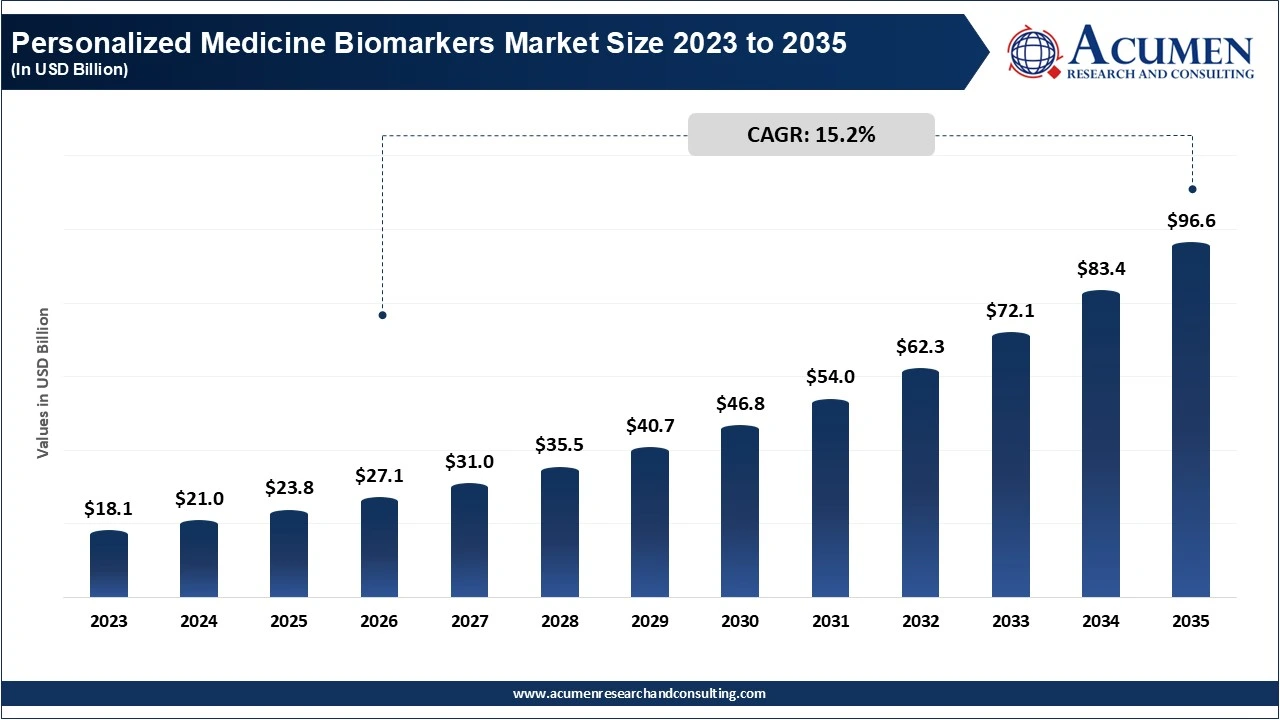
The global personalized medicine biomarkers market size was worth USD 23.80 billion in 2025 and is anticipated to expand to around USD 96.61 billion by 2035, registering a compound annual growth rate (CAGR) of 15.2% from 2026 to 2035.
What Is the Personalized Medicine Biomarkers Market?
The personalized medicine biomarkers market refers to the global industry centered on biological indicators—such as genes, proteins, or metabolites—that reveal key information about an individual’s health, disease susceptibility, and response to treatment. These biomarkers are foundational to precision or personalized medicine, allowing healthcare providers to tailor diagnoses, therapies, and monitoring strategies to a person’s unique biological profile rather than using a one‑size‑fits‑all approach.
Biomarkers are critical in early disease detection, risk stratification, patient selection for targeted therapies, and monitoring treatment effectiveness, particularly in areas such as oncology (cancer), cardiology, neurology, diabetes, and autoimmune disorders. As scientific understanding deepens—especially in genomics, proteomics, and systems biology—biomarkers increasingly drive clinical decisions and drug development.
Get a Free Sample: https://www.acumenresearchandconsulting.com/request-sample/3853
Market Trends
1. Rapid Growth Through Genomic and Proteomic Technologies
The market is expanding fast, driven by breakthroughs in next‑generation sequencing (NGS), high‑throughput proteomic platforms, and advanced bioinformatics tools. These technologies significantly enhance the speed and accuracy of biomarker discovery and validation, enabling more refined patient stratification and better therapeutic outcomes.
2. Strong Presence in Oncology and Chronic Diseases
Oncology remains the dominant disease area, with roughly one‑third of market share linked to cancer biomarkers, as precision oncology relies extensively on biomarkers for detecting mutations and guiding targeted therapies.
3. Collaboration and Partnerships across Sectors
Cross‑industry partnerships between biotechnology firms, pharmaceutical companies, diagnostic vendors, and research organizations are increasingly common. These collaborations aim to accelerate the development and commercialization of biomarker assays and companion diagnostics.
4. Multi‑Use Applications and Diversification
Biomarkers are no longer limited to diagnosis; they play roles in early screening, treatment selection, monitoring therapy response, and even health economics decisions in personalized care. Adoption of AI and machine learning tools has opened new possibilities for biomarker pattern recognition and predictive analytics.
Market Dynamics
Drivers
Rising demand for targeted therapies and individualized treatment plans as clinicians and patients seek better outcomes with fewer side effects.
Technological innovation in genomics, proteomics, and data analytics that enables discovery of novel biomarkers with clinical relevance.
Expansion of chronic and genetic disease burden worldwide increases the need for predictive and personalized healthcare solutions.
Increased research funding and precision medicine initiatives by governments and institutions.
Restraints
High R&D cost and complex validation processes, making biomarker discovery financially and technically demanding.
Lack of global standardization and differing regulatory environments can delay clinical adoption and approval processes.
Shortage of specialized expertise and infrastructure limits rapid deployment in some regions.
Opportunities
Broadening applications beyond oncology, especially into cardiovascular, neurological, and metabolic diseases.
Adoption of AI/ML for data analysis to accelerate discovery and interpretation of complex biomarker profiles.
Market penetration in emerging economies as precision medicine tools become more accessible and cost‑effective.
Regional Analysis
North America
North America dominates the market, contributing a significant share of global revenue due to advanced healthcare infrastructure, significant R&D investment, supportive regulatory policies, and precision medicine initiatives.
Asia Pacific
The Asia Pacific is the fastest‑growing region, fueled by increasing healthcare expenditure, rising prevalence of chronic diseases, and government support for genomic research and diagnostic infrastructure. Countries such as China, India, Japan, and South Korea are key contributors to this growth.
Europe
Europe holds a strong position, supported by collaborative research projects, a robust biopharmaceutical industry, and public funding for health innovation. Germany, the UK, and France are leading markets in this region.
Middle East & Africa / Latin America
These regions show steady growth, propelled by modernization of healthcare systems and adoption of advanced diagnostics, although at a smaller scale compared with North America and Asia Pacific.
Recent Developments
Partnerships and Strategic Collaborations
Leading biotechnology and pharmaceutical companies continue to form partnerships to expand companion diagnostic tests and precision medicine solutions.
Collaborations in precision biomarker platforms leveraging AI for complex disease stratification have increased, indicating growing industrial emphasis on data‑driven personalized approaches.
Innovation in Biomarker Analytics
Companies increasingly integrate AI, machine learning, and multiomic data analysis to identify drug‑response biomarkers and support clinical decision making.
Expansion of Companion Diagnostics and Liquid Biopsy Tools
Ongoing improvements and increased market availability of liquid biopsy and genomic profiling tests demonstrate the translation of biomarker science into clinical practice.
Conclusion
The personalized medicine biomarkers market is rapidly evolving, driven by technological innovation, rising demand for tailored healthcare, and expanding applications across a spectrum of diseases. With robust growth forecasts through 2035, continued advancements in genomics, AI‑based analytics, and strategic collaborations will further entrench biomarkers as central tools in modern healthcare. As global healthcare systems seek more efficient and effective ways to treat complex and chronic illnesses, biomarkers will remain at the forefront of personalized medical innovation.
To Get Detailed Overview, Contact Us: https://www.acumenresearchandconsulting.com/contact-us