Table of Contents
ToggleAnimal Model Market Size
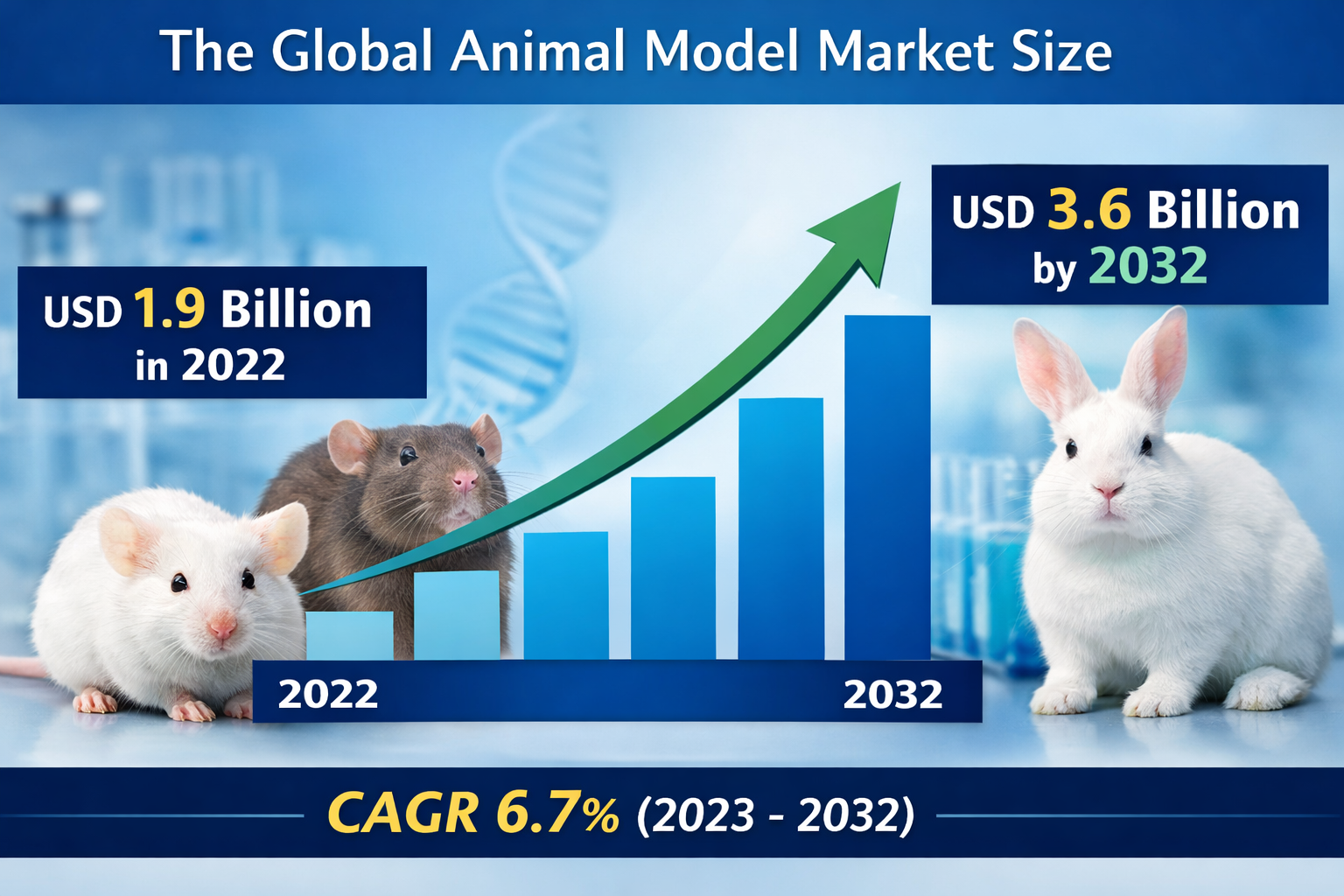
The global Animal Model Market was valued at approximately USD 1.9 billion in 2022 and is projected to reach around USD 3.6 billion by 2032, growing at a CAGR of about 6.7% during the forecast period. The market’s growth underscores its importance in advancing therapeutic innovation and biomedical research.
What is the Animal Model Market?
The Animal Model Market refers to the global industry focused on the development, breeding, supply, and utilization of non-human animals to replicate human biological processes and disease conditions for research purposes. These models are widely used in preclinical testing to evaluate the safety, efficacy, and biological behavior of new drugs and therapies before they enter human clinical trials.
Animal models commonly include mice, rats, rabbits, guinea pigs, and other species that are genetically or biologically suitable for studying human diseases. The market encompasses model generation (including genetically modified animals), breeding services, cryopreservation, surgical models, and related support services used by pharmaceutical companies, biotechnology firms, contract research organizations (CROs), and academic institutions.
Market Trends
The Animal Model Market is evolving in response to scientific advancements and shifting research priorities. Several key trends are shaping its trajectory:
1. Advancements in Genetic Engineering Technologies
The adoption of advanced gene-editing tools such as CRISPR has significantly enhanced the development of precise and disease-specific animal models. These technologies allow researchers to create genetically engineered models that closely mimic human disease conditions, improving the accuracy and predictive value of preclinical studies.
2. Growing Focus on Personalized Medicine
As personalized and precision medicine gains traction, there is increasing demand for customized animal models that reflect specific genetic mutations and patient populations. This trend is particularly prominent in oncology and rare disease research, where tailored therapeutic approaches are becoming more common.
3. Expansion of Preclinical Research Activities
Rising global investments in pharmaceutical and biotechnology R&D are driving increased reliance on animal models for safety and efficacy testing. Regulatory authorities continue to require comprehensive preclinical data, which sustains demand for validated and high-quality animal models.
4. Increased Ethical Considerations and Alternative Methods
Although animal models remain essential, ethical concerns and regulatory scrutiny around animal welfare are intensifying. This has led to growing interest in alternative research methods such as in vitro systems and computational models. However, these alternatives currently complement rather than replace traditional animal models.
Get a Free Sample: https://www.acumenresearchandconsulting.com/request-sample/3408
Market Dynamics
The Animal Model Market is influenced by a combination of drivers, restraints, opportunities, and challenges.
Drivers
Increasing prevalence of chronic and complex diseases such as cancer, cardiovascular disorders, and neurological conditions, which require advanced research models.
Growing pharmaceutical and biotechnology pipelines, necessitating extensive preclinical validation.
Technological progress in gene editing and transgenic model development, enhancing model reliability and relevance.
Restraints
Ethical concerns and stringent animal welfare regulations that may limit certain experimental procedures.
High costs associated with animal breeding, housing, genetic modification, and maintenance.
Regulatory complexities that vary across regions and can slow research processes.
Opportunities
Development of humanized and disease-specific animal models that more accurately replicate human biology.
Expanding collaborations between academic institutions, CROs, and commercial providers to enhance innovation.
Growth in emerging markets with expanding biomedical research infrastructure.
Challenges
Balancing ethical considerations with scientific necessity.
Managing regulatory compliance across multiple jurisdictions.
Ensuring reproducibility and translational relevance of animal-based findings.
Regional Analysis
The Animal Model Market exhibits distinct regional patterns influenced by research infrastructure, regulatory frameworks, and healthcare investments.
North America
North America holds the largest share of the global market. The region’s dominance is driven by robust pharmaceutical and biotechnology industries, strong research funding, and advanced technological capabilities. The United States plays a central role due to its well-established preclinical research ecosystem and significant R&D expenditure.
Europe
Europe represents a significant market, supported by strong academic research networks and regulatory oversight focused on ethical animal usage. The region emphasizes refinement, reduction, and replacement (3Rs) principles while maintaining steady growth in biomedical research activities.
Asia-Pacific
The Asia-Pacific region is expected to witness substantial growth during the forecast period. Expanding pharmaceutical manufacturing, increasing R&D investments, and the development of research infrastructure in countries such as China, Japan, India, and South Korea are contributing to market expansion. Cost advantages and supportive government initiatives further enhance growth prospects.
Latin America, Middle East & Africa
These regions currently account for a smaller market share but are gradually emerging due to improving healthcare systems and rising research collaborations. As infrastructure and funding increase, these regions are expected to present new growth opportunities.
Recent Developments
The Animal Model Market continues to evolve through innovation and strategic initiatives by key industry participants.
Ongoing investments in genetically engineered and transgenic animal models to support advanced research applications.
Expansion of model portfolios and breeding capabilities by major market players to meet rising demand.
Increasing focus on improving animal welfare standards and compliance with evolving regulatory guidelines.
Continued efforts to enhance model accuracy and translational reliability through advanced genetic and molecular tools.
Overall, the Animal Model Market remains a foundational component of biomedical research. With steady growth projected through 2032, driven by technological advancements and expanding pharmaceutical pipelines, the market is expected to maintain its strategic importance in global healthcare innovation.
To Get Detailed Overview, Contact Us: https://www.acumenresearchandconsulting.com/contact-us