Cell Culture Market Size
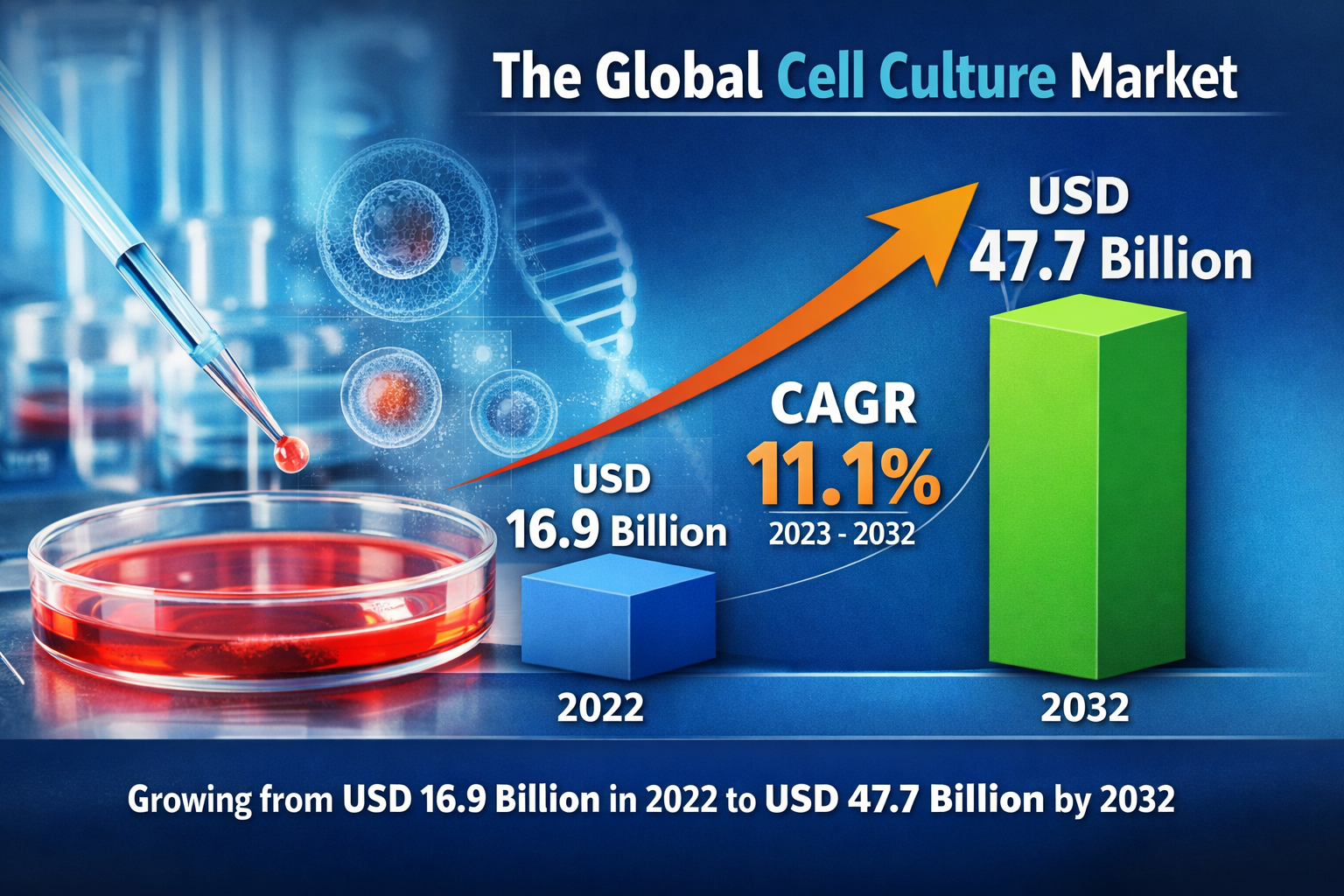
In 2022, the global Cell Culture Market was valued at USD 16.9 billion and is projected to reach approximately USD 47.7 billion by 2032, expanding at a CAGR of 11.1% during the forecast period.
What is the Cell Culture Market?
The Cell Culture Market refers to the global industry focused on technologies, products, and services used to grow and maintain cells in controlled laboratory environments outside their natural biological setting. These systems allow researchers and manufacturers to study cellular behavior, produce biologics, test drug safety and efficacy, and develop advanced therapies.
Scope of the Market
The market encompasses:
Products: Consumables (media, sera, reagents), instruments, and accessories
Applications: Biopharmaceutical production, vaccine manufacturing, drug discovery, toxicity testing, cell and gene therapy, diagnostics, and tissue engineering
End Users: Pharmaceutical and biotechnology companies, academic and research institutes, and clinical laboratories
Significance
Cell culture technology is central to modern biomedical research and therapeutic innovation. It enables the development of biologics, monoclonal antibodies, stem cell therapies, and personalized medicine solutions. Its importance significantly increased during the global pandemic, highlighting its critical role in vaccine and biologics development.
Market Trends
The Cell Culture Market is witnessing rapid evolution driven by innovation and changing research priorities.
1. Growing Adoption of 3D Cell Culture Systems
Researchers are transitioning from traditional 2D cell culture models to advanced 3D cell culture systems and organoids. These systems better replicate in vivo biological environments, improving drug screening accuracy and disease modeling outcomes.
2. Automation and Integration of AI
Automation technologies and AI-powered monitoring systems are increasingly integrated into cell culture workflows. These solutions enhance reproducibility, minimize human error, improve scalability, and reduce operational costs.
3. Expansion of Cell & Gene Therapy Applications
The rise in personalized medicine and regenerative therapies has accelerated demand for specialized cell culture systems capable of supporting complex cell-based treatments.
4. Dominance of Consumables Segment
Consumables such as media, sera, and reagents account for the largest share of the market. Their recurring usage in laboratories and manufacturing processes ensures steady revenue generation.
5. Shift Toward Serum-Free and Animal-Free Media
Ethical concerns, regulatory pressures, and the need for consistent product quality are driving innovation in serum-free and chemically defined culture media.
Market Dynamics
Key Drivers
Rising Demand for Biopharmaceuticals
Increasing production of biologics, vaccines, and monoclonal antibodies is significantly driving the adoption of advanced cell culture technologies.
Technological Advancements
Improvements in bioreactors, culture media formulations, and cell line development technologies are enhancing scalability and efficiency.
Growing R&D Investments
Governments and private organizations are heavily investing in biotechnology and life sciences research, boosting demand for cell culture products and services.
Restraints
High Operational Costs
Advanced cell culture systems and specialized media can be expensive, limiting adoption among smaller research institutions.
Complex Regulatory Environment
Strict regulatory standards for biologics and cell-based therapies can delay product approvals and increase compliance costs.
Opportunities
Rapid expansion of regenerative medicine
Development of advanced organoid and 3D culture models
Growth in emerging markets
Increasing demand for personalized medicine
Challenges
Maintaining contamination-free environments
Ensuring reproducibility across laboratories
Shortage of skilled professionals trained in advanced cell culture techniques
Regional Analysis
North America
North America accounted for the largest market share in 2022, representing approximately 36% of global revenue. The region benefits from strong biotechnology infrastructure, high R&D spending, established pharmaceutical companies, and favorable regulatory support.
Asia-Pacific
Asia-Pacific is expected to witness the fastest growth during the forecast period. Rapid expansion of biotech industries in China, India, Japan, and South Korea, along with increasing healthcare expenditure and clinical research activities, is driving regional growth.
Europe
Europe maintains a significant market share due to strong academic research networks, government funding, and a robust pharmaceutical manufacturing base.
Latin America and Middle East & Africa
These regions are experiencing gradual growth supported by improving healthcare infrastructure, rising investments in research facilities, and increasing awareness of advanced therapeutic technologies.
Recent Developments
Continuous innovation in automated cell culture platforms
Expansion of production facilities by major biopharmaceutical companies
Increased strategic collaborations between biotech firms and research institutions
Growing focus on 3D cell culture and organoid technologies
Regulatory advancements supporting cell and gene therapy commercialization
Conclusion
The Cell Culture Market is poised for substantial growth, expanding from USD 16.9 billion in 2022 to nearly USD 47.7 billion by 2032 at a CAGR of 11.1%. Driven by biopharmaceutical demand, technological advancements, and rising investments in life sciences research, the industry is set to remain a cornerstone of biomedical innovation.
As therapeutic approaches become increasingly personalized and biologics continue to dominate pharmaceutical pipelines, cell culture technologies will remain essential to future scientific and medical breakthroughs.
To Get Detailed Overview, Contact Us: https://www.acumenresearchandconsulting.com/contact-us