Understanding the Global Human Growth Hormone (HGH) Market
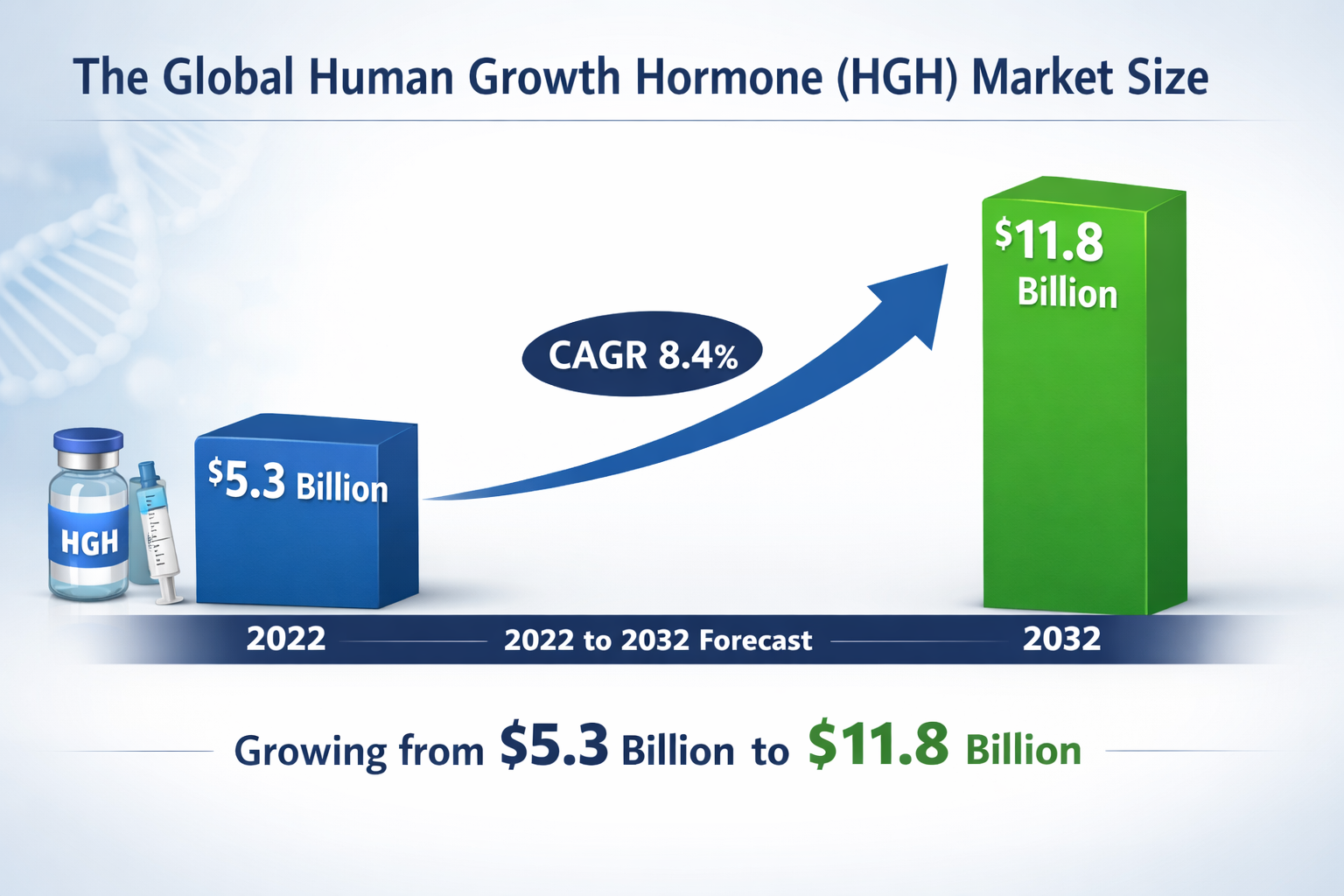
The global Human Growth Hormone (HGH) Market was valued at approximately USD 5.3 billion in 2022 and is projected to reach USD 11.8 billion by 2032, expanding at a compound annual growth rate (CAGR) of about 8.4 % during 2023–2032.
The Human Growth Hormone (HGH) Market is a rapidly expanding global pharmaceutical sector centered on the development, production, and distribution of human growth hormone therapies. HGH — scientifically known as somatotropin — is a naturally occurring peptide hormone synthesized by the pituitary gland that plays a vital role in regulating growth, cell regeneration, metabolism, and maintenance of body composition. It is clinically significant in treating conditions like growth hormone deficiency (GHD), Turner syndrome, Prader‑Willi syndrome, and other growth‑related disorders in both children and adults. Beyond these traditional medical uses, HGH has also attracted attention for its potential applications in anti-aging and performance enhancement, though these uses remain controversial and regulated.
Market Trends Driving Growth
The HGH market is evolving amid a dynamic set of trends that are reshaping how therapies are developed, delivered, and adopted:
Advancements in Personalized Medicine
Cutting-edge diagnostics and genetic profiling are enabling more targeted HGH therapy, tailoring dosages and regimens to individual patient needs. This precision approach helps improve treatment outcomes and can reduce side effects.
Innovation in Drug Delivery Technologies
Traditional HGH administration requires frequent injections, which can be a barrier for many patients. To improve compliance, pharmaceutical firms are developing longer-acting formulations, intuitive delivery systems such as pens, and potential non-injectable options.
Expansion Beyond Traditional Therapeutic Use
While medical treatment of growth disorders remains core, there is growing interest in therapeutic applications that may enhance metabolism, muscle maintenance, and aspects of adult health, notably within anti-aging medicine.
Greater Awareness of Hormonal Disorders
Awareness campaigns and improved diagnostic tools have increased identification of HGH deficiencies, especially among pediatric patients, driving stronger demand globally.
Emerging Market Interest
Regions such as Asia-Pacific show rapid growth potential due to rising healthcare investments, increasing patient populations, and expanding access to advanced therapies.
Get a Free Sample: https://www.acumenresearchandconsulting.com/request-sample/3404
Market Dynamics: Drivers, Restraints, and Opportunities
Key Drivers
Increasing incidence of growth hormone disorders: A rise in diagnosis of GHD and related conditions is a primary driver of HGH therapy demand.
Biotechnology advancements: Recombinant DNA technology enables efficient production of synthetic HGH, broadening therapeutic use.
Growing geriatric population: Older adults increasingly seek treatments that support muscle health and metabolic balance.
Restraints and Challenges
High treatment costs: HGH therapies remain expensive, especially in countries with limited insurance coverage, restricting access.
Strict regulatory environment: Due to potential misuse (e.g., athletic performance enhancement), regulatory bodies impose rigorous controls on HGH approvals and prescribing.
Safety concerns: Long-term therapy can involve side effects like joint pain or metabolic changes, which may deter some prescribers and patients.
Emerging Opportunities
Personalized and digital health approaches: Integration of telemedicine, mobile health platforms, and patient tracking technologies offers new avenues for therapy management.
Improved formulations: Long-acting and user-friendly formulations could broaden patient adoption and compliance.
Regional Analysis: Who’s Leading the Market?
North America
North America holds a leading share of the global HGH market — over 40% — supported by advanced healthcare infrastructure, high rates of diagnosis, and large patient populations with endocrine disorders. The U.S. drives much of this growth, backed by strong reimbursement systems and robust pharmaceutical innovation.
Asia-Pacific
The Asia-Pacific region is projected to exhibit one of the fastest CAGRs due to increasing healthcare spending, expanding insurance coverage, and heightened awareness of growth hormone therapy benefits. This region’s large population base also presents significant demand opportunities.
Europe, Latin America & MEA
Europe follows North America in market size, driven by strong healthcare systems and emerging biotech advances. Latin America and the Middle East & Africa show early-stage growth potential, marked by rising healthcare investments and expanding access to specialty treatments.
Recent Developments Impacting the Market
Strategic Partnerships and Mergers
Major pharmaceutical players are engaging in collaborations and acquisitions to enhance portfolios and accelerate research, especially in biotechnology applications such as long-acting formulations and delivery systems.
Product Launches
Companies are increasingly launching innovative HGH products with improved dosing and delivery options, aimed at improving patient compliance and therapeutic outcomes.
Regulatory Progress
Approvals of biosimilar HGH products in regions like Europe have expanded patient access and encouraged competition through lower pricing.
Conclusion
The Human Growth Hormone Market stands at a pivotal point of growth, driven by advances in biotechnology, rising disease prevalence, and increasing patient awareness. While affordability and regulatory constraints pose challenges, innovations in personalized medicine and drug delivery technologies promise to expand market access and improve patient outcomes. With North America currently leading and the Asia-Pacific region emerging rapidly, the global HGH market is poised for sustained expansion over the coming decade.
To Get Detailed Overview, Contact Us: https://www.acumenresearchandconsulting.com/contact-us