Artificial Intelligence (AI) In Oncology Market Size & Growth
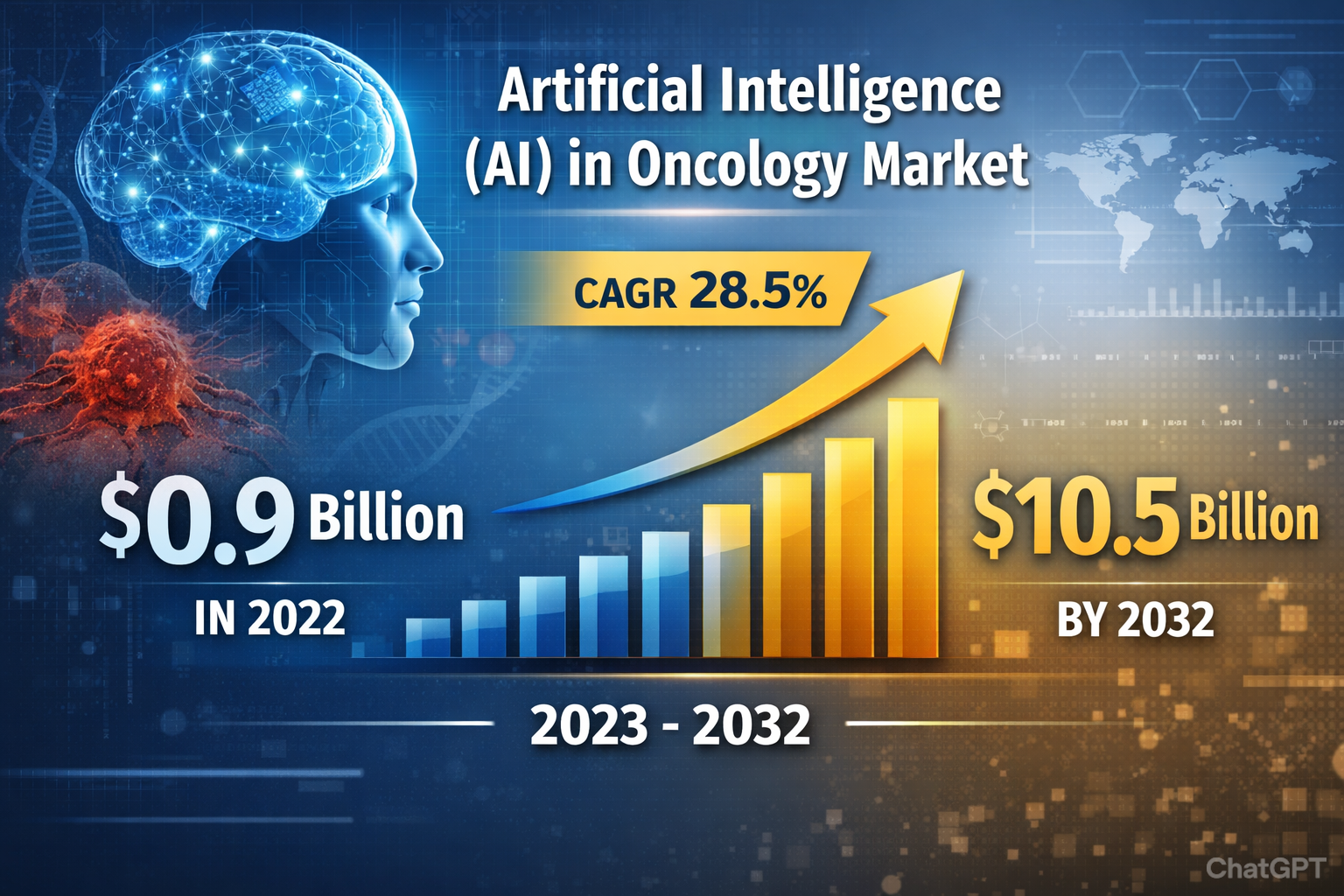
The global AI in Oncology Market was valued at USD 0.9 billion in 2022 and is projected to reach USD 10.5 billion by 2032, exhibiting a strong compound annual growth rate (CAGR) of 28.5% over the forecast period.
Key takeaways: Artificial Intelligence (AI) In Oncology Market
- The global AI in Oncology Market was valued at USD 0.9 billion in 2022 and is projected to reach USD 10.5 billion by 2032, exhibiting a strong compound annual growth rate (CAGR) of 28.5% over the forecast period.
- The AI in Oncology Market refers to the use of advanced Artificial Intelligence technologies—including machine learning, deep learning, and data analytics—in the prevention, diagnosis, treatment, and management of cancer.
- Key growth drivers: Rising global incidence of cancer, increasing demand for early and accurate detection., Adoption of personalized medicine and precision oncology., Investments from healthcare organizations and tech firms to accelerate AI development., Potential to significantly improve patient outcomes and reduce overall healthcare costs..
What Is the Artificial Intelligence (AI) in Oncology Market?
The AI in Oncology Market refers to the use of advanced Artificial Intelligence technologies—including machine learning, deep learning, and data analytics—in the prevention, diagnosis, treatment, and management of cancer. These technologies are employed across multiple stages of oncology care:
Early detection and diagnostics through AI‑powered analysis of medical images (MRI, CT scans, mammography, etc.)
Precision treatment planning by processing patient data, genetic profiles, and clinical history to recommend therapeutic strategies
Predictive analytics to estimate disease progression and expected outcomes
Drug discovery and development using AI to analyze molecular and biological datasets for new therapeutic targets
AI is enabling clinicians to uncover patterns not visible to the human eye, reduce errors, enhance personalization of treatments, and accelerate research. This market encompasses a spectrum of AI hardware, software solutions, and services aimed at oncology applications.
Market Trends: Technology, Adoption & Opportunity
The AI in Oncology Market is shaped by several significant trends:
Advanced Diagnostics & Imaging
AI tools are increasingly integrated into diagnostic workflows. By analyzing vast image datasets with superior speed and accuracy, these tools help detect tumors at early stages. This trend is crucial given the high global burden of cancer and the challenges of manual image interpretation.
Personalized Medicine & Precision Oncology
With growing demand for tailored treatment plans, AI is being deployed to sift through complex patient data—genomic sequences, treatment histories, biomarkers—to suggest optimized, patient‑specific therapies.
Greater Investment & Partnerships
Healthcare providers, pharmaceutical companies, and technology firms are investing heavily in AI solutions for:
drug discovery and development,
clinical trial design,
and data‑driven decision support.
These collaborative efforts are fueling innovation and commercialization of AI applications in oncology.
Shift Toward Integrated AI Platforms
Software solutions capable of handling multiple oncology functions—diagnostics, treatment planning, and predictive insights—are gaining traction. This reflects a broader industry shift from siloed tools toward integrated AI platforms that support comprehensive cancer care.
Get a Free Sample: https://www.acumenresearchandconsulting.com/request-sample/3556
Market Dynamics: Drivers, Restraints, Opportunities & Challenges
Key Market Drivers
Rising global incidence of cancer, increasing demand for early and accurate detection.
Adoption of personalized medicine and precision oncology.
Investments from healthcare organizations and tech firms to accelerate AI development.
Potential to significantly improve patient outcomes and reduce overall healthcare costs.
Market Restraints
Despite strong growth, the market faces challenges:
Concerns over data privacy, security, and regulatory compliance in healthcare settings.
Integration and interoperability issues with existing medical infrastructure.
Need for trained personnel to manage and interpret AI outputs.
Market Opportunities
Expanding AI applications beyond diagnostics into drug discovery and clinical trials.
Development of AI‑driven decision support tools to enhance clinician decision‑making.
Adoption of AI in emerging markets with rising cancer prevalence.
Regional Analysis
The AI in Oncology Market shows varied growth dynamics across different regions:
North America
Dominated the market in 2022 with approximately 46% market share, driven by advanced healthcare infrastructure, high technology adoption, and significant R&D spending.
Asia‑Pacific
Projected to experience the highest growth rate through 2032, fueled by increasing cancer prevalence, rising healthcare expenditure, and technology uptake across healthcare systems.
Europe, Latin America, MEA
Mature healthcare markets in Europe are strengthening AI integration, while Latin America and Middle East & Africa are emerging with increasing interest and investments in oncology AI solutions.
Overall, each region presents unique growth drivers, from technology readiness and healthcare infrastructure to regulatory support and market demand.
Recent Developments Impacting the Market
Emerging industry advancements and collaborations are shaping the AI in Oncology landscape:
Corporate Partnerships & Acquisitions
Major pharmaceutical companies are acquiring or partnering with AI technology firms to strengthen AI-driven oncology R&D.
Collaborations between pharma and tech giants are enabling AI-based lung cancer detection and predictive analytics.
Clinical AI Deployments
AI-powered chatbots and decision-support systems are being deployed in hospitals to enhance patient engagement and improve treatment planning.
These developments illustrate rapid real-world adoption of oncology AI technologies—not just in diagnostics, but across the entire care continuum.
Conclusion
The AI in Oncology Market is advancing rapidly, driven by technological innovation, rising cancer incidence, and the urgent need for enhanced diagnostics and personalized therapies. With projected exponential growth through 2032 and beyond, AI is poised to become an integral element of oncology care worldwide. Continued investment, regulatory clarity, and collaborative innovation will determine how effectively AI revolutionizes cancer treatment and patient outcomes in the years ahead.
To Get Detailed Overview, Contact Us: https://www.acumenresearchandconsulting.com/contact-us
Frequently asked questions about Artificial Intelligence (AI) In Oncology Market
What is the size of the Artificial Intelligence (AI) In Oncology Market?
The global AI in Oncology Market was valued at USD 0.9 billion in 2022 and is projected to reach USD 10.5 billion by 2032, exhibiting a strong compound annual growth rate (CAGR) of 28.5% over the forecast period.
What is the Artificial Intelligence (AI) In Oncology Market?
The AI in Oncology Market refers to the use of advanced Artificial Intelligence technologies—including machine learning, deep learning, and data analytics—in the prevention, diagnosis, treatment, and management of cancer. These technologies are employed across multiple stages of oncology care:
What are the key drivers of the Artificial Intelligence (AI) In Oncology Market?
Key drivers include Rising global incidence of cancer, increasing demand for early and accurate detection., Adoption of personalized medicine and precision oncology., Investments from healthcare organizations and tech firms to accelerate AI development., Potential to significantly improve patient outcomes and reduce overall healthcare costs..
Related reading: