Table of Contents
ToggleAnkylosing Spondylitis Market Size
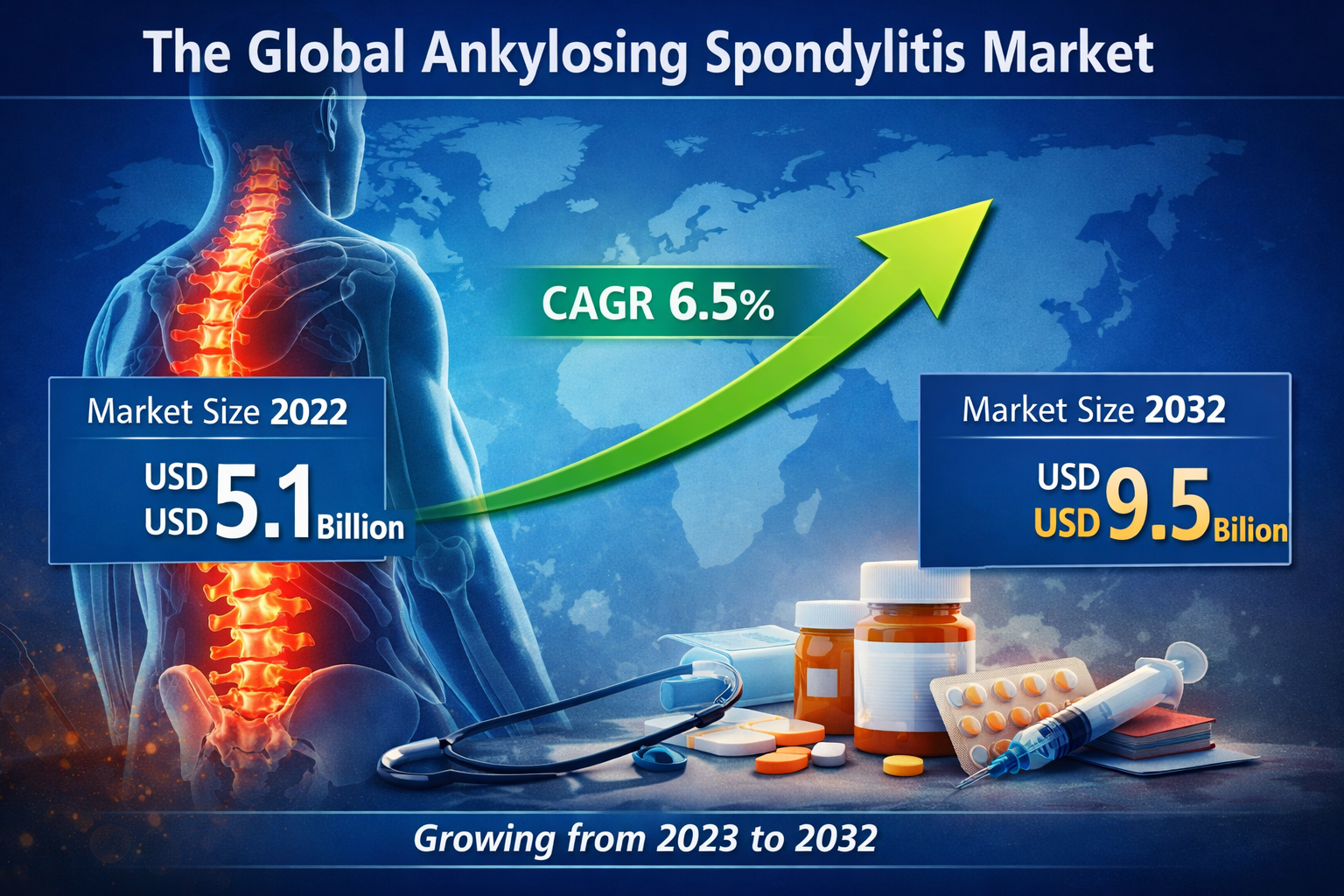
The global ankylosing spondylitis market was valued at approximately USD 5.1 billion in 2022 and is projected to reach around USD 9.5 billion by 2032, growing at a CAGR of about 6.5% during the forecast period. The growth of the ankylosing spondylitis market is largely attributed to increasing awareness of inflammatory diseases, rising prevalence of autoimmune conditions, and the growing availability of advanced biologic therapies.
What is Ankylosing Spondylitis Market?
The ankylosing spondylitis market refers to the global industry focused on the development, production, distribution, and commercialization of therapies used to diagnose, manage, and treat ankylosing spondylitis (AS). Ankylosing spondylitis is a chronic inflammatory disease that primarily affects the spine and sacroiliac joints, leading to pain, stiffness, and potential fusion of vertebrae over time. The market includes a wide range of treatment options such as non-steroidal anti-inflammatory drugs (NSAIDs), tumor necrosis factor (TNF) inhibitors, interleukin inhibitors, and JAK inhibitors, as well as supportive care and diagnostic technologies.
Continuous research and development efforts by pharmaceutical companies are also accelerating the introduction of innovative treatments, expanding the overall therapeutic landscape for patients with ankylosing spondylitis. Beyond treatment, the market includes healthcare services, diagnostic tools, hospital and retail pharmacy distribution channels, and patient support programs aimed at improving long-term disease management and quality of life.
Ankylosing Spondylitis Market Trends
Several emerging trends are shaping the future of the ankylosing spondylitis market, transforming the way the disease is diagnosed, treated, and managed globally.
Increasing Adoption of Biologic and Targeted Therapies
Biologic drugs, particularly TNF inhibitors and IL-17 inhibitors, have become the cornerstone of treatment for moderate to severe ankylosing spondylitis. These therapies target specific inflammatory pathways, providing improved symptom control and slowing disease progression compared to traditional therapies.
Growing Research in Novel Treatment Mechanisms
Pharmaceutical companies are increasingly investing in therapies that target new inflammatory pathways. Innovations such as JAK inhibitors and IL-23 inhibitors are expanding treatment options for patients who do not respond to existing therapies.
Rise of Biosimilars
The expiration of patents for several biologic drugs has led to the development of biosimilars, which offer comparable efficacy at lower costs. These products are expected to significantly improve treatment accessibility, particularly in emerging economies.
Integration of Digital Health Technologies
Digital healthcare technologies are increasingly being used to manage chronic diseases such as ankylosing spondylitis. Tools such as telemedicine platforms, mobile health applications, and wearable monitoring devices help physicians track disease progression and improve treatment adherence.
Early Diagnosis and Imaging Advancements
Improved diagnostic techniques, including advanced imaging technologies such as MRI, are enabling earlier detection of ankylosing spondylitis. Early diagnosis allows physicians to initiate treatment sooner, improving long-term patient outcomes.
Get a Free Sample: https://www.acumenresearchandconsulting.com/request-sample/3362
Ankylosing Spondylitis Market Dynamics
Market Drivers
Rising Prevalence of Autoimmune and Inflammatory Disorders
The increasing incidence of autoimmune diseases and chronic inflammatory conditions worldwide is a major factor driving the ankylosing spondylitis market. Growing awareness among healthcare professionals and patients is leading to earlier diagnosis and increased demand for effective treatments.
Advancements in Biologic and Targeted Therapies
Innovations in biotechnology have significantly improved treatment outcomes for ankylosing spondylitis patients. Targeted therapies such as TNF inhibitors and IL-17 inhibitors offer better disease control and reduced inflammation, which is accelerating market growth.
Expanding Healthcare Infrastructure
Improved healthcare infrastructure and rising healthcare expenditure across both developed and emerging economies are enhancing access to advanced therapies and diagnostic services.
Market Restraints
High Cost of Biologic Treatments
One of the major restraints in the ankylosing spondylitis market is the high cost associated with biologic drugs. These therapies can be expensive, which may limit access for patients without adequate insurance coverage or reimbursement support.
Limited Awareness in Developing Regions
In several low- and middle-income countries, limited awareness about ankylosing spondylitis often leads to delayed diagnosis and inadequate treatment.
Market Opportunities
Growth of Personalized Medicine
Advancements in biomarker research and genetic profiling are enabling more personalized treatment approaches. Precision medicine strategies can help physicians select the most effective therapy for individual patients.
Expansion in Emerging Markets
Developing countries in Asia-Pacific and Latin America present significant opportunities for market expansion due to improving healthcare access and increasing disease awareness.
Market Challenges
Complex Drug Development and Regulatory Processes
The development of new biologic drugs requires extensive clinical trials and regulatory approvals, which can delay product launches and increase development costs.
Supply Chain and Manufacturing Complexity
Biologic therapies require specialized manufacturing processes and cold-chain logistics, which can create supply chain challenges and affect product availability.
Regional Analysis of Ankylosing Spondylitis Market
North America
North America dominates the ankylosing spondylitis market, accounting for the largest share of global revenue. The region benefits from advanced healthcare infrastructure, high disease awareness, and strong adoption of biologic therapies. The United States remains the largest contributor due to extensive research activities and early regulatory approvals for innovative treatments.
Europe
Europe represents another significant market driven by increasing diagnosis rates, strong reimbursement systems, and a growing number of clinical trials. Countries such as Germany, the UK, and France play a major role in market growth due to well-established healthcare systems and strong pharmaceutical industry presence.
Asia-Pacific
The Asia-Pacific region is expected to witness the fastest growth in the ankylosing spondylitis market. Rising healthcare investments, expanding patient populations, and increasing awareness about autoimmune diseases are driving market expansion across countries such as China, India, and Japan.
Latin America and Middle East & Africa
These regions are gradually emerging as potential markets due to improving healthcare infrastructure, government healthcare initiatives, and increasing access to biologic treatments.
Recent Developments in the Ankylosing Spondylitis Market
Several recent developments highlight the ongoing innovation and competitive landscape in the ankylosing spondylitis market:
Pharmaceutical companies are introducing new biologic therapies that target inflammatory pathways involved in ankylosing spondylitis.
Strategic collaborations between pharmaceutical firms and research institutions are accelerating the development of next-generation therapies.
Multiple companies are launching biosimilar versions of established biologic drugs to improve treatment affordability and accessibility.
Ongoing clinical trials are exploring innovative treatment mechanisms aimed at improving long-term disease management.
Healthcare providers are increasingly adopting digital tools and remote monitoring systems to enhance patient care and treatment adherence.
Conclusion
The ankylosing spondylitis market is expected to experience steady growth over the coming years, driven by rising disease prevalence, increasing adoption of biologic therapies, and continuous advancements in medical research. Innovations in targeted therapies, personalized medicine, and digital healthcare technologies are likely to reshape treatment approaches and improve patient outcomes.
With expanding healthcare infrastructure, increasing investments in research and development, and growing awareness about autoimmune disorders, the ankylosing spondylitis market will continue to present significant opportunities for pharmaceutical companies, healthcare providers, and industry stakeholders worldwide.
To Get Detailed Overview, Contact Us: https://www.acumenresearchandconsulting.com/contact-us