
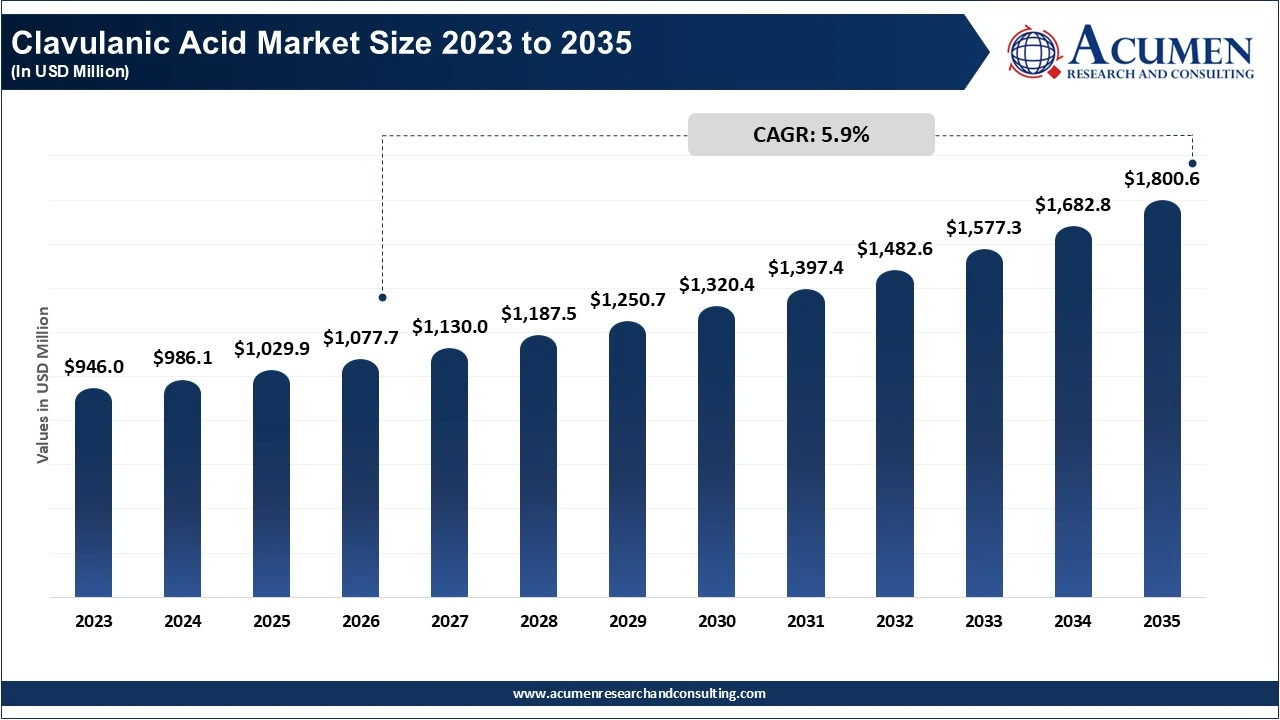
The global clavulanic acid market is witnessing steady expansion due to the growing demand for advanced antibiotics and rising concerns about antimicrobial resistance. Clavulanic acid is a beta-lactamase inhibitor commonly combined with antibiotics such as amoxicillin to improve their effectiveness against resistant bacteria. This compound plays a vital role in modern antimicrobial therapy, helping restore the activity of antibiotics that might otherwise be ineffective against resistant pathogens.
Key takeaways: Clavulanic Acid Market
- According to market research from Acumen Research and Consulting, the global clavulanic acid market was valued at approximately USD 1,029.9 million in 2025 and is expected to reach USD 1,800.6 million by 2035, growing at a compound annual.
- Key growth drivers: 1. Rising Prevalence of Bacterial Infections, 2. Expansion of the Pharmaceutical Industry, 3. Growing Healthcare Expenditure, 4. Aging Population.
According to market research from Acumen Research and Consulting, the global clavulanic acid market was valued at approximately USD 1,029.9 million in 2025 and is expected to reach USD 1,800.6 million by 2035, growing at a compound annual growth rate (CAGR) of 5.9% between 2026 and 2035.
The market growth is driven by rising cases of bacterial infections, expansion of pharmaceutical manufacturing, increasing healthcare spending, and growing investments in antibiotic research and development. Clavulanic acid has become an essential active pharmaceutical ingredient (API) used in both human and veterinary medicines to combat resistant bacterial strains.
𝐃𝐨𝐰𝐧𝐥𝐨𝐚𝐝 𝐏𝐃𝐅 𝐁𝐫𝐨𝐜𝐡𝐮𝐫𝐞 𝐍𝐨𝐰 👉 https://www.acumenresearchandconsulting.com/request-sample/3875?utm_source=Abhishek
Current Market Trends
Several key trends are shaping the growth and development of the clavulanic acid market worldwide.
One of the most prominent trends is the growing use of combination antibiotics, particularly those that combine clavulanic acid with beta-lactam antibiotics such as amoxicillin. These combinations significantly improve antibiotic effectiveness against resistant bacteria by inhibiting beta-lactamase enzymes that destroy standard antibiotics.
Another important trend is the increasing demand for powder-based formulations, which accounted for approximately 66% of the global market share in 2025. Powder forms are widely used because they offer better stability, longer shelf life, and easier integration into pharmaceutical formulations.
In addition, expanding healthcare infrastructure and pharmaceutical production in emerging economies is boosting the supply and demand for clavulanic acid. Many pharmaceutical companies are investing in advanced manufacturing technologies that improve production efficiency and reduce costs.
Another trend gaining attention is the growing use of clavulanic acid in veterinary medicine. Rising pet ownership, livestock management, and concerns about animal infections are encouraging the use of combination antibiotics in veterinary practices.
Market Drivers
1. Rising Prevalence of Bacterial Infections
One of the primary drivers of the clavulanic acid market is the increasing incidence of bacterial infections globally. Antibiotic-resistant infections have become a major public health concern. In the United States alone, more than 2.8 million antibiotic-resistant infections occur annually, highlighting the need for effective treatment solutions.
Clavulanic acid helps restore the effectiveness of antibiotics, making it an essential component in treating resistant bacterial infections.
2. Expansion of the Pharmaceutical Industry
The rapid growth of the pharmaceutical sector, particularly in emerging economies, is significantly contributing to market expansion. Increasing investments in drug development, manufacturing capabilities, and generic medicine production are fueling demand for clavulanic acid-based formulations.
3. Growing Healthcare Expenditure
Governments and private organizations around the world are investing heavily in healthcare infrastructure, hospitals, and research institutions. This rise in healthcare spending has improved access to antibiotics and increased the adoption of advanced antimicrobial treatments.
4. Aging Population
The global aging population is more vulnerable to infections due to weakened immune systems. As the elderly population grows, the demand for effective antibiotics and supportive therapies such as clavulanic acid is also increasing.
Market Restraints
Despite strong growth prospects, the clavulanic acid market faces several challenges.
1. Strict Regulatory Requirements
Pharmaceutical products must comply with stringent regulatory approvals before entering the market. Drug approval processes are often lengthy and expensive, which can slow down the introduction of new clavulanic acid formulations.
2. High Research and Development Costs
Developing innovative antibiotics and combination therapies requires significant investment in research, clinical trials, and production technologies. Smaller pharmaceutical companies may find it difficult to compete due to these high costs.
3. Risk of Antibiotic Misuse
Overuse or misuse of antibiotics may accelerate antimicrobial resistance. Governments and healthcare organizations are increasingly implementing stricter regulations on antibiotic use, which could impact market growth.
Market Opportunities
While challenges exist, several emerging opportunities are expected to drive future market growth.
1. Rising Demand for Veterinary Antibiotics
The veterinary medicine sector is creating new growth avenues for the clavulanic acid market. Increasing pet ownership and the growing livestock industry are driving demand for effective treatments against bacterial infections in animals.
2. Advancements in Antibiotic Research
Continuous investment in research and development is expected to lead to the discovery of new antibiotic combinations that incorporate clavulanic acid. These next-generation therapies may provide more targeted and effective treatments for resistant infections.
3. Personalized and Targeted Medicine
The growing focus on personalized medicine is creating opportunities to develop customized antibiotic therapies tailored to specific patient needs. This trend may further increase the use of clavulanic acid in specialized treatments.
Regional Market Insights
North America
North America currently holds the largest share of the clavulanic acid market, supported by a well-developed healthcare system, strong pharmaceutical research infrastructure, and high awareness of antibiotic resistance. In 2025, the region generated approximately USD 342 million in market revenue.
The presence of major pharmaceutical companies and ongoing research initiatives also strengthens the region’s market dominance.
Europe
Europe represents another significant market due to its advanced healthcare infrastructure and strong regulatory support for antimicrobial stewardship programs. Governments and healthcare organizations in the region are actively promoting research into new antibiotic therapies.
Asia-Pacific
The Asia-Pacific region is expected to experience the fastest growth, with a projected CAGR of around 6.9% during the forecast period.
Rapid population growth, rising healthcare spending, and expanding pharmaceutical manufacturing in countries such as China and India are driving market expansion in this region.
Latin America and Middle East & Africa
These regions are witnessing gradual growth due to improving healthcare systems, increased access to antibiotics, and rising awareness of infectious diseases.
Competitive Landscape
The clavulanic acid market is highly competitive, with several global pharmaceutical companies actively participating in research, manufacturing, and product development.
Key companies operating in the market include:
GlaxoSmithKline plc
Merck & Co., Inc.
Pfizer Inc.
Sanofi S.A.
Novartis AG
Bayer AG
Abbott Laboratories
Roche Holding AG
AstraZeneca plc
Johnson & Johnson
These companies are focusing on strategic collaborations, product innovations, and expansion of manufacturing capabilities to strengthen their market positions.
Future Market Growth Potential
The future outlook for the clavulanic acid market appears highly promising. With increasing global awareness of antimicrobial resistance and the continuous emergence of resistant bacterial strains, the demand for effective antibiotic combinations is expected to grow steadily.
Advancements in pharmaceutical manufacturing technologies, increased investments in research and development, and expanding healthcare access in emerging economies will further accelerate market growth. Additionally, the growing use of clavulanic acid in veterinary medicine and the development of next-generation antibiotic therapies are expected to create new revenue streams for industry players.
Overall, the clavulanic acid market is poised for sustained growth over the next decade. As healthcare systems continue to prioritize effective antimicrobial treatments, clavulanic acid will remain a crucial component in the fight against bacterial infections worldwide.
Conclusion
In conclusion, the global clavulanic acid market is experiencing steady growth driven by rising bacterial infections, increasing antibiotic resistance, and expanding pharmaceutical research. While regulatory challenges and high development costs remain obstacles, the market offers strong opportunities through technological innovation, veterinary applications, and expanding healthcare infrastructure. With a projected CAGR of nearly 6% through 2035, the clavulanic acid industry is expected to play a pivotal role in advancing modern antimicrobial therapy and improving global health outcomes.
Purchase this premium report now: https://www.acumenresearchandconsulting.com/buy-now/0/3875?utm_source=Abhishek
Linkedin Article URL:
https://www.linkedin.com/pulse/india-hyperscale-data-center-market-size-yrlyf
https://www.linkedin.com/pulse/cobalt-based-amorphous-alloy-market-size-trends-bvepf
https://www.linkedin.com/pulse/electric-commercial-vehicle-market-size-ehyoe
https://www.linkedin.com/pulse/aircraft-market-size-share-growth-trends-report-2025-1gvbe
https://www.linkedin.com/pulse/biologics-market-size-share-growth-report-nawue
Media Contact:
Richard Johnson
Email: sales@acumenresearchandconsulting.com
Phn: +91 8983225533
Acumen Research and Consulting
Frequently asked questions about Clavulanic Acid Market
What is the size of the Clavulanic Acid Market?
According to market research from Acumen Research and Consulting, the global clavulanic acid market was valued at approximately USD 1,029.9 million in 2025 and is expected to reach USD 1,800.6 million by 2035, growing at a compound annual growth rate (CAGR) of 5.9% between 2026 and 2035.
What are the key drivers of the Clavulanic Acid Market?
Key drivers include 1. Rising Prevalence of Bacterial Infections, 2. Expansion of the Pharmaceutical Industry, 3. Growing Healthcare Expenditure, 4. Aging Population.
Related reading: