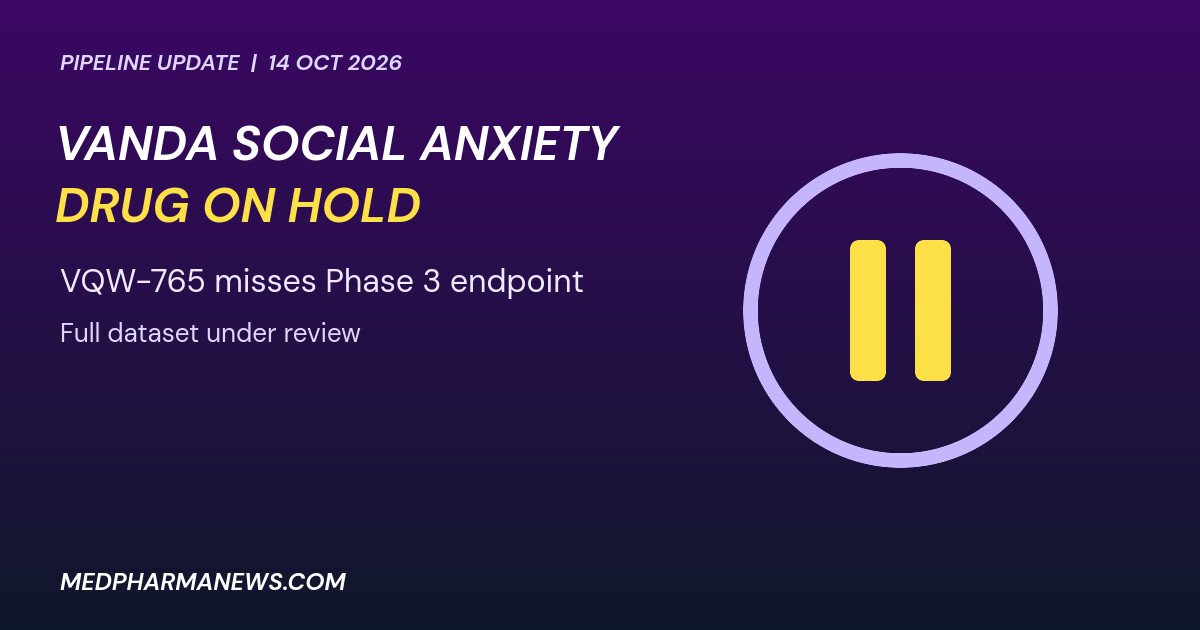
The Vanda Pharmaceuticals social anxiety drug, VQW-765, is on hold after a Phase 3 trial that showed no benefit over placebo on its primary measure. In a release of 14 October 2026, Vanda (Nasdaq: VNDA) said Study 3201 missed its primary endpoint and a key secondary endpoint, that the drug was safe and well tolerated, and that development is paused while it reviews the full dataset. For a company, a late-stage miss is not only a scientific event but also a pipeline and planning event, and this report looks at that side of the story.
It covers what is being paused, what the company has and has not said about its pipeline, and the questions that remain open.
Vanda Pharmaceuticals social anxiety drug: key takeaways
- Asset: VQW-765, an oral alpha-7 nicotinic receptor partial agonist, formerly AQW-051 and licensed from Novartis.
- Trial: 546 adults at about 30 US sites; single dose versus placebo, followed by a stress test.
- Result: 65.6 versus 66.0 on the primary endpoint in females; the full-population secondary also missed.
- Decision: programme on hold pending data review.
- Not said: no financial impact, timelines or alternative plans were given in the release.
What is being paused at the Vanda Pharmaceuticals social anxiety drug programme
VQW-765 was being developed as an on-demand treatment: a single oral dose taken before a stressful event, rather than a daily medicine. Study 3201 (NCT07221578) was the Phase 3 test of that idea in social anxiety disorder, using a public-speaking stress test as the challenge. The company describes the drug as a small molecule that binds the alpha-7 nicotinic acetylcholine receptor with much higher affinity than nicotine. It is being studied for psychiatric disorders, and it came to Vanda from Novartis, where it was known as AQW-051.
How the study was designed
Study 3201 was randomised, double-blind and placebo-controlled. It enrolled 546 adults aged 18 to 65 at about 30 US sites, all with elevated baseline scores on the Liebowitz Social Anxiety Scale and the Public Speaking Anxiety Scale. Each person received one oral dose of VQW-765 or placebo, assigned one to one, and then took the Trier Social Stress Test, which involves an anticipation phase and an interview-style presentation to a panel that does not respond. Distress was scored from 0 to 100. A design like this gives a clean comparison, but it measures acute distress at one moment, which limits what it can say about longer-term benefit.
How the Vanda Pharmaceuticals social anxiety drug performed
On the primary endpoint, measured in female participants during the performance phase on a 0 to 100 distress scale, VQW-765 averaged 65.6 and placebo 66.0 (p = 0.8899). On the key secondary endpoint in all participants, the averages were 64.7 and 63.8 (p = 0.6605). By our arithmetic, the primary gap is about 0.6 percent of the placebo score. The company said the drug was safe and well tolerated, consistent with prior studies, and did not provide further safety detail.
What the company said about the Vanda Pharmaceuticals social anxiety drug
Mihael Polymeropoulos, Vanda’s president, chief executive and chairman, said the company was “disappointed that Study 3201 did not confirm the earlier Phase II findings” and thanked participants, investigators and site staff. The earlier Phase II work, in people with performance anxiety, showed numerically lower stress with the drug and was reported in a peer-reviewed Phase II report. The company has described the programme as on hold pending further analysis of the full Study 3201 dataset.
What a company-led pause means
A pause decided by the company differs from a regulatory clinical hold, which is imposed by an agency. The release describes a company decision and mentions no regulatory action. The study was registered on ClinicalTrials.gov, so outside observers can compare the registered design with the reported results once the company publishes the full data. Until then, the public record consists of the release and the registry entry.
What the release does not address on the Vanda Pharmaceuticals social anxiety drug
The release gives no estimate of costs, no revised timelines, and no statement on whether a different design or population might be tried. It refers to the rest of the company’s late-stage pipeline only in its forward-looking statements and gives no detail. We therefore do not assess any financial impact, share-price move or valuation effect. Readers looking for those should consult the company’s regulatory filings, which may add detail in time.
Why the Vanda Pharmaceuticals social anxiety drug target is watched
The alpha-7 receptor has attracted interest as a target in psychiatric and neurological conditions, which is why a clean Phase 3 miss draws attention beyond a single company. One negative result does not settle whether the target has value, because drugs differ in how they act on a receptor, in dose and in the conditions studied. The release makes no claims about the target as a whole, and we do not draw one.
Risks and caveats on the Vanda Pharmaceuticals social anxiety drug
- Figures come from the company’s release and the trial registry, not a peer-reviewed Phase 3 paper.
- The programme is on hold, not formally ended; the company has not said what happens next.
- Our percentage is our own arithmetic.
- The result concerns one experimental drug and does not mean existing social anxiety treatments are ineffective.
In our assessment, the open question for the Vanda Pharmaceuticals social anxiety drug is less about the safety profile, which the company calls favourable, and more about whether the data review finds any signal worth a second design. See also EU Panel Backs Revolution Medicines’ Rasonque for Pancreatic Cancer. More is in our pharmaceuticals coverage.
What to watch next on the Vanda Pharmaceuticals social anxiety drug
- The outcome of the full dataset review.
- Any decision to end, redesign or resume the programme.
- Detailed results at a scientific meeting or in a paper.
- Company updates on the rest of its late-stage pipeline.
Frequently asked questions
What is the Vanda Pharmaceuticals social anxiety drug?
VQW-765, an oral alpha-7 nicotinic receptor partial agonist studied as an on-demand treatment.
Did the Phase 3 trial succeed?
No. It missed its primary endpoint and a key secondary endpoint.
Is development over?
It is on hold while the full dataset is reviewed.
Was the drug safe?
The company says it was safe and well tolerated.
How we reported this: we relied on Vanda’s release of 14 October 2026 and the trial registry. The 0.6 percent figure is our own arithmetic. Last updated: 16 October 2026. This article is news reporting and not medical or investment advice.