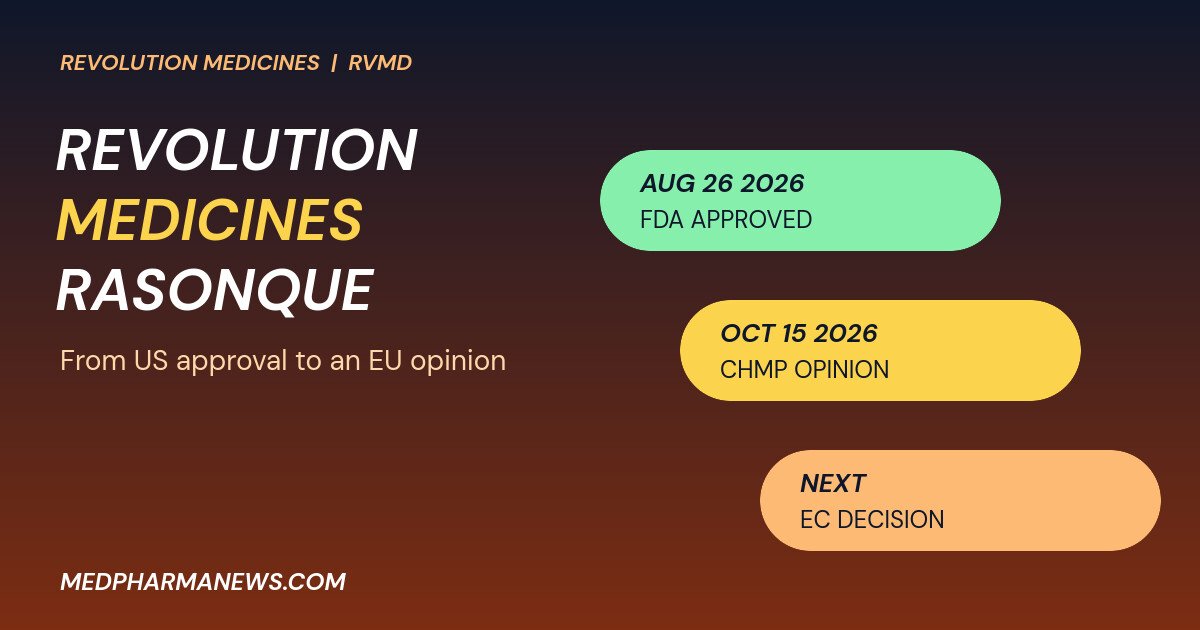
For investors and industry watchers, the Revolution Medicines Rasonque story has now moved from the United States to Europe. On 15 October 2026, Revolution Medicines (Nasdaq: RVMD) announced that EMA’s CHMP had adopted a positive opinion recommending marketing authorisation for Rasonque (daraxonrasib) as monotherapy in adults with metastatic pancreatic adenocarcinoma who have received at least one prior systemic therapy. The US Food and Drug Administration approved the drug on 26 August 2026. The European Commission, which makes the final EU decision, has not yet ruled.
This report takes the regulatory and company view: the path so far, what remains, what the trial data support, and which questions the announcement leaves open.
Revolution Medicines Rasonque: key takeaways
- Europe: a CHMP positive opinion on 15 October 2026. The European Commission decides next; no timing was given.
- United States: approved on 26 August 2026 for adults with metastatic pancreatic cancer after at least one prior systemic therapy, or those not candidates for multiagent therapy.
- Evidence: in the Phase 3 RASolute 302 trial, median overall survival was 13.2 versus 6.7 months in the main analysis and 12.4 versus 6.7 months in an ad hoc analysis.
- Designations: orphan status for pancreatic cancer and high-priority status in the EMA’s Cancer Medicines Pathfinder project.
- Not disclosed: EU pricing, launch timing and enrolment figures in the company release.
The regulatory path so far for Revolution Medicines Rasonque
The company’s record shows a quick sequence. FDA approval came on 26 August 2026, and reports say the agency granted breakthrough therapy designation in September 2026 for use with gemcitabine and nab-paclitaxel as a first-line treatment. On 15 October 2026 the CHMP followed with its opinion after what the company describes as an expedited, phased review under the Cancer Medicines Pathfinder project, an EMA initiative for medicines that address significant unmet needs. The CHMP’s recommended use is narrower than the US label, covering patients who have received at least one prior systemic therapy.
If the European Commission agrees, centralised authorisation would apply across the EU and in Iceland, Norway and Liechtenstein. The UK and Switzerland have separate processes. Mark Goldsmith, chief executive and chairman, called the opinion “a major step toward making RASONQUE available to eligible adults” in the EU and said the Phase 3 results were unprecedented. That is the company’s characterisation.
What the Revolution Medicines Rasonque data show
The RASolute 302 trial compared Rasonque with investigator’s choice of chemotherapy in previously treated metastatic pancreatic cancer. In the main analysis of the overall population, median overall survival was 13.2 months versus 6.7 months (hazard ratio 0.40), and median progression-free survival was 7.2 months versus 3.6 months (hazard ratio 0.49). An ad hoc analysis gave 12.4 months versus 6.7 months (hazard ratio 0.49). Reports of the published trial describe 500 patients, and a confirmed response rate of 31.6% versus 11.2%. The primary analysis was presented at the 2026 ASCO meeting and published in the New England Journal of Medicine.
Our note on the two survival figures: 13.2 months is the prespecified main result, and 12.4 months comes from a later ad hoc analysis. The company attributes the ad hoc figure to the RAS G12 group, while a report on the publication describes it as an overall-population result. We present both rather than choose.
Safety and what it means for Revolution Medicines Rasonque use
Rasonque causes frequent side effects. The company lists diarrhoea (63.1%), acneiform dermatitis (62.4%), stomatitis (55.5%), nausea (50.8%), vomiting (41.6%) and fatigue (33.2%) as the most common. In the US label, 30% of patients had serious adverse reactions and 2.9% discontinued for them, with rare but fatal cases of gastrointestinal perforation and lung inflammation. Prophylaxis for rash and mouth problems is advised. For prescribers and payers, the management of these effects, not just survival, will shape real-world use.
The commercial and pipeline picture for Revolution Medicines Rasonque
Revolution Medicines describes itself as a commercial-stage oncology company focused on RAS-addicted cancers, with a platform of oral RAS(ON) inhibitors. Rasonque is in a global Phase 3 programme in pancreatic cancer and in metastatic RAS-mutant non-small cell lung cancer. A separate pancreatic trial, RASolute 303, tests the drug in first-line disease. The company release does not give EU pricing, expected launch timing or sales guidance, so any forecast would be speculation. Company filings are available through the SEC’s EDGAR database.
What the Revolution Medicines Rasonque announcement does not say
- When the European Commission will decide.
- How many patients were enrolled, in the release itself. The figure of 500 comes from reports of the published trial.
- Individual chemotherapy comparators and full response data, which come from trial reports.
- EU price and reimbursement plans.
Risks and caveats for Revolution Medicines Rasonque
- A CHMP opinion is a recommendation. It usually precedes, but does not guarantee, authorisation.
- The drug is not a cure; survival improved by months in the trial.
- Side effects are common and can be serious.
- Outside the US the drug is investigational until a regulator decides. Forward-looking statements carry the usual company risks.
In our assessment, the sequence of FDA approval followed by a CHMP opinion within seven weeks is a strong regulatory result for a cancer with few options. The open questions are commercial: pricing, reimbursement and how quickly treating centres can manage the side effects. For another oncology regulatory story, see FDA Grants Fast Track Status to New Biliary Tract Cancer Immunotherapy, Opamtistomig and our pharmaceuticals section.
What to watch next for Revolution Medicines Rasonque
- The European Commission’s decision.
- RASolute 303 first-line data.
- Pricing and reimbursement news in major EU markets.
Questions about Revolution Medicines Rasonque
Is Rasonque approved in the EU?
Not yet. The CHMP recommended it on 15 October 2026, and the European Commission has to decide.
Is it approved in the US?
Yes. The FDA approved it on 26 August 2026, with a broader label than the EU recommendation.
What did the trial show?
Median overall survival of 13.2 versus 6.7 months in the main analysis, and 12.4 versus 6.7 months in an ad hoc analysis.
Is it a cure?
No.
How we reported this: we relied on Revolution Medicines’ announcement of 15 October 2026 and reports of the trial publication. Percentages are the company’s. Last updated: 16 October 2026. This article is news reporting and not investment or medical advice.