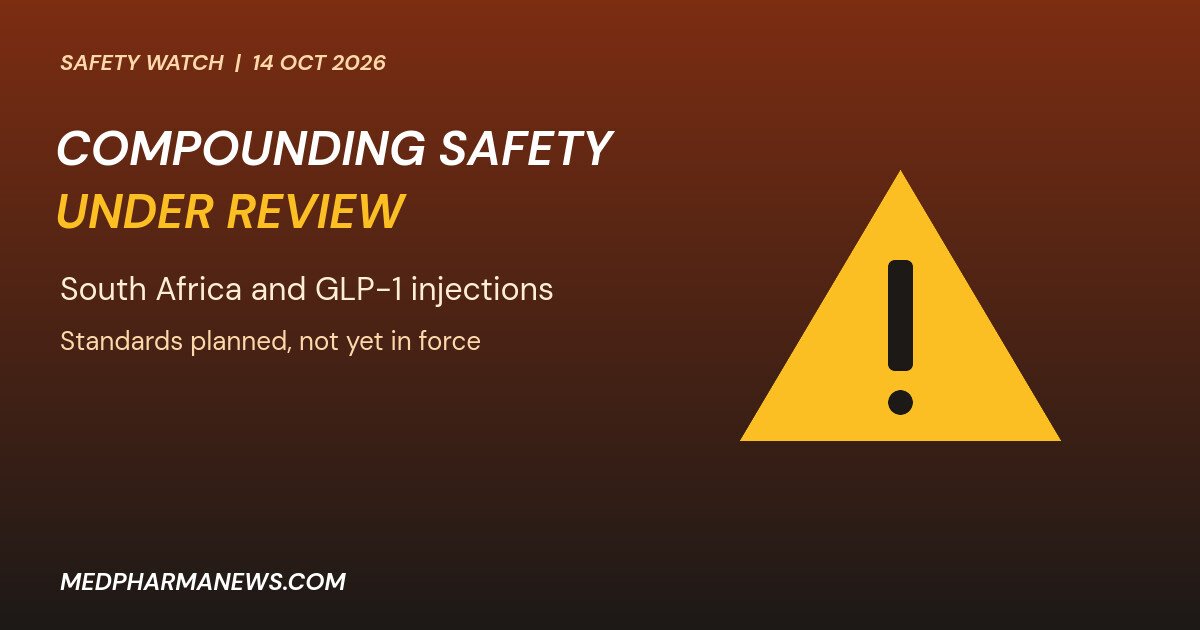
Pharmaceutical compounding safety has moved to the centre of South Africa’s debate over GLP-1 weight-loss injections. The Pharmacy Council and the medicines regulator SAHPRA are developing updated standards for compounding, and the reason is quality: injectable medicines made in pharmacies are only as safe as their ingredients, testing and sterile conditions. The work was described on 14 October 2026, and the standards are planned, not yet in force. This report looks at the safety questions regulators have raised and what patients and pharmacies should understand.
Pharmaceutical compounding safety: key takeaways
- Regulators say compounding must be for an individual patient with a valid prescription.
- Their stated safety concerns: untested ingredients, unsuitable sterile conditions and no system to track adverse reactions.
- Revised standards are expected before the council in February and published in March.
- No figures on affected patients have been published.
What pharmaceutical compounding safety means in practice
Compounding is the preparation of a medicine by a pharmacist for a particular patient. For sterile injectables, safety depends on three things: that the active ingredient is what it claims to be and is made to a known standard, that each batch is tested for identity, potency and purity, and that preparation takes place in a clean, controlled environment. When a product is made in bulk and sold widely, regulators say it stops being compounding and becomes manufacturing, which requires registration. That distinction is the one the South African regulators want to sharpen.
Why pharmaceutical compounding safety matters most for injectables
Injected medicines bypass some of the body’s natural barriers, so contamination, wrong strength or poor-quality ingredients can matter more than with a tablet. That is general pharmaceutical principle rather than a finding about any South African product, but it is the logic behind the regulators’ emphasis on sterile conditions and testing. It also explains why they single out injectables made from complex active ingredients, such as GLP-1 medicines, where an error in identity or dose is hard for a patient to detect.
What inspectors reported on pharmaceutical compounding safety
In the government news release of 26 May 2026, SAHPRA and the Pharmacy Council described a joint inspection of a compounder in Silverton, Pretoria. They said the site appeared to make and supply semaglutide, tirzepatide and combination products for broader distribution, with illegally imported ingredients, no analytical testing for identity, potency or purity, unsuitable sterile manufacturing conditions and no pharmacovigilance system to monitor adverse reactions. SAHPRA said it had received reports of adverse events, including hospitalisations, as set out in the regulators’ joint statement. These are regulators’ findings; no numbers were given.
Who is responsible for what
Responsibility is split. SAHPRA regulates medicines, and in this case it seized products and ordered a recall of anything already distributed. The Pharmacy Council regulates pharmacy professionals, and said it would take further action against those involved, which could include removal from the register. Its chief executive, Vincent Tlala, said the council would not tolerate conduct that compromises patient safety. The split matters for the planned standards, because they are being developed jointly by both bodies.
The registered-product gap and pharmaceutical compounding safety
Part of the pressure comes from supply. In SAHPRA’s November 2024 position statement, SAHPRA said Ozempic was registered for type 2 diabetes and not for weight management, and that Mounjaro had not been placed on the South African market through its manufacturer’s channels and was not registered for weight management. SAHPRA also said it could not know whether the ingredient in compounded semaglutide matched the registered one. That statement is nearly two years old, so current registration status should be checked with the regulator rather than assumed.
What regulators plan next
Vincent Tlala, the Pharmacy Council’s Registrar and CEO, told a roundtable on counterfeit medicines on 14 October that the council opposes pharmacies becoming small-scale manufacturers, compounding in anticipation of demand. SAHPRA’s Daphney Fafudi said the revised standards and guidelines aim to clarify what is permissible. The standards are expected before the council in February and publication is targeted for March; the year was not stated, and by the calendar it means 2027. The text has not been published.
What is not yet known about pharmaceutical compounding safety
Several basics remain unanswered in the public record: how many patients have been affected, how many other compounders are under review, and what testing or facility thresholds the new standards will set. The regulators have also not said whether the standards will apply only to GLP-1 products or to all sterile compounding. We have left those questions open rather than infer answers.
What patients and pharmacies should know
SAHPRA’s November 2024 statement urged the public to buy only registered GLP-1 products, and its joint statement of May 2026 urged people to consult healthcare professionals about weight management or diabetes treatment and to report suspected adverse reactions or suspicious products to SAHPRA. SAHPRA listed a 24-hour reporting line, 0800 204 307, in its 2024 statement. We cannot advise individuals on treatment; a doctor or pharmacist can. For pharmacies, the message is to keep compounding tied to named patients and prescriptions.
Risks and caveats on pharmaceutical compounding safety
- Inspection findings concern one site and cannot be generalised to all compounders.
- The standards are proposals and their content is not yet public.
- Registration facts quoted from 2024 may have changed.
- This is news reporting and not medical or legal advice.
In our assessment, pharmaceutical compounding safety will be judged by detail: whether the final standards require ingredient testing, sterile-condition checks and adverse-event tracking in plain terms, because those were the gaps regulators named. See also Anti-Diabetic Drugs Market Posts Strong Growth in India. More in our pharmaceuticals coverage.
What to watch next on pharmaceutical compounding safety
- Council submission in February and publication in March.
- Updated SAHPRA guidelines issued alongside.
- Further inspections, recalls and disciplinary decisions.
- Any public consultation on the standards.
Frequently asked questions
What is pharmaceutical compounding safety?
The quality and sterility controls that make a pharmacy-prepared medicine safe to use.
Are compounded GLP-1 injections approved?
Regulators say compounded versions have not been evaluated by SAHPRA.
Where can problems be reported?
To SAHPRA; its 2024 statement listed a 24-hour line at 0800 204 307.
Are new rules in force?
No. They are planned for publication in March.
How we reported this: we relied on SAHPRA statements, a government news release and remarks at the 14 October 2026 roundtable. Last updated: 16 October 2026. This article is news reporting and not medical or legal advice.