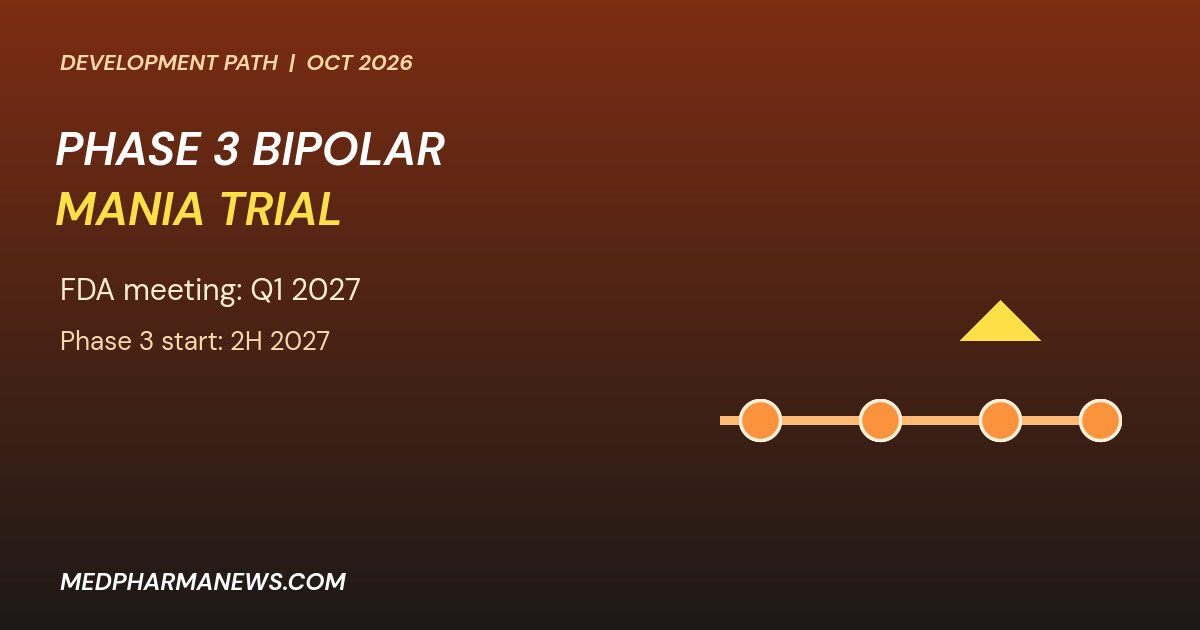
A Phase 3 bipolar mania trial programme is now the next step for Rapport Therapeutics after its RAP-219 Phase 2 study met its primary endpoint on 20 October 2026. The company plans an end-of-Phase 2 meeting with the US Food and Drug Administration in the first quarter of 2027 and expects two Phase 3 trials to start in the second half of 2027. This industry report looks at the development path, what a registrational programme would have to show, the rest of the pipeline and the financial runway, and keeps company claims separate from our analysis.
Phase 3 bipolar mania trial: key takeaways
- FDA meeting: end-of-Phase 2 discussion planned for the first quarter of 2027.
- Phase 3: two trials in bipolar mania expected to start in the second half of 2027.
- Phase 2 base: 253 adults, a 3.1-point gain over placebo on the Young Mania Rating Scale (p=0.045).
- Cash: $436.1 million at 30 June 2026, which the company says funds operations into the second half of 2029.
- Same compound: Phase 3 trials in focal onset seizures are already enrolling.
The road to a Phase 3 bipolar mania trial
According to the company announcement, the first step is a meeting with the FDA to discuss the Phase 2 data and the design of registrational studies. The company says two Phase 3 trials are expected to begin in the second half of 2027. By our arithmetic, that leaves a gap of roughly three to nine months between the regulatory meeting and the first patient, depending on exact timing, which is a calendar estimate and not a company statement. The chief medical officer says the Phase 2 study will help optimise the Phase 3 design.
What a Phase 3 bipolar mania trial would need to show
General background: Phase 3 trials are larger confirmatory studies, and regulators usually look for replicated evidence of benefit and an acceptable safety profile before approval, as described in the FDA drug development process. For this indication, the Phase 2 evidence is a single three-week inpatient trial with a p-value of 0.045, so confirmation in larger studies matters. Whether regulators will want longer treatment, outpatient settings or comparisons with approved medicines is something the FDA meeting will address, and the release does not say.
The Phase 2 base for the Phase 3 bipolar mania trial
The Phase 2 trial randomised adults with bipolar I disorder in an acute manic episode to 0.75 mg of RAP-219 daily or placebo. The drug group improved by 15.4 points and placebo by 12.3. A secondary clinician-rated severity measure improved by 0.4 points over placebo (p=0.024). Safety showed no serious adverse events, discontinuations of 3.2% against 0.8%, and agitation of 16.7% against 9.4%. Eight-week post-treatment safety data have not been presented.
Design questions for the next Phase 3 bipolar mania trial stage
- Dose: only one dose, 0.75 mg, was tested in the trial described.
- Duration: the trial lasted three weeks.
- Setting: patients were treated as inpatients in the United States.
- Rescue medication: lorazepam was allowed, which could affect both efficacy and agitation reporting.
- Endpoints: item-level results were nominal and were not adjusted for multiple testing.
These are issues that we see for the company to resolve, and they are our reading of the reported design, not statements by Rapport.
What the company has said about commercial potential
Chief executive Abraham Ceesay described RAP-219 as a pipeline in a product with two multibillion-dollar indications, a reference to epilepsy and bipolar mania. That is a company assertion about market size, and the release gives no sales forecast or supporting data. We have not verified the figure and treat it as management’s view. Commercial outcomes depend on approval, labelling, competition and pricing, none of which can be assessed from a Phase 2 readout.
Pipeline behind the bipolar programme
RAP-219 is also in pivotal Phase 3 trials, FOCUS 1 and FOCUS 2, for focal onset seizures, with initial open-label extension data from a Phase 2a study expected in the fourth quarter of 2026. A Phase 3 trial in primary generalised tonic-clonic seizures is expected in the first half of 2027, and Phase 1 pharmacokinetic data on a long-acting injectable form in the third quarter of 2027. A second compound, RAP-641, is expected to report preliminary Phase 1 results in the second half of 2027, and the company has preclinical work in chronic pain, migraine and hearing and vestibular disorders.
Financial runway behind the Phase 3 bipolar mania trial
The company reports $436.1 million in cash, cash equivalents and short-term investments at 30 June 2026 and expects this to fund operations into the second half of 2029, beyond the expected topline data from the Phase 3 seizure programme. That is management’s projection. Running several Phase 3 trials at once is expensive, and the guidance does not state whether it includes the two planned bipolar trials. We do not report share-price moves because we have not verified them.
Risks and caveats on the Phase 3 bipolar mania trial plan
- Timelines are company expectations and can slip.
- Phase 2 results frequently do not replicate in larger trials.
- Regulatory feedback in 2027 may change the design or the number of trials.
- This is news reporting, not investment or medical advice.
In our assessment, the Phase 3 bipolar mania trial plan is fundable on the company’s own numbers but rests on a narrow Phase 2 result, so the FDA meeting in early 2027 is the event that will define how large and how long the registrational programme must be. See also Bundibugyo Virus Outbreak: No Vaccine Raises Alarm. More in our pharmaceuticals coverage. Trial registrations are listed on ClinicalTrials.gov.
What to watch next on the Phase 3 bipolar mania trial
- Open-label extension data in focal onset seizures in the fourth quarter of 2026.
- Outcome of the FDA meeting in the first quarter of 2027.
- Registration of the Phase 3 protocols.
Frequently asked questions
When will the Phase 3 trials start?
The company expects two Phase 3 bipolar mania trials to start in the second half of 2027.
Is RAP-219 approved?
No. It is investigational.
How long does the company’s cash last?
The company expects its cash to fund operations into the second half of 2029.
How we reported this: we relied on the company announcement of 20 October 2026 and the public FDA and trial-registry pages. Our analysis is labelled. Last updated: 20 October 2026. This article is news reporting and not investment or medical advice.