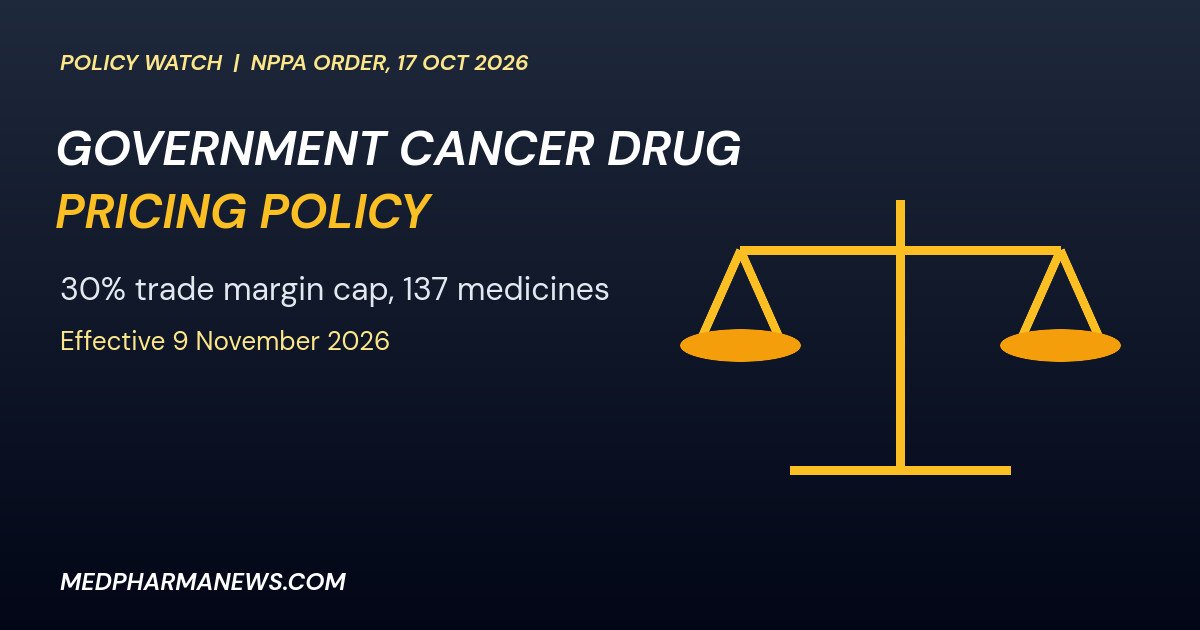
India has widened its government cancer drug pricing policy, capping trade margins at 30% on 137 non-scheduled anti-cancer medicines from 9 November 2026. The National Pharmaceutical Pricing Authority (NPPA) issued the order on 17 October 2026 under Paragraph 19 of the Drugs (Prices Control) Order, 2013, and the Ministry of Chemicals and Fertilisers expects retail prices to fall by up to 70%, depending on the product. For drugmakers, distributors and hospitals, the interesting questions concern who absorbs the change and whether supply holds.
Government cancer drug pricing policy: key takeaways
- Instrument: a trade margin cap, not a cap on manufacturers’ selling prices.
- Reference point: each manufacturer’s March 2026 price to stockists, according to summaries of the order.
- Obligations: revised price lists, production kept at existing levels, notice before discontinuation.
- Effect: the Ministry expects retail prices to fall by up to 70%; actual cuts vary.
- Unverified here: the official list of medicines and any company-level financial effect.
From pilot to wider government cancer drug pricing policy
The tool is not new. A February 2019 notice capped margins at 30% on 42 anti-cancer drugs as a proof of concept, and a March 2019 release reported cuts of up to 87% on 390 brands. A later government release cited cuts of up to 90% across 526 brands. The 2026 order extends the approach to 137 medicines, a threefold larger list, and is described in reports as following the 2019 precedent. The step from pilot to broader policy suggests regulators regard the earlier exercise as workable.
How the margin formula works in the government cancer drug pricing policy
Summaries of the order give the maximum MRP as the price to stockist multiplied by 100/70, plus GST. In the illustration reported from the order, a product with a price to stockist of ₹70 and a current MRP of ₹300 would be limited to ₹100 plus GST. By our arithmetic, the ₹30 margin is 30% of ₹100 but about 43% of ₹70, which is why the cap is a limit on the share of the retail price rather than a limit on markup. The numbers are an illustration, not the price of any named medicine.
What the government cancer drug pricing policy asks of manufacturers
Under summaries of the order, manufacturers must report revised prices to the NPPA and state drug controllers within seven days of publication and circulate new price lists. They must keep production at existing levels, with prior permission needed to cut it, and give six months’ notice before discontinuing a listed medicine. Free supplies under a patient assistance programme are reported to be excluded, subject to undertakings, record-keeping and NPPA audit. Because the order reportedly covers patented products too, global brands marketed in India fall within its reach.
Who absorbs the cut
The cap restricts the margin between the manufacturer’s price to stockists and the retail price, so the burden of a lower MRP falls on the distribution chain in the first instance rather than on the manufacturer’s own price. One independent analysis suggests manufacturers may hold net realisation broadly stable while distributors or hospitals take the reduction, but it describes that as not established. We treat it as a hypothesis. Which parties lose margin will become clearer once revised prices and company filings appear.
Hospitals, pharmacies and the government cancer drug pricing policy
Hospitals are directed to display revised prices and are responsible for implementation, and state drug controllers are told to enforce compliance. Direct supplies to hospitals are reportedly within scope. Consumers can look up rates on the NPPA website and the Pharma Sahi Daam app, per the Ministry’s statement. Pharmacies that hold stock printed with older, higher MRPs will need guidance on how to handle it, and we have not seen the transition rules.
Supply risks in the government cancer drug pricing policy
The order’s production-maintenance clause reflects an obvious risk: a price cut that triggers shortages gives patients little benefit. The Ministry’s statement says the rationalisation is meant to work without denting legitimate manufacturing revenues or causing artificial shortages. The six-month discontinuation notice and the permission requirement for output cuts are the safeguards. Whether they are sufficient is an empirical question that only post-implementation reports can answer.
The wider medicine-pricing debate
The order arrives while medicine prices are under wider scrutiny in India. Our earlier coverage of a Supreme Court hearing on medicine price caps looked beyond cancer drugs, and readers following this story may want to track both strands. The 2026 order is limited to the 137 listed anti-cancer medicines and says nothing about other therapeutic areas, so we do not read it as a general change to pricing for all medicines.
What we have not verified
We have not reviewed the gazette text, the official list of 137 drugs or revised prices. Reports describe the list as including targeted therapies and immunotherapies, but we do not name individual medicines or quote revised prices, and we make no claim about any company’s revenue or share price.
Risks and caveats on the government cancer drug pricing policy
- Several details come from summaries of the order, not the gazette text.
- The list is open to periodic updates.
- Printed price changes may differ from what patients actually pay.
- This is news reporting, not investment, legal or medical advice.
In our assessment, the government cancer drug pricing policy has moved from a pilot to a standing instrument, and the next signal will be which medicines are added to the list and how supply behaves after 9 November. See also Supreme Court Pushes Beyond Cancer Drugs on Medicine Prices. More in our pharmaceuticals coverage.
What to watch next on the government cancer drug pricing policy
- Official list and revised price lists.
- Company compliance filings and statements.
- Additions to the list of 137 medicines.
- Any supply disruption reports.
Frequently asked questions
What is the government cancer drug pricing policy?
An NPPA order capping trade margins at 30% on 137 non-scheduled anti-cancer medicines.
When does it take effect?
On 9 November 2026.
Does it cap manufacturers’ prices?
It caps trade margins, with the reference taken from the manufacturer’s March 2026 price to stockists.
Is there a precedent?
Yes. The NPPA capped margins on 42 anti-cancer drugs in 2019.
How we reported this: we relied on the Ministry’s statement as reported, summaries of the NPPA order and government releases on the 2019 precedent; we could not open the gazette text. Last updated: 19 October 2026. This article is news reporting and not investment, legal or medical advice.