The Moderna Merck melanoma vaccine has cleared the hardest scientific hurdle so far, a Phase 3 win, and now faces the regulatory and commercial steps that decide whether patients can get it. The companies report that intismeran autogene plus Keytruda (pembrolizumab) cut the risk of recurrence or death by 42% versus Keytruda alone in 1,137 patients with resected melanoma. This article sets out the results briefly and focuses on what must happen next.
Key takeaways on the Moderna Merck melanoma vaccine and what follows
- Recurrence-free survival hazard ratio 0.58 (42% lower risk) and distant metastasis-free survival hazard ratio 0.62 (38% lower risk), per the companies.
- Two-year recurrence-free survival was 82.2% on the combination versus 70.0% on Keytruda alone.
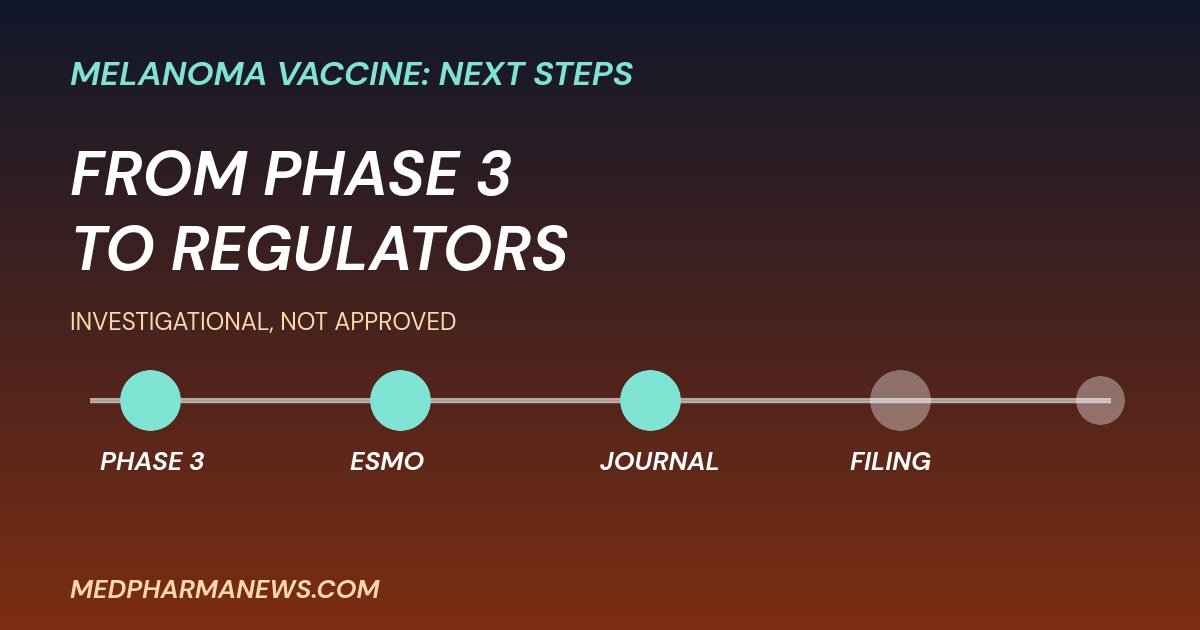
- The companies say they are engaging with regulatory authorities; the release gives no filing or launch dates.
- The results were selected for the ESMO Presidential Symposium and accepted for publication in the New England Journal of Medicine, according to the release.
- The Moderna Merck melanoma vaccine is investigational; overall survival data are immature.
The Moderna Merck melanoma vaccine results in brief
The INTerpath-001 trial (NCT05933577) randomised patients 2:1 to intismeran plus Keytruda or placebo plus Keytruda after complete surgical removal of stage IIB to IV melanoma. At a median follow-up of 24.6 months, the recurrence-free survival hazard ratio was 0.58 (95% CI 0.45 to 0.75), and the distant metastasis-free survival hazard ratio was 0.62 (95% CI 0.45 to 0.85). Grade 3 to 5 treatment-related events were similar between groups, at 14.2% and 13.4%. Full details are in the Merck release.
Why the trial design matters to regulators
Two design features will matter when agencies review the Moderna Merck melanoma vaccine. First, both arms received Keytruda, so the trial measures what the individualised product adds on top of a drug already used after surgery. Second, the study was double-blind and placebo-controlled, which reduces the chance that knowledge of treatment affected how recurrences were assessed.
Reviewers will also look at the timing of the effect. The companies report that the recurrence hazard ratio was about 1.0 in the first six months and 0.42 afterwards. That pattern is plausible for an immune therapy that needs time to take hold, but it also means that early follow-up alone would have understated the benefit, and that longer follow-up is important. These are company-reported sensitivity analyses and have yet to be examined in peer review.
General background: what regulators look for
In the United States and Europe, regulators weigh the size and reliability of a benefit against the risks, the strength of the trial design and the availability of alternatives. For adjuvant cancer therapy, where patients have had surgery and may already be cured, they also look closely at safety, because treatment is given to people who might never have had a recurrence. Overall survival is the most persuasive endpoint, though recurrence-free survival has supported approvals in adjuvant settings.
Merck says an existing Keytruda indication covers stage IIB, IIC or III melanoma after complete resection in the United States. That is the setting in which the new combination would compete, which is why regulators will focus on the incremental benefit over Keytruda alone.
Our analysis: the path from data to patients
In our assessment, the Moderna Merck melanoma vaccine has a clearer scientific case than most early-stage cancer vaccines because it has randomised Phase 3 evidence and consistent earlier Phase 2b data (a 49% reduction in recurrence or death at five years, reported at ASCO). The steps ahead are largely procedural: a peer-reviewed publication, one or more regulatory filings, and agreement on a label.
The less certain questions are practical. An individualised product has to be manufactured for each patient on a tight timeline, which affects capacity, cost and access. A potential 2027 launch has been mentioned in press coverage; the release does not state a date, so we treat it as unconfirmed. We do not forecast approvals, and nothing here is investment advice. See our pharmaceuticals coverage for related reporting.
Industry context: a broader pipeline
The companies describe the INTerpath programme as nine Phase 2 and Phase 3 trials across melanoma, non-small cell lung cancer, bladder cancer and renal cell carcinoma, plus early studies in other tumour types. A Phase 3 success in melanoma could therefore shape expectations for the wider programme, though each tumour type will need its own evidence. The Moderna website lists its oncology programmes.
Individualised therapies also differ from conventional drugs in how they reach patients. Each product is made after a tumour sample is analysed, so the time between surgery and first dose depends on manufacturing speed, and capacity limits could shape the pace of any rollout. The companies have not described their manufacturing plans in the material we reviewed.
What is not disclosed about the Moderna Merck melanoma vaccine
- Overall survival results with event counts.
- Manufacturing time per patient, cost and price.
- Dates for regulatory submissions and any launch.
- Results by subgroup and long-term safety.
Risks and caveats for the Moderna Merck melanoma vaccine
The figures are the sponsors’ and will be tested in peer review. Hazard ratios are relative measures and do not predict individual outcomes. The population is limited to resected melanoma. Regulators may reach different conclusions on the balance of benefit and risk, and approval is not assured. This is news reporting, not medical or investment advice.
What to watch next
- The full presentation and the journal paper.
- Overall survival updates for the Moderna Merck melanoma vaccine.
- Regulatory filing announcements and agency decisions.
- Results from other INTerpath trials.
FAQ
When could the Moderna Merck melanoma vaccine be approved?
No date has been given. The companies say they are engaging with regulators, and any decision rests with the agencies.
Does the trial prove it improves survival?
Not yet. Overall survival data are immature, although the companies report a favourable trend.
Who was in the trial?
Patients with completely resected stage IIB to IV cutaneous melanoma, randomised 2:1 to the combination or to Keytruda alone.
How we reported this: we relied on the sponsors’ release and attributed all figures to Merck and Moderna. Calculations and interpretations are labelled as ours. Last updated 23 October 2026. This is news reporting and not advice.