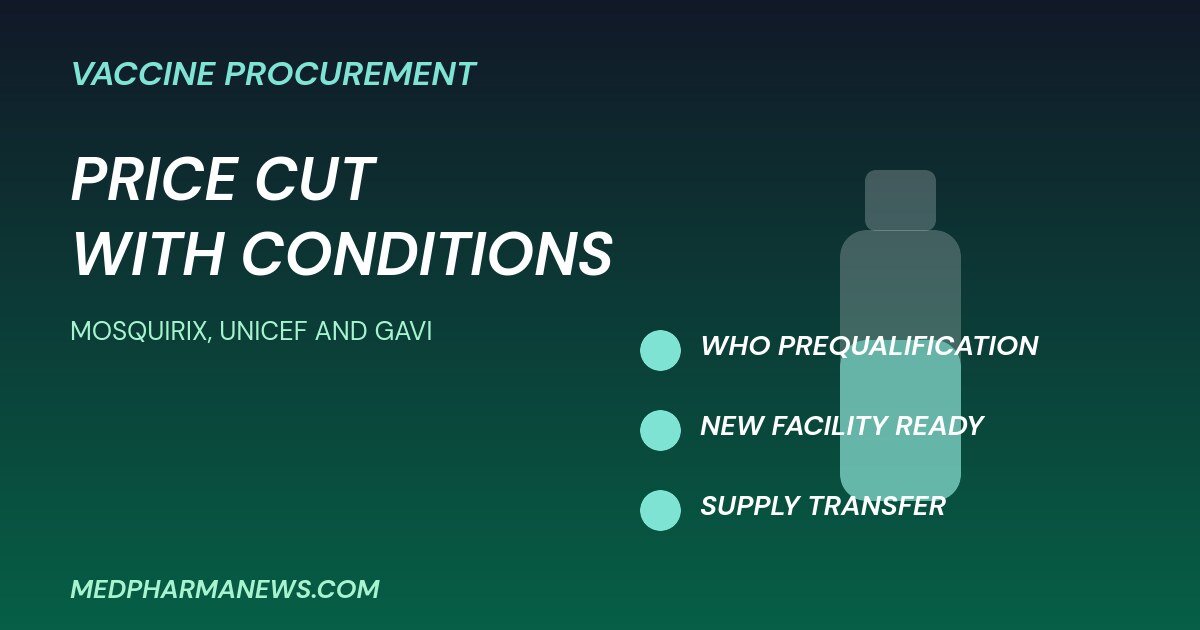
The Mosquirix malaria vaccine price cut is best understood as a procurement agreement with conditions: UNICEF and Gavi have agreed a price of €5.50 per dose, about 40% lower, but the price applies only after regulatory and manufacturing milestones are met. The agreement, reported on 22 October 2026, accompanies the transfer of production from GSK to India’s Bharat Biotech, and is expected to save about US$50 million between 2027 and 2029.
Key takeaways on the Mosquirix malaria vaccine price cut as a procurement deal
- Price: about 40% lower, at €5.50 per dose, according to the wire-service report.
- Savings: about US$50 million over 2027 to 2029, a projection that depends on order volumes.
- Timing: the lower price should take effect by early 2027, subject to milestones including WHO prequalification of a new manufacturing facility.
- Supply: Bharat Biotech takes over production from GSK, targeted for 2028, with GSK continuing to supply the adjuvant.
- Context: a 2025 plan by GSK and Bharat Biotech aimed for a price below US$5 per dose by 2028.
How the Mosquirix malaria vaccine price cut is structured
UNICEF buys vaccines for many countries, and Gavi finances them. They negotiated the new price with the manufacturer, and the report says the deal is conditional. UNICEF will begin buying at the lower price once regulatory and manufacturing milestones are met. The vaccine, RTS,S/AS01, was developed by GSK and the nonprofit PATH, and production is moving to Bharat Biotech under a technology transfer.
The report says GSK is expected to keep supplying the adjuvant after Bharat Biotech fully takes over production, which is targeted for 2028. Last year, according to the report, Gavi and UNICEF agreed a 25% price cut for a malaria vaccine made by the Serum Institute of India. We have not seen a side-by-side comparison of the two vaccines’ prices or schedules.
The numbers behind the Mosquirix malaria vaccine price cut
By our own arithmetic, a 40% reduction to €5.50 implies a prior price of about €9.20 per dose. The report as we read it does not state the earlier price, so that is an estimate. The US$50 million saving over three years equals about US$17 million a year on average, again by our arithmetic, but the actual saving depends on dose orders and on the price taking effect on schedule.
The dollar equivalent of €5.50 is about US$6 at recent exchange rates, which is our approximate conversion. For comparison, the 2025 plan was for a price below US$5 by 2028, and the report treats the new price as part of the path towards it. Our pharmaceuticals coverage tracks vaccine pricing news.
Questions procurement officials will ask about the Mosquirix malaria vaccine price cut
Buyers in a pooled procurement system tend to test a conditional deal against practical questions. The list below is our own, based on general procurement practice, and is not drawn from UNICEF or Gavi statements:
- What happens to the price if the milestones are late?
- Is there enough supply from the existing manufacturer to bridge the transition?
- Does the new site’s product match the original in quality and presentation?
- How does the new price compare with the other malaria vaccine already purchased?
- What volumes are assumed, and what happens if country demand differs?
The report answers few of these. It confirms that GSK is expected to keep supplying the adjuvant and that the price is conditional on milestones, but it gives no figures on supply during the transition, which is the point at which procurement risk is usually greatest.
General background: how a manufacturing transfer lowers cost behind the Mosquirix malaria vaccine price cut
Vaccine costs fall when production scales, when yields improve and when a manufacturer with lower unit costs takes over. Technology transfer is the step that moves the know-how from the originator to the new manufacturer. For regulatory purposes, the new site must demonstrate that its product is equivalent in quality, and for UN procurement it generally needs WHO prequalification, a process linked to the malaria programme described by the World Health Organization.
The risk is that each step takes time. Equipment must be validated, trial batches produced and data reviewed. The report names prequalification of a new facility as a milestone but does not give dates. Our reading is that the lower price is a contingent commitment and not a delivered saving.
Our analysis: what buyers gain from the Mosquirix malaria vaccine price cut
In our assessment, the Mosquirix malaria vaccine price cut illustrates how pooled buyers use volume and manufacturer transitions to lower prices. UNICEF and Gavi gain a lower unit cost and, over time, a second Indian source of malaria vaccine supply. The manufacturer gains a long-term contract. Neither benefit is guaranteed until the milestones are cleared.
There is also a concentration question. If both malaria vaccines in use are made in India, supply resilience depends on a small number of sites. The report gives no data on capacity, so we cannot assess that. We offer it as a point to watch, not a finding. Nothing here is investment advice.
What is not disclosed about the Mosquirix malaria vaccine price cut
- The earlier price and the exchange rate used.
- Dose volumes assumed in the US$50 million estimate.
- The date of WHO prequalification for the new site.
- Commercial terms between GSK, PATH and Bharat Biotech.
- Production capacity at the new facility.
Risks and caveats for the Mosquirix malaria vaccine price cut
The agreement is conditional, and milestones can slip. The report is a single wire account, and our conversions and estimates are approximate. The deal covers procurement by UNICEF for Gavi-supported programmes; it does not change prices in private markets or in countries outside that system. This article is news reporting and not medical or investment advice.
What to watch next after the Mosquirix malaria vaccine price cut
- Updates from Gavi and UNICEF on the start date of the lower price.
- WHO prequalification of the Bharat Biotech facility.
- Progress on production at Bharat Biotech towards 2028.
- Any updated price target below US$5 per dose.
FAQ
What does the Mosquirix malaria vaccine price cut cover?
It covers UNICEF purchases, financed by Gavi, at a price about 40% lower, at €5.50 per dose, once conditions are met.
When will savings begin?
The lower price should apply by early 2027, with savings of about US$50 million expected over 2027 to 2029.
Who will make the vaccine after the transfer?
Bharat Biotech, with GSK still supplying the adjuvant, targeted for 2028.
How we reported this: we relied on a wire-service report and attributed every figure to it. Conversions and estimates are labelled as ours. Last updated 23 October 2026. This is news reporting and not advice.