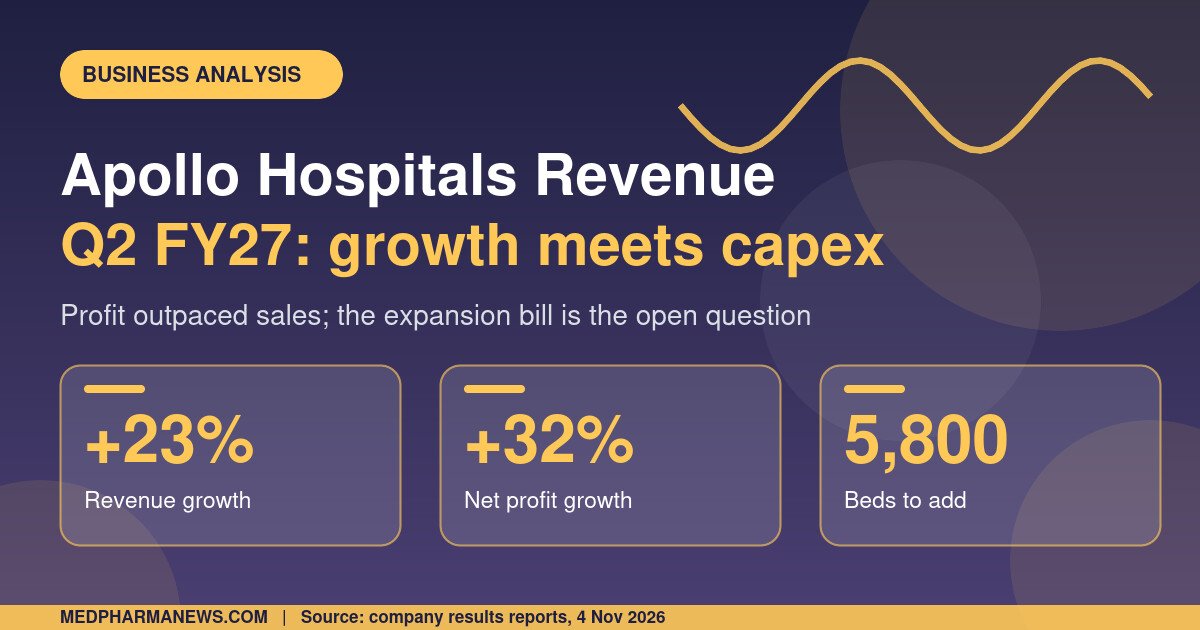
Apollo Hospitals revenue rose 23% to ₹7,615 crore in the quarter ended 30 September 2026, and net profit grew faster, up 32% to ₹630 crore, according to results reported on 4 November 2026. Occupancy climbed to 73% from 69%. The business question is whether that operating leverage can survive a five-year plan to add 5,800 beds, since new hospitals tend to dilute margins before they mature. This analysis covers the numbers, the caveats and what is not yet known.
Key takeaways on Apollo Hospitals revenue and profit
- Revenue from operations: ₹7,615 crore, up 23%.
- Net profit: ₹630 crore, up 32% in most reports; one report says ₹660 crore, up 33.6%.
- EBITDA up nearly 29% in one report; absolute value not given in the sources reviewed.
- Occupancy: 73% versus 69%.
- Expansion: 5,800 beds over five years, including a 470-bed Gurugram hospital due in Q3 FY27.
- Shares were reported to have closed 1.89% higher at ₹8,599.50 on 4 November; this is a market fact, not a recommendation.
Revenue and profit: operating leverage at work
Profit growth of 32% on revenue growth of 23% suggests that costs rose more slowly than sales. In hospitals, many costs are fixed in the short term, including buildings, equipment and core clinical teams, so higher occupancy lifts profit disproportionately. The EBITDA growth of nearly 29% reported by one source, below the profit growth rate, hints that factors below the EBITDA line may also have helped, such as depreciation, interest or tax, though the sources do not break this down.
| Measure | Q2 FY27 | Change |
|---|---|---|
| Revenue from operations | ₹7,615 crore | Up 23% |
| Net profit (most reports) | ₹630 crore | Up 32% |
| Net profit (one report) | ₹660 crore | Up 33.6% |
| EBITDA | Not given in rupees | Up nearly 29% (one report) |
| Occupancy | 73% | From 69% |
The two profit figures fit different prior-year bases (about ₹477 crore and ₹494 crore by our calculation), which suggests different profit definitions. The reports do not confirm this. The filing on the BSE website would settle it.
The growth drivers named
Press reports attribute growth to higher occupancy and a richer case mix, with healthcare services revenue up about 23%, helped by more international patients and demand in oncology and urology. The sources did not give revenue per occupied bed, a specialty split or the international share, so we cannot decompose growth into price, volume and mix.
The expansion bill and the margin question
Apollo plans to add 5,800 beds over five years to a base of roughly 10,000 beds in India, according to a press report. If added evenly, that would be about 1,160 beds a year, which is our simple arithmetic and not a company schedule. New hospitals typically post early losses, sometimes called gestational losses, until they build referral networks and occupancy. The investment amount was not disclosed in the sources we reviewed, so returns on the expansion cannot be estimated.
Portfolio and management changes
A press report said Apollo completed the sale of its stakes in Apollo Specialty Hospitals and Apollo Fertility Centre to Kids Clinic India Limited (Cloudnine) on 3 November 2026, and that Dr Madhu Sasidhar, President and CEO of its Hospitals Division, steps down effective 14 November 2026. We have not checked these against company filings. A leadership change in the core division during an expansion phase is something analysts typically watch, though the sources do not discuss succession.
Competitive context
A press analysis named Manipal Health Enterprises and Fortis Healthcare as competitors. High fixed costs mean that occupancy swings drive profits across the sector, and an industry building capacity at the same time can face temporary pressure on utilisation. The sources provide no peer data, so we do not compare Apollo’s figures with those of rivals.
Timeline
- 30 September 2026: quarter ends.
- 3 November 2026: divestment completed, per a press report.
- 4 November 2026: results published; shares up 1.89% on the day.
- 14 November 2026: Hospitals Division CEO due to step down.
- Q3 FY27: 470-bed Gurugram hospital scheduled to open.
Market context: medical tourism
Acumen Research And Consulting has no report on Indian hospital operators, so we cite its Medical Tourism Market report as adjacent. It values the global market at USD 11,395 million in 2021 and projects USD 88,595 million by 2030, a compound annual growth rate of 27.4% for 2022 to 2030. Asia-Pacific is described as dominant and cancer treatment as the largest segment in 2021.
The page was last updated in August 2022 and its stated growth rate does not reconcile with its endpoints, which imply about 25.6% a year (our calculation). India has no stated share. We regard the projection as aggressive, dated and not specific to Apollo, and use it only to show that international patients are a recognised growth theme.
Our analysis
In our assessment, the quarter demonstrates the core appeal of the hospital model, in which higher utilisation of existing assets lifts profit faster than revenue. The challenge is that Apollo is also building a large amount of new capacity, which will lower utilisation at the group level until the new hospitals mature. The numbers we have do not tell us how deep or long that dilution could be. We make no forecast of earnings or share price.
What is not disclosed
- Investment required for the 5,800-bed plan.
- Revenue per occupied bed, specialty mix and international share.
- EBITDA margin in the sources reviewed.
- Succession plan for the Hospitals Division.
Risks and caveats
- New hospitals can post losses before reaching target occupancy.
- Regulatory changes in tariffs or pharmacy margins could affect profitability.
- Several facts come from press reports, not the filing.
- This article is not investment advice.
What to watch next
- Earnings call commentary on margins and expansion capex.
- Occupancy at new hospitals.
- Appointment of a new Hospitals Division head.
- Regulatory changes affecting procedures or drug margins.
General background
Company information is at Apollo Hospitals. See also our report on India cancer medicine price revisions and the industry insights section.
Questions readers are asking about Apollo Hospitals revenue
How much did Apollo’s revenue grow?
23% to ₹7,615 crore in the quarter ended 30 September 2026.
Why did profit grow faster than revenue?
Higher occupancy spreads fixed costs, though the sources do not give a full cost breakdown.
What are the main risks?
Early losses at new hospitals and regulatory changes affecting tariffs or pharmacy margins.
FAQ
What is FY27?
The financial year April 2026 to March 2027.
Did Apollo disclose capex?
Not in the sources we reviewed.
Is the divestment confirmed?
A press report says it was completed on 3 November 2026; we have not checked the filing.
How we reported this: details come from press reports of Apollo Hospitals’ Q2 FY27 results published on 4 November 2026; we did not review the filing. Market figures are attributed to Acumen Research And Consulting. Last updated 4 November 2026. This is news reporting and not investment advice.