Early cancer detection is one of the most closely watched areas in diagnostics, and on 4 November 2026 it gained a large public test case: the University of Birmingham announced STRIDE-RCT, a trial of multi-cancer blood tests at 200 or more GP practices in England, backed by up to £8.49 million from the Office for Life Sciences through NIHR. For the diagnostics industry, the announcement is a signal of how health systems want evidence generated, not a sign that any product has been proven or bought.
Key takeaways on early cancer detection and the NHS trial
- STRIDE-RCT plans to recruit more than 20,000 patients aged 45 and over with abdominal symptoms.
- The test and its developer are not named in the announcement, so no company can be linked to the trial from this source.
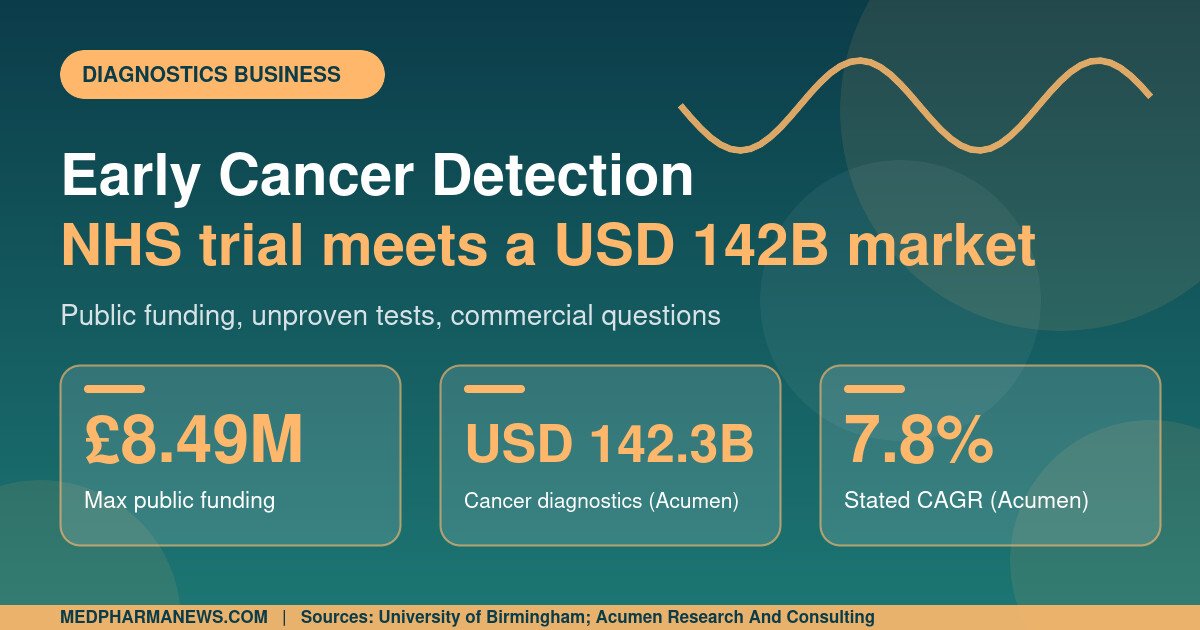
- Funding is public: up to £8.49 million through the Office for Life Sciences and NIHR.
- The trial will inform whether the NHS uses the tests more widely; no procurement decision has been announced.
- Effectiveness has not been proven.
Why a public trial matters commercially
A diagnostic test usually needs three things to reach routine use: evidence of accuracy, evidence that it changes care for the better, and a payer willing to cover it. A randomised trial in the health system where the test would be deployed addresses the second and informs the third. By funding the study, the NHS and the government are, in effect, building the evidence base before committing to purchase. That lowers the risk for the health service and raises the bar for developers.
The announcement does not say who supplies the tests, how they are priced or whether participating practices bear any cost. We therefore make no statement about revenue or contracts.
The trial at a glance
| Item | Detail |
|---|---|
| Sponsor and lead | University of Birmingham |
| Funding | Up to £8.49 million (Office for Life Sciences via NIHR) |
| Practices | At least 200 in England |
| Patients | More than 20,000 aged 45 and over with abdominal symptoms |
| Cancers | Thirteen, including bowel, pancreatic, ovarian, kidney, bladder, prostate |
| Start, end and results dates | Not stated |
The disease burden behind the interest
The announcement cites about 71,000 people diagnosed each year in England with pancreatic, stomach, liver, ovarian or bowel cancer, and almost 35,000 deaths a year from them. Cancers that cause vague abdominal symptoms are hard to diagnose early, which is why a test that could help GPs decide whom to refer has obvious appeal to health systems. The same burden is what gives developers a commercial reason to invest, although the announcement offers no estimate of how many tests might be used if the approach were adopted.
How the diagnostics industry may read it
These are our framing of questions analysts and developers typically ask; the announcement does not address them. If the tests prove accurate, who pays: the NHS, private insurers or patients? How would a test be integrated into GP workflows and laboratories? Would regulators require separate evidence for each test or cancer? Will developers need local clinical data, as STRIDE-RCT is generating, to enter other national markets? These questions determine whether clinical promise turns into a commercial product.
Three outcomes to watch (our framing)
- Positive and actionable: the tests improve referral decisions and the NHS moves to evaluate adoption, which would open a route for approved suppliers.
- Mixed: performance is useful for some cancers but not others, leading to narrower use or further trials.
- Negative: accuracy or downstream harms do not justify use, which would be a setback for the approach but still valuable information for the health system.
The announcement gives no indication which is likely, and we make no prediction.
Timeline
- 4 November 2026: STRIDE-RCT announced as being launched.
- Recruitment and reporting dates: not disclosed.
- After results: a decision on nationwide use.
Market context: cancer diagnostics
According to Acumen Research And Consulting, the global cancer diagnostics market was valued at USD 142.3 billion and is projected to reach USD 276.2 billion by 2032, a compound annual growth rate of 7.8% for 2024 to 2032. North America held 41% and Asia-Pacific is projected to grow at 8.5% a year; in vitro diagnostics is described as the largest type segment.
The page gives the base year as 2022 in some places and 2023 in others, and the stated growth rate does not reconcile with the endpoints, which imply roughly 6.9% to 7.6% a year depending on the base year (our calculation). The report is broad and does not isolate multi-cancer blood tests. If these projections held, the market would roughly double in a decade, which we regard as a publisher’s scenario and not a forecast we endorse.
Our analysis
In our assessment, STRIDE-RCT is best seen as market infrastructure: it builds the evidence a health system would need before paying for a multi-cancer test. Developers with promising tests may welcome that clarity, while those without strong clinical data may find the bar higher. The commercial prize, if the tests work, is large, but the announcement gives no basis for sizing it, and we make no forecast for any company.
What is not disclosed
- The test supplier and technology.
- Pricing, contracts or procurement plans.
- Primary outcomes and success criteria.
- Start and end dates.
Risks and caveats
- The tests are unproven and under evaluation.
- Public funding for a trial is not a commitment to buy.
- Market figures are adjacent and inconsistent.
- This article is not investment or medical advice.
What to watch next
- Identification of the test supplier.
- Recruitment milestones.
- Publication of outcomes.
- NHS commissioning signals after results.
General background
The original announcement is at the University of Birmingham, with funder information at NIHR and NHS England. See also our analysis of the UK GP website outage and the industry insights section.
Questions readers are asking about early cancer detection
Which company makes the test?
The announcement does not name it.
Will the NHS buy the tests?
No decision has been announced; the trial will inform it.
Is the test proven?
No. Evaluation is the point of the trial.
FAQ
How much is the funding?
Up to £8.49 million.
Who is funding it?
The Office for Life Sciences, through NIHR.
How many practices?
At least 200.
How we reported this: details come from the University of Birmingham announcement of 4 November 2026; market figures are attributed to Acumen Research And Consulting. Last updated 4 November 2026. This is news reporting and not investment or medical advice.