Novo Nordisk’s World Diabetes Foundation commitment, announced on November 11, 2026 from Bagsværd, Denmark, puts US$200 million behind diabetes prevention and care in low- and middle-income countries over ten years, from 2027 through 2036. The pledge landed three days before World Diabetes Day on November 14 and gives the foundation something it rarely has: a decade of funding it can plan against.
The number is modest next to Novo’s revenue, but the timing and structure say a lot about where the diabetes market is heading. Below we break down what the money covers, what the foundation has delivered before, and how the pledge fits a year in which generic semaglutide started reaching emerging markets.
Key takeaways on the Novo Nordisk World Diabetes Foundation pledge
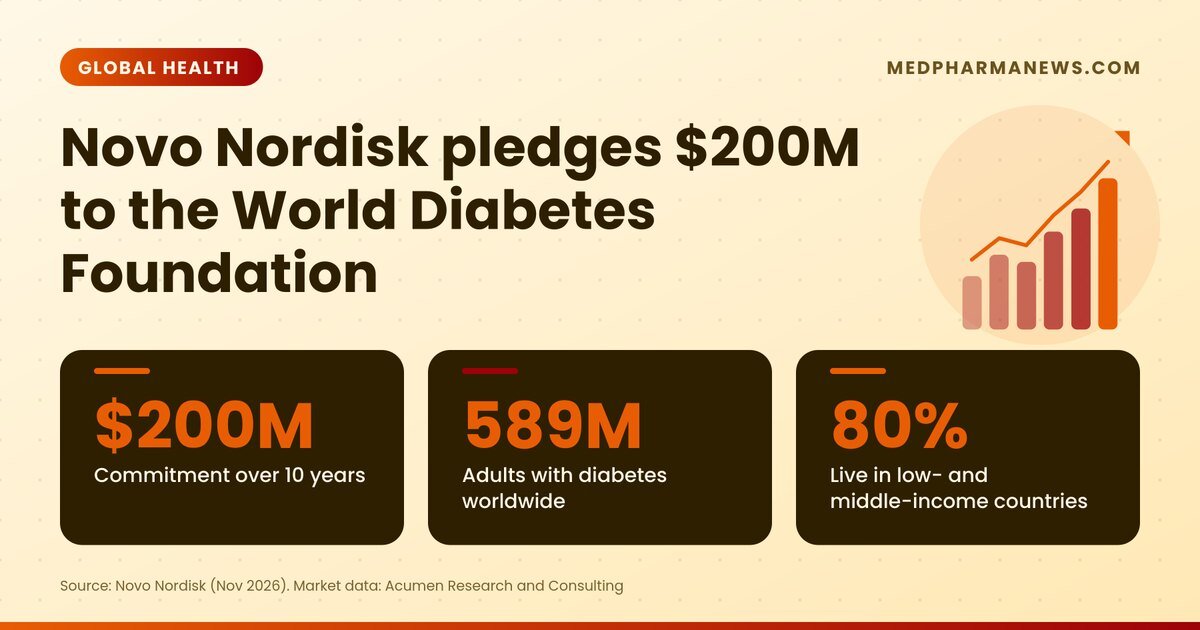
- Novo Nordisk will give the World Diabetes Foundation (WDF) US$200 million over 2027 to 2036, roughly $20 million a year by our calculation.
- The focus is prevention and care in low- and middle-income countries, with an emphasis on fair access for underserved communities.
- About 589 million adults live with diabetes worldwide, and around 80% of adults aged 20 to 79 with the disease live in low- and middle-income countries.
- WDF points to Tanzania and Jordan as proof that long-term funding can turn pilot clinics into national programs.
The pledge in numbers
| Metric | Figure | Note |
|---|---|---|
| Total commitment | US$200 million | Novo Nordisk release, 11 Nov 2026 |
| Period | 2027 to 2036 | Ten years |
| Average per year | About $20 million | By our calculation |
| Adults with diabetes worldwide | About 589 million | Cited in the release |
| Share in low- and middle-income countries | About 80% | Adults aged 20 to 79 |
| Implied adults with diabetes in LMICs | About 470 million | By our calculation (589m x 80%) |
| Funding per affected adult in LMICs per year | Roughly 4 US cents | By our calculation; shows the money is catalytic, not a care budget |
That last row is the point worth absorbing. Spread across hundreds of millions of people, $20 million a year cannot pay for care directly. The foundation’s model is to fund health-system building blocks such as trained staff, treatment guidelines, referral pathways and screening, then hand programs to governments.
What the foundation has delivered before
The Novo Nordisk announcement leans on two case studies. In Tanzania, more than two decades of partnership helped a small diabetes clinic grow into a government-owned nationwide noncommunicable disease program, with thousands of health workers trained and treatment and referral guidelines built into the public system. In Jordan, a five-year program strengthened more than 190 health facilities, trained more than 2,000 providers and improved care for more than 192,000 people, including refugees and host communities.
Elin Jäger, Novo Nordisk senior vice president and chief of staff to the CEO, framed the decade-long horizon simply: “Lasting improvements in health don’t happen overnight.” WDF, which marks 25 years of work, said multi-year certainty lets it scale regional and global responses rather than renewing projects one grant at a time.
Why Asia is the center of gravity
The release does not single out countries for the new money, but the epidemiology is clear. India and China together account for well over 200 million adults with diabetes, according to the International Diabetes Federation, and both are classed as middle-income economies. Any program aimed at the 80% of patients outside rich countries will inevitably run through South and East Asia as well as sub-Saharan Africa, where diagnosis rates are lowest.
Market context: the diabetes care opportunity
The commercial backdrop helps explain why a drugmaker invests in health-system capacity. According to Acumen Research and Consulting, the global diabetes management market was valued at USD 19.4 billion in 2023 and is projected to reach USD 37.8 billion by 2032, growing at a 7.9% compound annual rate. Acumen identifies North America as the largest region and Asia-Pacific as the fastest growing, the same region where most undiagnosed and untreated patients live.
Our analysis: philanthropy in a year of generic competition
Novo has funded WDF for a quarter century, so this is continuity rather than a new strategy. Still, 2026 changed the landscape. Semaglutide exclusivity began to lapse in several large emerging markets, and generic versions are winning approvals, as seen in the wider obesity-drug funding race and in Aspen’s approvals in Brazil and South Africa. Rivals, including Lilly, are moving fast in China.
In that market, strong primary care systems that screen, diagnose and keep patients on treatment benefit every supplier, branded or generic. A long-dated pledge to build that capacity supports Novo’s public-health positioning while the competitive edge shifts from patents to presence, supply and trust. That is our reading; the company frames the commitment purely around access and equity.
What remains unclear
- Which countries and programs will receive the first tranches from 2027.
- Whether funding is evenly spread across the decade or front-loaded.
- How progress will be measured and reported, for example people screened, facilities upgraded or blood sugar control achieved.
For more industry analysis, see our Industry Insights coverage and our report on the FDA’s shelved national priority voucher pilot.
FAQ
How much is Novo Nordisk giving the World Diabetes Foundation?
US$200 million over ten years, from 2027 to 2036, announced on November 11, 2026.
What does the World Diabetes Foundation do?
It funds diabetes and noncommunicable disease prevention and care programs in low- and middle-income countries, such as training health workers, building treatment guidelines and strengthening clinics.
How many people have diabetes worldwide?
About 589 million adults, with around 80% of adults aged 20 to 79 with diabetes living in low- and middle-income countries.
When is World Diabetes Day?
World Diabetes Day is marked every year on November 14.
Sources: Novo Nordisk company announcement (November 11, 2026); Reuters; International Diabetes Federation. Market data: Acumen Research and Consulting, Diabetes Management Market report. Analysis sections reflect MedPharmaNews’ interpretation. Not medical or investment advice. Last updated November 13, 2026.