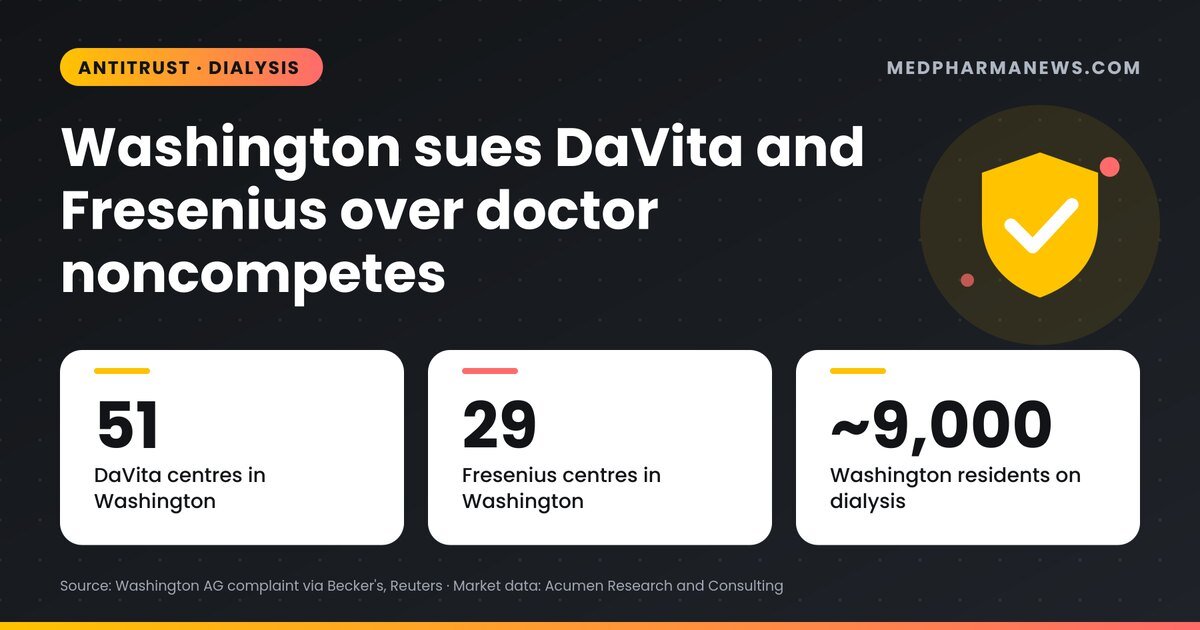
The DaVita Fresenius lawsuit filed by Washington Attorney General Nick Brown on 10 November 2026 accuses the state’s two largest dialysis chains of using illegal noncompete agreements with the nephrologists who serve as their clinic medical directors, locking in local monopolies. The case, brought in Thurston County Superior Court, covers a network of about 80 dialysis centres that treat many of the roughly 9,000 Washington residents who depend on dialysis.
Key takeaways on the DaVita Fresenius lawsuit
- Washington says DaVita and Fresenius Medical Care require part-time medical directors to sign noncompetes that bar them from working with nearby rivals and can restrict home dialysis work.
- The state argues the restrictions can reach whole physician practices, not just individual doctors, making it harder for new clinics to recruit the medical director every US dialysis facility must have.
- The complaint relies on Washington’s 2019 Noncompetition Covenants Act and consumer-protection law, and asks the court to void the agreements and impose penalties per violation.
- DaVita calls the state’s account “fundamentally distorted” and says it is in talks with the Federal Trade Commission. Fresenius says its contracting complies with the law.
- The case lands while an FTC inquiry into dialysis noncompetes, opened in 2024, remains unresolved.
The case at a glance
| Item | Detail |
|---|---|
| Plaintiff | State of Washington, Attorney General Nick Brown |
| Defendants | DaVita Inc. and Fresenius Medical Care |
| Court | Thurston County Superior Court |
| Filed | 10 November 2026 |
| DaVita centres in Washington | 51 |
| Fresenius centres in Washington | 29 |
| Combined centres | 80 (by our calculation) |
| Washington residents on dialysis | About 9,000 |
| Relief sought | Void the noncompetes; civil penalties per violation |
Why medical directors are the pressure point
Federal Medicare rules require every certified dialysis facility to have a physician medical director, usually a nephrologist. That makes local kidney specialists a bottleneck: a would-be competitor cannot open a clinic without one. If the established chains tie up the nephrologists in a market, rivals struggle to enter, even when patients want closer or different options.
Washington’s noncompete law voids such clauses for workers and independent contractors earning below set thresholds. According to The Seattle Times, the medical directors in question earn far below the 2026 contractor threshold of just over $317,000 from these roles, which is why the state says the clauses are unenforceable. The state also points to counties, including Clark, Lewis, Spokane and Thurston, where DaVita or Fresenius is the only in-centre dialysis provider.
How the companies respond
Both providers reject the claims. DaVita says the arrangements with independent physician practices are long-standing, that the state’s description is distorted, and that it will vigorously defend them while it continues discussions with the FTC. Fresenius told Becker’s it has long-standing partnerships with physicians and that its contracting with medical directors complies with the law. Neither company has said whether it will revise the agreements while the case proceeds.
What it could mean for patients and the industry
Dialysis patients usually need treatment three times a week for several hours, so travel distance and clinic choice matter in daily life. If the court voids the clauses, nephrologists would be free to support new or smaller providers, including home dialysis programmes, which could widen options in areas served by a single chain. For DaVita and Fresenius, which together dominate US dialysis, the larger risk is precedent: a win for Washington could encourage other states, and the FTC, to challenge similar contracts elsewhere.
The timing also matters. Washington has passed a broader ban on noncompete agreements that takes effect on 30 June 2027, according to Becker’s. The lawsuit targets conduct under existing law, and any penalties would apply to past violations, so the outcome could still carry a cost even after the new ban arrives. Antitrust scrutiny is rising across healthcare services; see our coverage of the widening FTC case against Hims & Hers and of lab consolidation at Labcorp.
Market context
The fight is over a large and steadily growing business. Acumen Research and Consulting’s dialysis market report values the global dialysis market at USD 107.3 billion in 2024 and projects USD 184.4 billion by 2033, a CAGR of 6.3%, with North America the largest region and haemodialysis the biggest segment. The same report cites National Kidney Foundation estimates that about 37 million US adults have chronic kidney disease, around 15% of adults, most of whom do not know it. That demand base is why access to local nephrologists, and the contracts around them, carries real commercial weight.
What we do not know yet
- How many individual agreements are covered, and the size of penalties the state is seeking in dollars.
- Whether the FTC will act on its 2024 investigation, and whether DaVita’s talks with the agency produce changes to its contracts nationwide.
- How quickly the court will rule, and whether the companies will seek to settle by dropping the clauses.
Follow more analysis in our Industry Insights section.
FAQ
Why is Washington suing DaVita and Fresenius?
The state says both companies make their clinic medical directors sign noncompete agreements that are illegal under Washington law and that help them keep monopolies on dialysis care in parts of the state.
Will dialysis patients lose access to care because of the lawsuit?
No change to patient care has been announced. The case concerns contracts with physicians. Patients should continue their scheduled treatment and speak to their care team about any concerns.
How many dialysis centres do DaVita and Fresenius run in Washington?
DaVita operates 51 and Fresenius operates 29, for a combined 80 centres, according to reporting on the complaint.
When does Washington’s full noncompete ban start?
The broader ban on noncompete agreements takes effect on 30 June 2027.
Sources: Becker’s; Cascadia Daily News; Reuters and The Seattle Times reporting (10-11 Nov 2026). Market data: Acumen Research and Consulting. Not legal or investment advice. Last updated 12 November 2026.