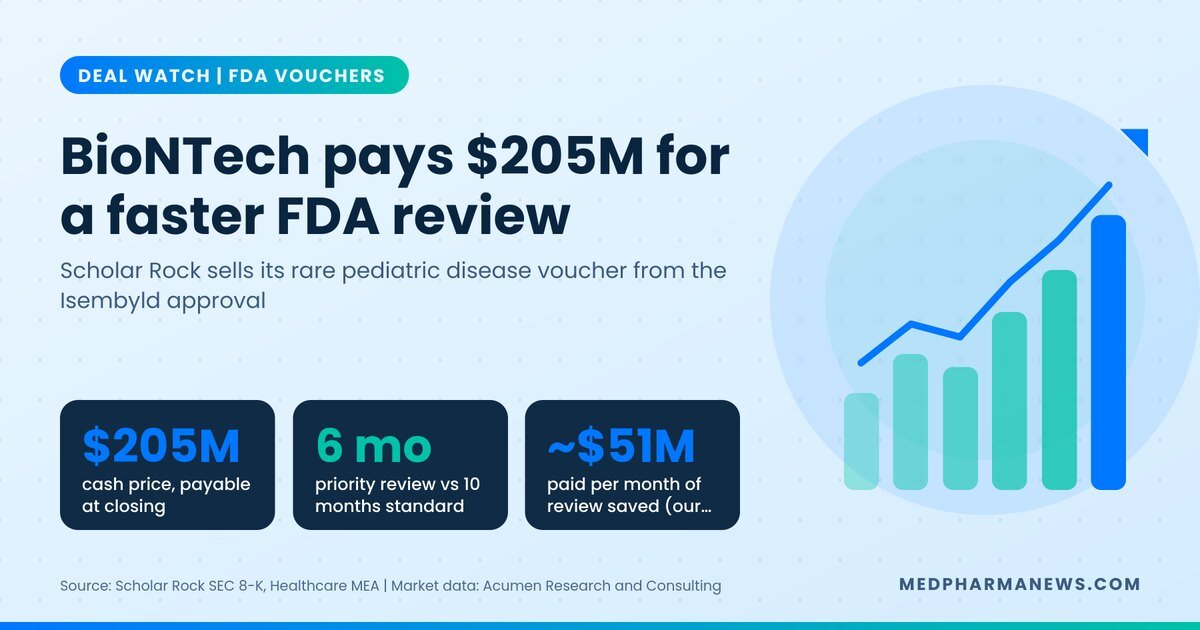
BioNTech priority review voucher deal: the German drugmaker has agreed to pay Scholar Rock $205 million in cash for an FDA Rare Pediatric Disease Priority Review Voucher, according to an agreement signed on November 9, 2026 and disclosed in Scholar Rock’s 8-K filing on November 10. The voucher can cut the FDA’s review of one future BioNTech application from the standard 10 months to six, and the price sits at the top of what these tradable vouchers have fetched.
BioNTech has not said which drug it will use the voucher on. But the purchase arrives at a telling moment: days after reports that the FDA has shelved its separate Commissioner’s National Priority Voucher pilot, and as BioNTech pivots its strategy toward oncology. Here is what the deal tells investors and the wider industry.
Key takeaways on the BioNTech priority review voucher
- Price: $205 million, payable in cash when the sale closes.
- Seller: Scholar Rock, which received the voucher on September 11, 2026 when the FDA approved Isembyld (apitegromab-mstn) for spinal muscular atrophy.
- Closing depends on customary conditions, including expiry of the Hart-Scott-Rodino antitrust waiting period.
- The voucher shortens FDA review of one application by about four months.
- BioNTech has not named the target drug; analysts point to pumitamig, its PD-L1xVEGF bispecific antibody partnered with Bristol Myers Squibb.
How priority review vouchers work
Congress created the Rare Pediatric Disease Priority Review Voucher program to reward companies that win approval for drugs treating serious rare diseases in children. Each qualifying approval earns a voucher that the holder can redeem for priority review of any later application, in any disease, or sell to another company. Because the review clock drops from roughly 10 months to six, large companies with big commercial launches ahead are willing to pay heavily for that time.
For small and mid-sized biotechs like Scholar Rock, selling the voucher is non-dilutive cash: money raised without issuing new shares. Scholar Rock is in the early commercial phase for Isembyld, its muscle-targeted therapy for spinal muscular atrophy, so $205 million is a meaningful boost to its balance sheet.
Voucher prices are climbing
Vouchers are scarce, and demand from large drugmakers has stayed strong. The table below shows recently reported sale prices.
| Seller | Reported price | Timing |
|---|---|---|
| Typical 2025 sales | $150M to $160M | 2025 |
| Edetis Therapeutics | $190M | Reported 2026 |
| Jazz Pharmaceuticals | $200M | January 2026 |
| Ultragenyx (two vouchers) | $203M and $210M | Reported 2026 |
| Scholar Rock (to BioNTech) | $205M | November 2026 |
By our calculation, BioNTech’s price is roughly 28% to 37% above the typical 2025 range. Put another way, at about four months of review time saved, BioNTech is paying around $51 million per month of earlier FDA action. For a cancer drug that could earn billions a year, a few extra months of sales can justify that cost, which explains why buyers keep paying more.
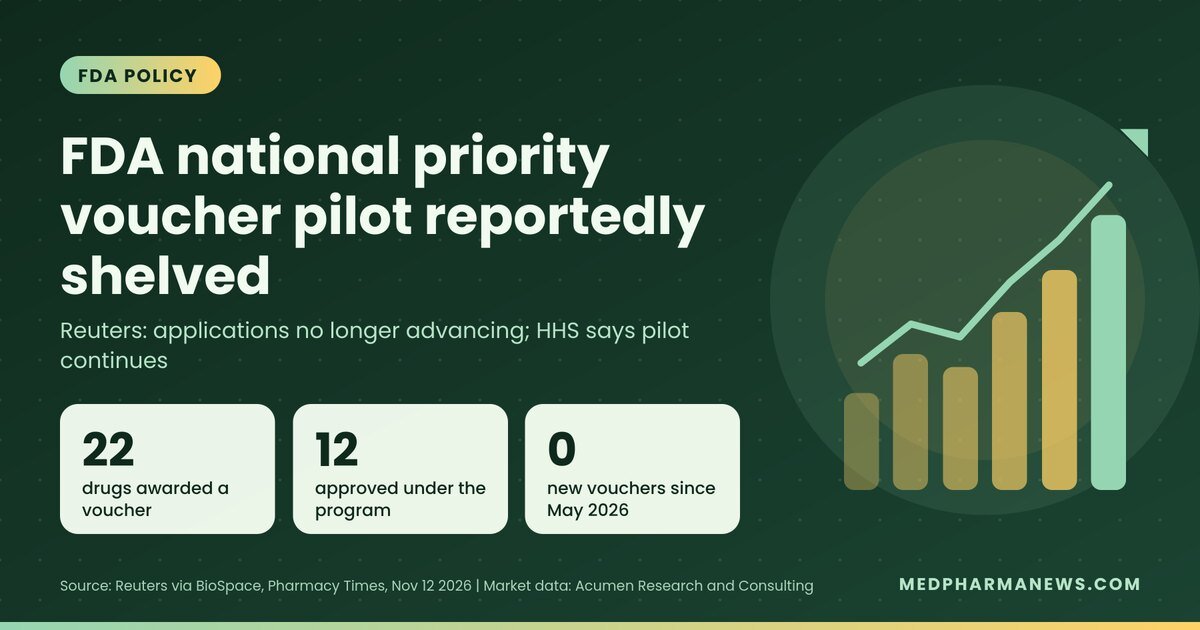
Supply is part of the story. Congress extended the rare pediatric disease voucher program through September 30, 2029, but only a handful of vouchers are issued each year. And the other fast lane that drugmakers had begun to use, the Commissioner’s National Priority Voucher pilot, has reportedly been shelved, as we covered in FDA National Priority Voucher Pilot Shelved: What Happens to 22 Drugs. We have not seen evidence that BioNTech’s timing was linked to that report, but fewer alternative routes to a faster review can only support demand for the vouchers that remain.
Where BioNTech could use it
BioNTech has been reshaping itself from a COVID-19 vaccine company into an oncology business. Its most advanced candidates include pumitamig (BNT327), a bispecific antibody that blocks PD-L1 and VEGF and is co-developed with Bristol Myers Squibb, the antibody-drug conjugate trastuzumab pamirtecan, and gotistobart. Industry commentary, including from Healthcare MEA, views pumitamig as the most likely beneficiary, arguing the other assets would not obviously justify a purchase of this size on their own. That remains analysis, not a company statement.
Speed matters in the PD-1 or PD-L1 plus VEGF class because several rivals are racing to market, including Summit Therapeutics and Akeso’s ivonescimab. Being first, or close to first, with a US approval in a major tumor type can shape prescribing habits for years. A voucher does not improve the data, though: it only accelerates a decision on a filing that must still convince regulators. BioNTech’s cancer vaccine work has had setbacks this year, as covered in mRNA Cancer Immunotherapy Setback: BNT113 Misses Endpoint.
Market context
Bispecific antibodies are one of oncology’s most crowded growth areas. Acumen Research and Consulting estimated the global bispecific antibodies market at USD 554 million in 2022, projecting USD 1,084 million by 2032, a 7.1% compound annual growth rate, with North America the largest region and Asia-Pacific the fastest growing. That report was last updated in 2023, before the PD-1/VEGF bispecific wave gathered pace, so its figures are best read as a conservative baseline.
What to watch
- Closing of the deal after the antitrust waiting period, and when Scholar Rock books the cash.
- BioNTech’s guidance on which Biologics License Application will carry the voucher and when it will be filed.
- Further voucher sales, which would show whether $200 million-plus is the new normal.
- Any formal FDA statement on the future of the national priority voucher pilot.
More analysis is available in our industry insights section.
FAQ
How much did BioNTech pay for the priority review voucher?
BioNTech agreed to pay Scholar Rock $205 million in cash, due when the sale closes.
What is an FDA priority review voucher?
It is a transferable award that entitles the holder to a six-month FDA review of one future drug application instead of the standard 10 months. Rare pediatric disease vouchers are earned by approvals for qualifying rare childhood diseases and can be sold.
Which drug will BioNTech use the voucher for?
BioNTech has not disclosed it. Analysts consider pumitamig, its PD-L1xVEGF bispecific antibody partnered with Bristol Myers Squibb, the most likely candidate.
Why did Scholar Rock have a voucher?
The FDA granted it on September 11, 2026 alongside approval of Isembyld (apitegromab-mstn) for spinal muscular atrophy, a rare disease that affects children.
Sources: Scholar Rock Form 8-K, November 10, 2026; Healthcare MEA. Market data: Acumen Research and Consulting. This article is for information only and is not investment advice. Last updated November 13, 2026.