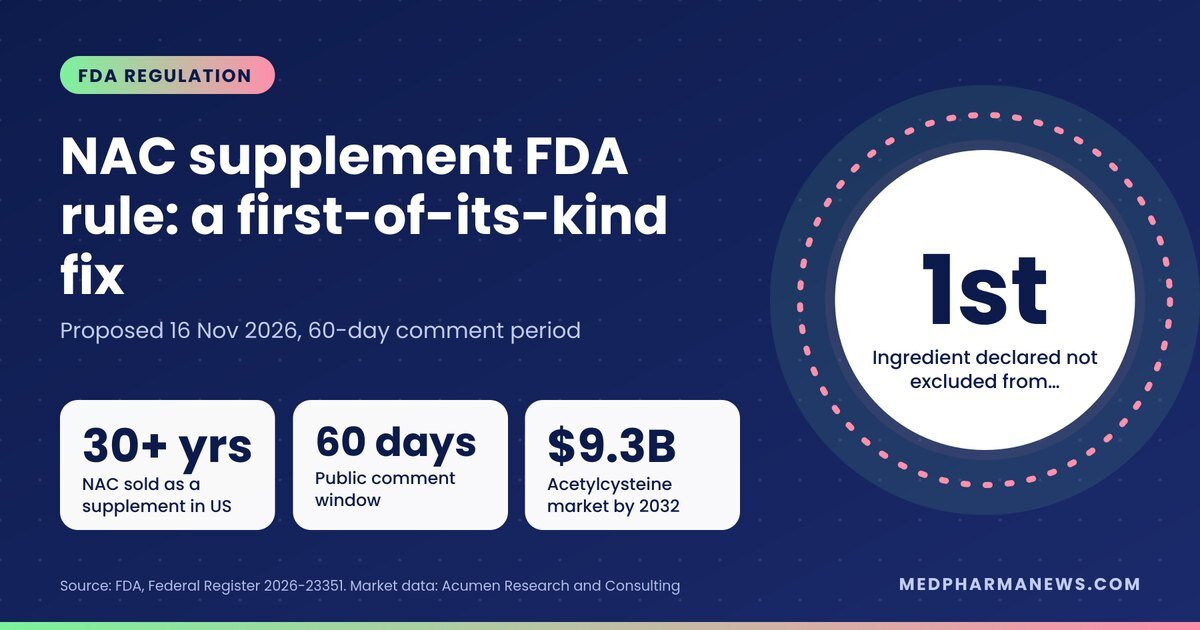
The US Food and Drug Administration has proposed an NAC supplement FDA rule that would formally allow N-acetyl-L-cysteine to be sold as a dietary supplement, ending a regulatory standoff that began in 2020. Issued on 16 November 2026 and published in the Federal Register on 17 November (document 2026-23351), the proposal is the first time FDA has used its power to declare that an ingredient is not excluded from the supplement definition. Comments are open for 60 days.
Key takeaways on the NAC supplement FDA rule
- FDA wants to create a new regulation, “Dietary Ingredients Not Excluded from the Dietary Supplement Definition,” with NAC as its first entry.
- The legal tool is section 201(ff)(3)(B) of the Federal Food, Drug, and Cosmetic Act, which FDA has never used before for this purpose.
- FDA says a comprehensive review found no safety concerns with NAC in or as a supplement, and that NAC products have been sold as supplements in the US for more than 30 years.
- Until a final rule takes effect, NAC supplements stay on shelves under FDA’s 2022 enforcement discretion policy.
- By our calculation, the 60-day comment window closes around 16 January 2027; check the Federal Register docket for the exact date.
How NAC ended up in legal limbo
The problem is a provision often called drug preclusion. Under US law, an ingredient first approved as a drug, or first studied as one in substantial clinical investigations, generally cannot later be sold as a supplement unless it was marketed as a food or supplement first. NAC was approved as a prescription drug long before supplement makers adopted it: as an inhaled mucus-thinning agent in 1963 and as an antidote for acetaminophen (paracetamol) overdose in 1985.
For decades that conflict was ignored. Then, beginning in 2020, FDA took the position that NAC could not lawfully be a supplement, which led some major retailers to pull products. The fight that followed is summarised below.
| Date | Milestone |
|---|---|
| 1963 | NAC approved as a drug to break up mucus in lung conditions |
| 1985 | NAC approved to treat acetaminophen overdose |
| March 2022 | FDA denies citizen petitions from CRN and NPA, saying NAC products cannot be supplements |
| August 2022 | FDA final guidance sets temporary enforcement discretion for certain NAC supplements |
| May 2023 | CRN files a new petition on drug preclusion |
| September 2025 | FDA denies the CRN petition |
| 16-17 Nov 2026 | FDA proposes rule declaring NAC not excluded from the supplement definition |
What the rule would and would not do
If finalised, NAC products could be lawfully marketed as dietary supplements, provided they do not break other parts of the FD&C Act. That caveat matters. The rule does not approve any health claim, does not set a dose, and does not exempt products from rules on labelling, manufacturing quality or disease claims. A supplement still cannot say it treats, cures or prevents a disease.
The proposal also does not change NAC’s status as a prescription drug. Hospital use for acetaminophen poisoning and respiratory indications continues under drug approvals. FDA has said it will publish its full safety review alongside the rulemaking and has framed the step as deregulatory under Executive Order 14192.
Why the industry cares beyond NAC
Trade groups see the precedent as bigger than one ingredient. The Natural Products Association, whose petition helped start the process, welcomed it; its chief, Daniel Fabricant, told NutraIngredients the law “works and works well.” The Council for Responsible Nutrition backed the proposal but said companies still lack a clear route for other ingredients facing the same exclusion, and plans to ask how FDA weighs confidential investigational drug filing dates. The American Herbal Products Association called the preclusion provision imbalanced and says legislative reform, including the proposed Dietary Supplement Innovation Act, will be a 2027 priority.
One related signal: an FDA spokesperson told the same outlet that beta-nicotinamide mononucleotide (NMN), another popular longevity ingredient, is not excluded from the supplement definition. That is a notable shift for a compound that has faced its own preclusion questions. It also contrasts with regulators elsewhere; India’s Maharashtra FDA recently seized NMN products it said lacked approval. The agency’s tougher posture on other parts of the supply chain, such as its warning letters to Chinese compounding API makers, shows it is not loosening oversight across the board.
Market context
NAC sits where two markets overlap. According to Acumen Research and Consulting’s acetylcysteine market report, the global acetylcysteine market was valued at USD 1.4 billion in 2022 and is projected to reach USD 9.3 billion by 2032, a CAGR of 21.1%, with pharmaceutical applications holding the largest share and North America the leading region. The wider dietary supplements market was valued at USD 172.5 billion in 2023 and is forecast to reach USD 354.3 billion by 2032, growing at 8.4% a year, per Acumen. Legal certainty for NAC removes a retail risk that has hung over the supplement side of that demand since 2020.
What consumers should keep in mind
Nothing changes on store shelves today. NAC supplements remain available under enforcement discretion. Because supplements are not reviewed for effectiveness before sale, quality varies between brands. People taking prescription medicines, those who are pregnant, and anyone with a chronic condition should check with a doctor or pharmacist before adding any supplement. This article does not offer dosing guidance.
FAQ
Is NAC legal as a supplement in the US?
It is sold under FDA enforcement discretion today. The proposed rule would make supplement status formally lawful once a final rule takes effect.
Why did FDA say NAC could not be a supplement?
Because NAC was approved as a drug in 1963 before it was marketed as a supplement, triggering the drug preclusion clause in the FD&C Act.
How can I comment on the NAC proposed rule?
Through Regulations.gov using the docket listed in Federal Register document 2026-23351, within 60 days of the 17 November 2026 publication.
Does the rule affect NMN?
The rule covers NAC only. Separately, an FDA spokesperson has said NMN is not excluded from the supplement definition.
More regulatory coverage in our Pharmaceuticals section.
Sources: FDA constituent update (16 Nov 2026); Federal Register 2026-23351; NutraIngredients; STAT. Market data: Acumen Research and Consulting. Not medical, legal or investment advice. Last updated 19 November 2026.