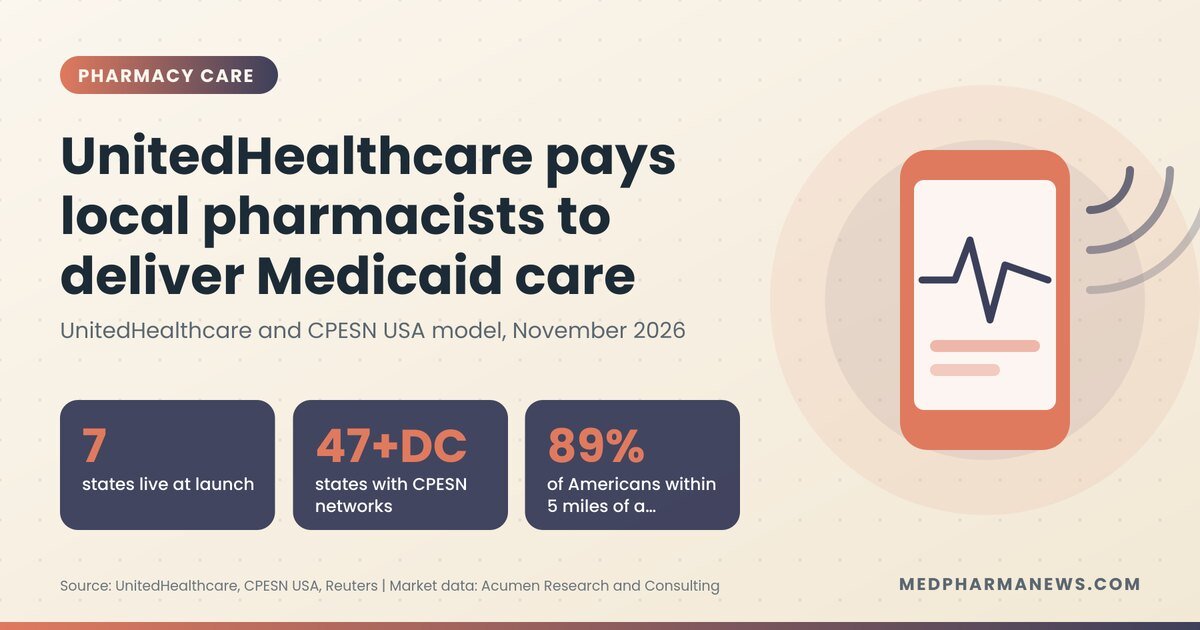
The new UnitedHealthcare pharmacist program, announced on 18 November 2026 with CPESN USA, will pay independent community pharmacies to deliver clinical services such as chronic disease support, point-of-care testing and medication management for UnitedHealthcare Community Plan (Medicaid) members. It is live in seven states (Florida, Kansas, Michigan, Missouri, North Carolina, Tennessee and Virginia), and both companies say more states will follow. Payment terms and the number of participating pharmacies were not disclosed.
Key takeaways on the UnitedHealthcare pharmacist program
- UnitedHealthcare and CPESN USA launched a hub-and-spoke model that treats local pharmacies as access points for primary-care-type services.
- Covered services include health risk assessments, testing for flu, strep, COVID-19 and pregnancy, chronic condition support, adherence counseling and preventive care.
- Pharmacy staff can also connect members to virtual visits through UHC Doctor Chat.
- The model is aimed at rural and underserved Medicaid populations, and what pharmacists may do varies by state law.
- No reimbursement rates, pharmacy counts or outcome data have been published yet.
What UnitedHealthcare and CPESN agreed
CPESN USA is a clinically integrated network of independent pharmacies organized into 44 local networks across 47 states and the District of Columbia. Under the deal, participating pharmacy teams work alongside UnitedHealthcare care managers and members’ doctors to spot care gaps, such as missed screenings or poorly controlled blood pressure, and close them at the pharmacy counter.
One less obvious element is emergency room diversion: pharmacies are asked to flag members who repeatedly use the ER for non-urgent problems and steer them to more appropriate care. Dr Arethusa Kirk, chief medical officer for UnitedHealthcare Community and State, described community pharmacies as “trusted, local access points for care.” She told Reuters the aim is better adherence and outcomes for conditions such as hypertension and diabetes.
| Service area | Examples named by the companies |
|---|---|
| Chronic disease | Health risk assessments, diabetes and hypertension support |
| Point-of-care testing | Flu, strep, COVID-19, pregnancy, chronic disease indicators |
| Medications | Medication management, adherence support, counseling |
| Access | Assisted virtual visits via UHC Doctor Chat |
| Utilization | Identifying non-emergent ER use and redirecting members |
Why insurers are turning to pharmacists now
Timing is the clearest business signal. Medicaid programs face tighter federal funding and new eligibility rules, including work requirements, from 2027. Managed care plans that run Medicaid on the states’ behalf are under pressure to keep members healthy at lower cost, and a pharmacy visit is far cheaper than an avoidable ER trip.
Geography matters too. The companies cite research that nearly 89% of Americans live within five miles of a pharmacy, and in many rural counties the pharmacist is the only clinician nearby. Independent pharmacies, meanwhile, have been squeezed by low dispensing margins and pharmacy benefit manager reimbursement. Paid clinical services offer them a revenue line that does not depend on drug spreads.
How this compares with other pharmacy-care moves
UnitedHealthcare is not alone. Humana’s Ohio Medicaid plan launched a value-based quality rewards program with CPESN USA in April 2026, and CVS Health is piloting expanded pharmacist services, including blood pressure, cholesterol and blood sugar monitoring, in five Michigan stores. CVS is also preparing to separate its insurance and benefits arm from its stores, as explained in our analysis of the CVS split.
The difference with UnitedHealthcare is scale. As the largest US health insurer and a major Medicaid contractor, it can give independents enough patient volume to justify staffing up for clinical work, if the payments are adequate.
What changes for Medicaid members
For a member in a participating state, the practical change is that a routine visit to collect a prescription can become a short clinical check: a blood pressure reading, a review of missed refills, a rapid strep test for a child, or help booking a video consultation with a doctor. CPESN’s Alison Haas said the model is designed to improve communication between pharmacies and other providers, which matters because pharmacists often see patients far more often than their physicians do. Services depend on which local pharmacies have joined, so availability will be patchy at first.
Market context: point-of-care testing
Testing is a central part of the pharmacy offer. According to Acumen Research and Consulting, the global point-of-care testing market was valued at USD 33.7 billion in 2021 and is projected to reach USD 71.7 billion by 2030, growing at 8.8% a year. Acumen notes that blood glucose testing holds a considerable share because of rising diabetes prevalence, and that infectious disease tests are expected to lead by product. By our calculation, that forecast implies the market more than doubles over the decade, which supports investment in testing capacity outside hospitals.
Open questions for pharmacies and investors
- Payment level: the companies say pharmacists will be appropriately reimbursed but have not said how much, or whether payment is fee-for-service or value-based.
- Scope of practice: test-and-treat and prescribing rules vary widely between states, which will shape what each pharmacy can offer.
- Evidence: no results from the existing states have been released. Watch for adherence, blood pressure control and ER-use data.
- Medicare spillover: pharmacists still lack provider status under Medicare Part B, so this model is unlikely to move into Medicare without legislative change.
FAQ
Which states have the UnitedHealthcare pharmacy program?
Florida, Kansas, Michigan, Missouri, North Carolina, Tennessee and Virginia, for UnitedHealthcare Community Plan members. More states are planned.
Can I get a flu or strep test at a CPESN pharmacy?
Participating pharmacies can offer point-of-care tests for flu, strep, COVID-19 and pregnancy, subject to state rules. Members should check with their plan or local pharmacy.
What is CPESN?
CPESN USA is a national network of independent community pharmacies that contract with health plans to provide enhanced clinical services beyond dispensing.
Does the program cover Medicare members?
No. The announcement covers UnitedHealthcare Community Plan, its Medicaid business.
Sources: UnitedHealthcare and CPESN USA announcement (Business Wire, 18 November 2026) and Reuters. Market data: Acumen Research and Consulting. More in Industry Insights. Not medical or investment advice. Last updated 19 November 2026.