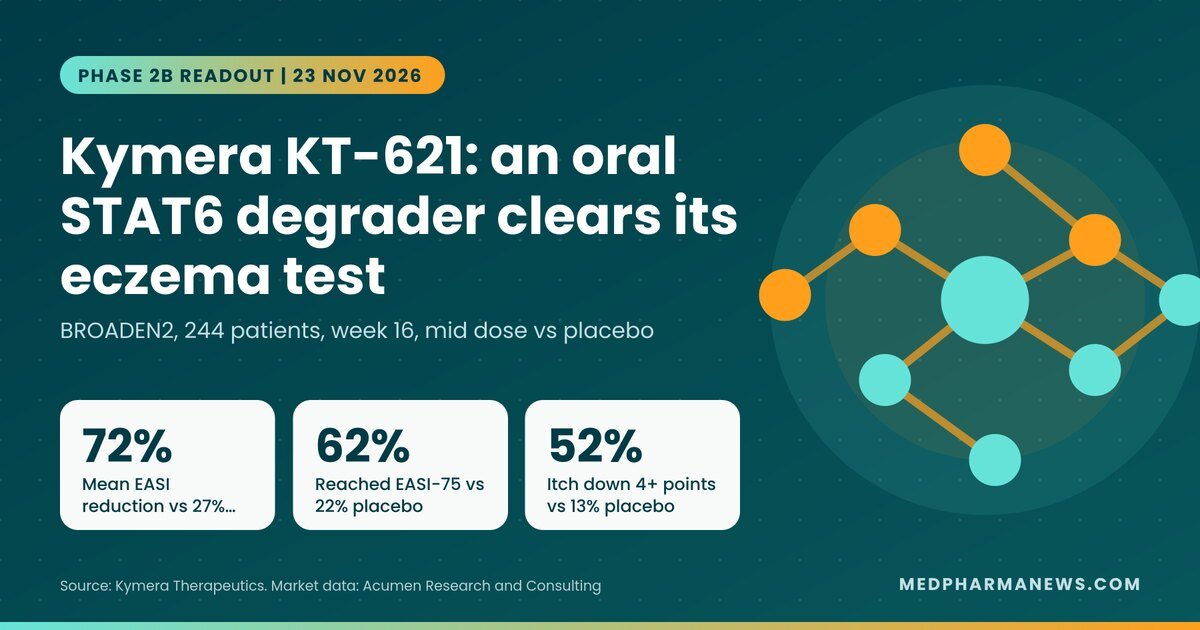
Kymera KT-621, a once-daily oral pill that destroys the STAT6 protein rather than blocking it, cut eczema severity by 72% at its middle dose in the 244-patient BROADEN2 Phase 2b trial, Kymera Therapeutics reported on 23 November 2026. All three doses beat placebo on every primary and secondary endpoint at week 16, and shares of the Watertown, Massachusetts company rose nearly 30% in premarket trading, according to Reuters. The data put a credible oral challenger in front of a market that injectable biologics have dominated for nearly a decade.
Key takeaways on Kymera KT-621
- Primary endpoint met at all three doses: mean EASI reduction of 64% (low), 72% (mid) and 61% (high) vs 27% for placebo at week 16.
- Mid dose: EASI-75 in 62% vs 22%, EASI-90 in 43% vs 10%, clear or almost clear skin (vIGA-AD 0/1) in 38% vs 11%.
- Itch: 52% had at least a four-point drop on the itch scale vs 13% on placebo, with separation from placebo as early as week 1.
- Safety: mild to moderate side effects; conjunctivitis was the only notable imbalance (11% to 20% across doses), with no discontinuations for it.
- Next step: a first Phase 3 atopic dermatitis trial by mid-2027; an asthma Phase 2b (BREADTH) reads out in late 2027.
Why investors care about a STAT6 degrader
Type 2 inflammation, the immune pattern behind atopic dermatitis, asthma, nasal polyps and several other allergic diseases, runs through two signalling molecules, interleukin-4 and interleukin-13. Both send their messages into the cell through STAT6, a transcription factor that switches on inflammatory genes. Sanofi and Regeneron’s Dupixent, one of the world’s best-selling drugs, works by blocking the receptor those cytokines share. KT-621 goes one step further downstream: it tags STAT6 for disposal by the cell’s own protein recycling machinery, so the signal never reaches the nucleus.
Transcription factors like STAT6 have long been considered undruggable with conventional small molecules because they lack a deep pocket for a drug to sit in. Targeted protein degradation sidesteps that problem. If the approach works as well in larger trials, it would let patients swap an injection every two weeks for a daily tablet while hitting the same biology. That is the commercial thesis behind the share price move.
BROADEN2 results by the numbers
BROADEN2 randomised 244 adults and adolescents with moderate to severe atopic dermatitis equally to low, mid or high doses of KT-621 or placebo for 16 weeks. Patients had a mean baseline EASI score of about 28 and a mean itch score of 7.1 out of 10; 38% had the most severe global rating and a third had previously taken a biologic. Kymera has not disclosed the milligram amounts behind each dose level. Of the 244, 234 completed the study and 230 entered a 52-week open-label extension.
| Week 16 endpoint (mid dose) | KT-621 | Placebo | Difference (by our calculation) |
|---|---|---|---|
| Mean EASI change | -72% | -27% | 45 points |
| EASI-75 | 62% | 22% | 40 points |
| EASI-90 | 43% | 10% | 33 points |
| vIGA-AD 0/1 (clear or almost clear) | 38% | 11% | 27 points |
| Itch NRS improvement of 4+ points | 52% | 13% | 39 points* |
| Mean itch NRS change | -58% | -21% | 37 points |
Two details stand out. First, the dose response was flat or slightly inverted: the high dose produced a smaller mean EASI reduction (61%) than the mid dose (72%). That is not unusual in a 60-patient-per-arm study and may reflect noise, but it means the Phase 3 dose choice will draw scrutiny. Second, speed. Kymera said skin and itch improvements separated from placebo from the first week, which, if confirmed, would match the fastest-acting oral options in the class. Chief executive Nello Mainolfi pointed to “the combination of improvements in disease severity and itch beginning as early as Week 1” as the profile the company had hoped to see.
How it stacks up against today’s standard
Cross-trial comparisons are imperfect because populations, placebo rates and rescue rules differ. With that caveat, Dupixent’s original SOLO 1 and SOLO 2 Phase 3 trials reported EASI-75 in roughly half of patients at week 16 against 12% to 15% on placebo. KT-621’s mid-dose EASI-75 of 62% sits in a similar or higher range, though its placebo arm (22%) was also higher, and the comparison is between a 61-patient arm and trials of several hundred. The JAK inhibitors Rinvoq and Cibinqo post higher skin-clearance numbers but carry boxed warnings for infections, cancer, heart events and clots. A drug that delivers biologic-like efficacy in a pill without those warnings would occupy a space nobody holds today.
The field is crowded, though. Several companies are chasing oral Type 2 agents, and earlier this month Celldex dropped its own eczema programme after a Phase 2 miss, a reminder of how hard the indication can be (see our barzolvolimab report).
Safety signals to watch
Kymera described KT-621 as well tolerated, with mild or moderate adverse events, no dose-related pattern and no meaningful imbalance versus placebo other than conjunctivitis. Pooled conjunctivitis terms occurred in 19.7%, 13.1% and 11.1% of the low, mid and high dose groups; none led to stopping treatment. The placebo rate was not disclosed. Conjunctivitis is a known effect of blocking IL-4 and IL-13 signalling and is also seen with Dupixent, so its appearance is consistent with on-target activity. Four patients across all arms had serious adverse events, none judged related to the drug. Overall adverse event and discontinuation rates were not reported, and 16 weeks is too short to judge long-term safety for a drug that would be taken for years.
Market context
Itch is the symptom eczema patients rank as most disruptive, and it anchors a sizeable treatment market. Acumen Research and Consulting valued the global pruritus therapeutics market at USD 8.4 billion in 2022 and projects USD 12.1 billion by 2032, a 3.9% compound annual growth rate, with atopic dermatitis the largest disease segment and Asia-Pacific the fastest-growing region. Acumen’s figures cover itch treatments broadly rather than the full eczema drug market, so they are best read as a floor for the opportunity. Our pruritus therapeutics market overview has more detail.
Open questions before Phase 3
- Dose selection, given the mid dose outperformed the high dose on mean EASI change.
- Durability over 52 weeks in the open-label extension, and whether responses hold in biologic-experienced patients.
- Regulatory alignment: Kymera says Phase 3 timing by mid-2027 depends on agreement with regulators.
- Cash and partnering: the release did not update the company’s cash position or mention a commercial partner for a global Phase 3 programme.
- Breadth: asthma data from BREADTH in late 2027 will test whether the effect extends beyond the skin.
More drug development coverage is in our pharmaceuticals section.
FAQ
What is KT-621?
KT-621 is an experimental once-daily oral drug from Kymera Therapeutics that degrades STAT6, the protein that carries IL-4 and IL-13 inflammatory signals. It is being developed for atopic dermatitis, asthma and other Type 2 diseases.
Is KT-621 better than Dupixent?
It is too early to say. Phase 2b efficacy looks comparable in cross-trial terms, but no head-to-head study has been run and Dupixent has years of long-term safety data.
When could KT-621 be approved?
Kymera plans to start Phase 3 by mid-2027. Pivotal trials typically take two to three years, so approval would be unlikely before the end of the decade.
Why did Kymera stock jump?
Shares rose nearly 30% premarket on 23 November because all three doses hit every endpoint, supporting the case for an oral alternative to injectable eczema biologics.
Sources: Kymera Therapeutics press release (23 Nov 2026); Reuters via Devdiscourse (23 Nov 2026); Dupixent SOLO 1/2 trials, NEJM 2016. Market data: Acumen Research and Consulting, Pruritus Therapeutics Market report. Not medical or investment advice. Last updated 24 November 2026.