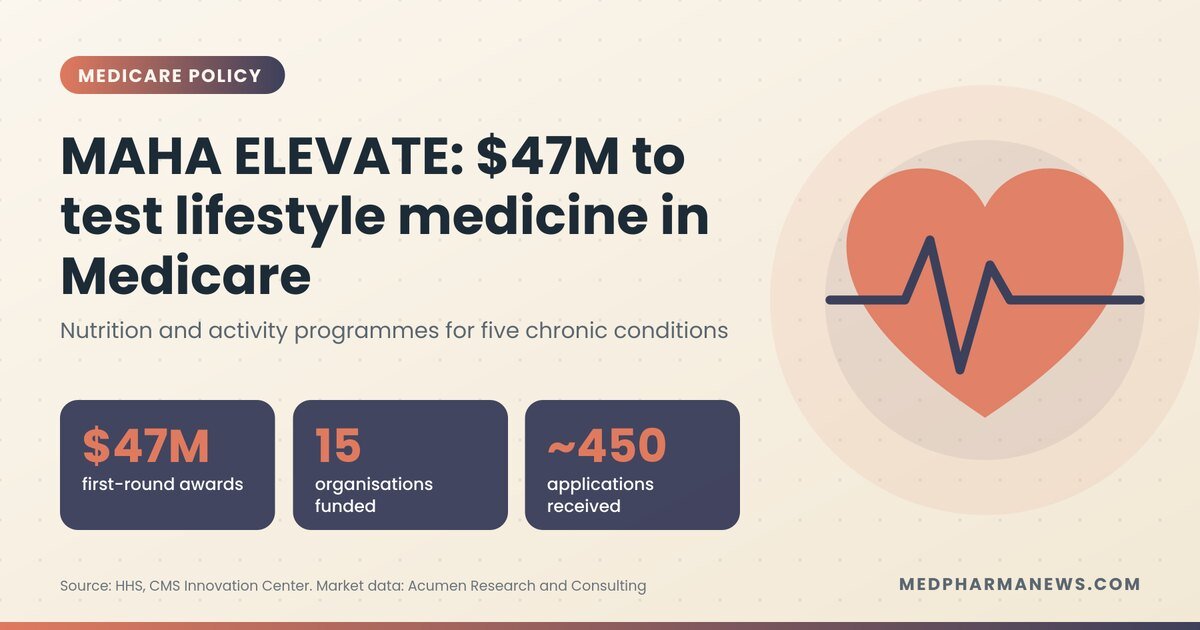
The MAHA ELEVATE model has its first winners: on 20 November 2026 HHS and the CMS Innovation Center announced $47 million in cooperative agreements to 15 organisations that will test nutrition, exercise and other lifestyle interventions for people in Original Medicare with heart failure, dementia, diabetes, obesity or hypertension. CMS picked them from nearly 450 applications and plans to fund up to 15 more projects in 2027.
Key takeaways on the MAHA ELEVATE model
- $47 million across 15 awards works out to roughly $3.1 million per project on average, by our calculation; CMS did not publish per-award amounts in its release.
- Every funded project includes a nutrition or physical activity component, delivered alongside, not instead of, conventional care.
- Target conditions are heart failure, dementia, diabetes, obesity and hypertension.
- Competition was stiff: about 15 of roughly 450 applicants were funded, a success rate near 3%, by our calculation.
- The model’s real test is evidence: CMS wants cost and quality data that could justify future Medicare coverage of services it does not pay for today.
What CMS is actually paying for
ELEVATE stands for Enhancing Lifestyle and Evaluating Value-based Approaches Through Evidence. It is a voluntary Innovation Center model built to fund whole-person and so-called functional or lifestyle medicine services that Original Medicare does not currently cover. Awardees choose the chronic conditions and interventions they will offer their Medicare patients, then work with CMS on recruitment, data collection and cost-containment plans.
The HHS announcement gave four illustrative projects without naming the organisations behind them:
- Dietitian coaching plus community health worker support and home blood pressure monitoring that alerts clinicians remotely.
- Virtual and in-person sessions with occupational therapy assistants for people with diabetes or cardiovascular risk.
- Fall-prevention education for beneficiaries living with cognitive impairment.
- A virtual structured lifestyle programme for obesity and hypertension covering diet, activity, sleep and stress.
Selection used a competitive merit review scored on evaluability, policy compliance, clinical soundness and potential to save money. Applicants included universities, non-profits, community groups, providers, local governments and technology companies. CMS Administrator Dr. Mehmet Oz framed the goal as moving upstream: “For too long, our health system has treated chronic disease after it takes hold.”
The model at a glance
| Item | Detail |
|---|---|
| Run by | CMS Innovation Center (HHS) |
| First-round awards | 15 organisations, $47 million total (20 Nov 2026) |
| Applications received | Nearly 450 |
| Agreement length | 3-year cooperative agreements |
| Overall model budget | About $100 million for up to 30 agreements, per the CMS model page |
| Second round | New funding notice for up to 15 more awards in 2027 |
| Population | Original Medicare beneficiaries (not Medicare Advantage) |
| Conditions | Heart failure, dementia, diabetes, obesity, hypertension |
| Required element | Nutrition or physical activity component in every project |
Read the numbers in context. HHS describes chronic disease as the driver of about 90% of US healthcare spending. Against that, $47 million is a rounding error in Medicare’s budget. ELEVATE is a research instrument, not a coverage expansion: its value lies in whether it produces rigorous data, because positive Innovation Center results are the main route to permanent Medicare payment for new services.
Why this matters to pharma, medtech and digital health
For drugmakers, the model lands as GLP-1 medicines reshape obesity and cardiometabolic care and as the administration pushes diet and lifestyle as first-line tools. Lifestyle programmes and drugs are not mutually exclusive, and Medicare data comparing the two could shape future coverage debates for anti-obesity medicines. For device and software companies, several example projects lean on remote blood pressure monitoring and virtual coaching, which means connected devices, care-management platforms and reimbursement-ready data pipelines.
Market data illustrate the scale of that opportunity. According to Acumen Research and Consulting, the global remote patient monitoring market was worth USD 45.2 billion in 2022 and is projected to reach USD 356.7 billion by 2032, growing at a 20.7% CAGR, with diabetes the largest application and North America the biggest region. Programmes such as ELEVATE are one way public payers test whether that monitoring translates into lower costs.
Open questions and criticisms
- Who won? The release did not list the 15 awardees or their individual grants, which limits outside scrutiny for now.
- What counts as evidence? “Functional medicine” covers a wide spectrum, from established interventions such as structured lifestyle programmes to approaches with thin evidence. How CMS evaluates outcomes will decide the model’s credibility.
- Scale. Fifteen projects cannot change population health; the question is whether results are strong enough to justify broader coverage.
- Political durability. The model carries the MAHA brand of HHS Secretary Robert F. Kennedy Jr., and three-year agreements will outlast changes in Congress.
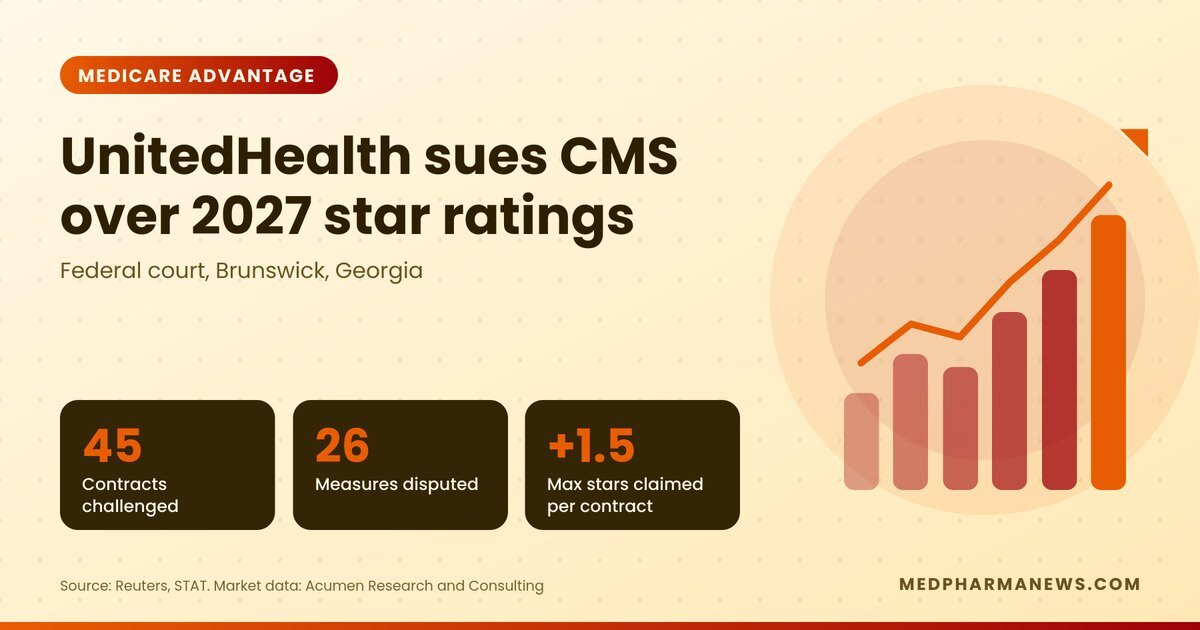
Related: CMS policy is under pressure from several sides this month, including UnitedHealth’s lawsuit over 2027 Medicare Advantage star ratings. For another payer experiment in community care, see UnitedHealthcare’s pharmacist care programme in Medicaid.
FAQ
What is MAHA ELEVATE?
It is a voluntary CMS Innovation Center model that funds organisations to test lifestyle and whole-person interventions for chronic disease in Original Medicare, alongside regular care.
How much money did MAHA ELEVATE award?
$47 million to 15 organisations in the first round, announced 20 November 2026. Up to 15 more awards are planned in 2027.
Can Medicare patients sign up for MAHA ELEVATE?
Not directly. Services are offered by the funded organisations to Original Medicare patients they serve; Medicare Advantage members are outside the model.
Which conditions does MAHA ELEVATE target?
Heart failure, dementia, diabetes, obesity and hypertension, with every project including nutrition or physical activity.
Sources: HHS press release, 20 Nov 2026; CMS MAHA ELEVATE model page. Market data: Acumen Research and Consulting. Not medical or investment advice. Last updated 21 November 2026.
More in Industry Insights.