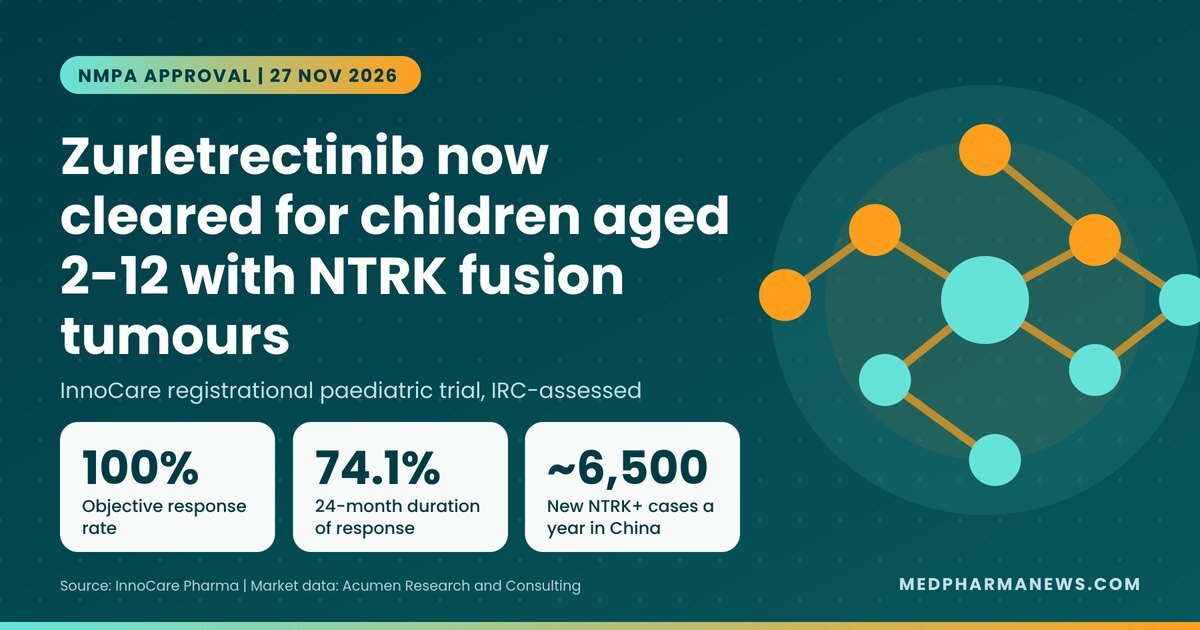
China’s National Medical Products Administration has granted a zurletrectinib approval for children aged 2 to 12 with solid tumours that carry an NTRK gene fusion, InnoCare Pharma said on 27 November 2026. In the registrational paediatric study, every evaluable child responded (objective response rate 100% by independent review), and 74.1% of responses were still ongoing at 24 months. The once-daily TRK inhibitor now covers patients from age 2 upward in China, a year after its first approval for adults and adolescents.
Key takeaways on the zurletrectinib approval
- Indication: NTRK fusion-positive solid tumours in patients aged 2 to 12, approved by the NMPA (announced 27 Nov 2026).
- Efficacy: ORR 100%, disease control rate 100%, 24-month duration-of-response rate 74.1% (IRC-assessed). InnoCare did not give the number of children in the release.
- Formulation: an orally disintegrating tablet was developed for young children who cannot swallow capsules.
- Earlier label: December 2025 approval for patients 12 and older with NTRK fusion-positive solid tumours.
- Commercial angle: it is InnoCare’s third marketed product after orelabrutinib and tafasitamab, aimed at an estimated 6,500 new NTRK fusion-positive cases a year in China.
Why a paediatric label matters for TRK drugs
NTRK fusions are rare in common adult cancers, typically well under 1% of lung or colorectal tumours. In some childhood cancers the picture flips. Infantile fibrosarcoma and certain rare paediatric tumours carry the fusion in a large majority of cases, which makes children one of the groups where TRK inhibitors have the biggest clinical effect. A tumour-agnostic drug that can be dosed in a toddler, in a form a toddler can take, is therefore more than a label extension: it moves the therapy to the population where testing is most likely to find a target.
Zurletrectinib (ICP-723) is a second-generation TRK inhibitor. InnoCare says it penetrates the brain well and stays active against the resistance mutations that can develop on first-generation agents, a known limitation of the class when tumours relapse after an initial response. Those are company claims; head-to-head data against other TRK inhibitors have not been published.
Regulatory timeline and trial readout
| Milestone | Detail |
|---|---|
| December 2025 | NMPA approval for patients aged 12 and older with NTRK fusion-positive solid tumours |
| 27 November 2026 | InnoCare announces NMPA approval for children aged 2 to 12 |
| Objective response rate (paediatric, IRC) | 100% |
| Disease control rate | 100% |
| 24-month duration-of-response rate | 74.1% |
| Dosing | Once daily, oral; orally disintegrating tablet for children |
| Not disclosed | Number of patients, median follow-up, adverse event rates |
A 100% response rate needs context. Paediatric NTRK studies are small by necessity, and a perfect response rate in a small cohort carries a wide confidence interval. The 24-month durability figure is the more informative number for doctors, because it shows roughly three in four responses holding at two years. InnoCare described the safety profile only as favourable; full data, including how many children needed dose reductions, will matter for paediatric oncologists weighing long-term use in growing patients.
Where it sits in a crowded class
The TRK space is already occupied globally by Bayer’s larotrectinib (Vitrakvi), Roche’s entrectinib (Rozlytrek) and Bristol Myers Squibb’s repotrectinib (Augtyro), the last of which is also designed to address resistance. Bayer, which has been active in Chinese oncology licensing this month with its Hansoh HS-20122 deal, built the class with larotrectinib’s tumour-agnostic label. For a domestic Chinese drug, the competitive edges are price, reimbursement listing and paediatric convenience. InnoCare has not said whether it will seek inclusion in China’s National Reimbursement Drug List for the new indication, or whether it plans filings outside China.
Chairwoman and CEO Jasmine Cui said in the release: “We expect to see zurletrectinib benefit more solid tumor patients.” For a company best known for its BTK inhibitor orelabrutinib, a second solid-tumour indication diversifies a portfolio still weighted towards haematology.
Market context
Targeted drugs are the commercial core of oncology. Acumen Research and Consulting estimates the global cancer therapeutics market at USD 193.7 billion in 2024, rising to USD 381.5 billion by 2033 at a 7.9% CAGR, with targeted therapy holding the largest share by treatment type and Asia-Pacific growing fastest. Treat these as indicative figures for the whole oncology market; tumour-agnostic TRK drugs are a small, high-value niche within it.
What to watch next
- Peer-reviewed publication of the paediatric cohort, with patient numbers, tumour types and safety.
- Pricing and any NRDL negotiation for the paediatric indication.
- Uptake of NTRK fusion testing in Chinese children’s cancer centres, which ultimately decides how many patients are found.
- Any partnering or filing plans outside China.
FAQ
What is zurletrectinib approved for?
In China it is approved for NTRK fusion-positive solid tumours in patients aged 12 and older (since December 2025) and, as announced on 27 November 2026, in children aged 2 to 12.
How well did zurletrectinib work in children?
InnoCare reports a 100% objective response rate and a 74.1% 24-month duration-of-response rate in its registrational paediatric trial, assessed by an independent committee. Patient numbers were not disclosed.
Is zurletrectinib approved by the FDA?
No. Its approvals so far are from China’s NMPA, and InnoCare has not announced US or EU filings.
What is an NTRK gene fusion?
It is a genetic rearrangement that joins an NTRK gene to another gene, producing an always-on TRK protein that drives tumour growth. TRK inhibitors block that protein regardless of where in the body the cancer started.
Sources: InnoCare Pharma release, 27 Nov 2026. Market data: Acumen Research and Consulting. Not medical or investment advice. See also our coverage of Rasonque’s EU approval and more pharmaceutical news. Last updated 27 November 2026.