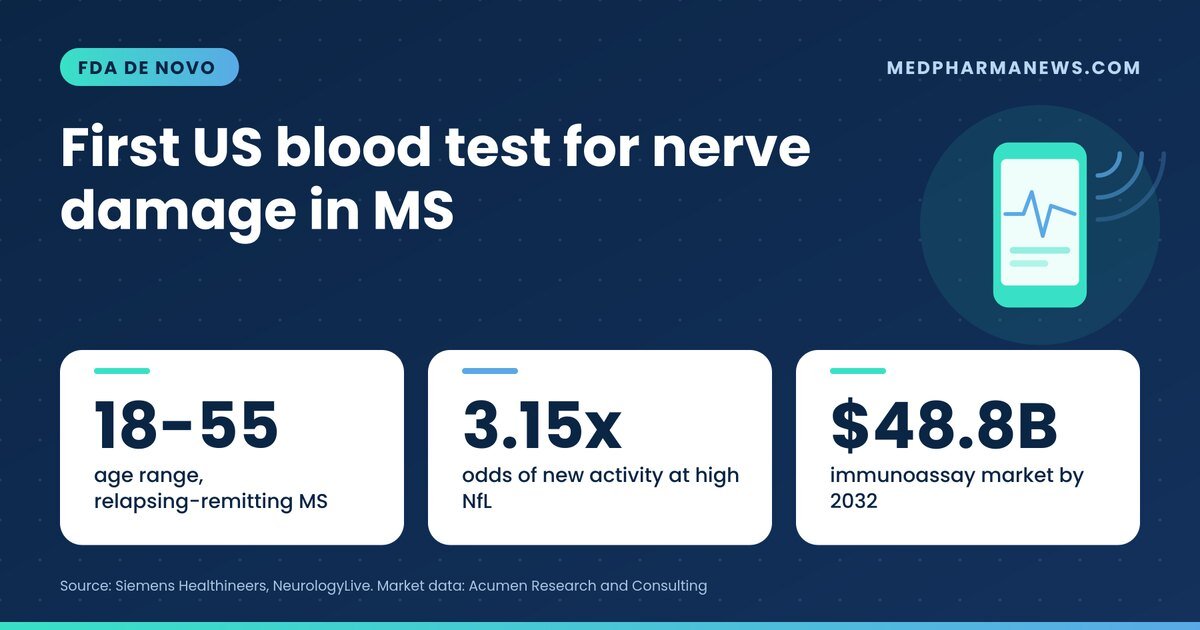
The US Food and Drug Administration has granted De Novo marketing authorization to Siemens Healthineers’ Atellica IM Neurofilament Light Chain (NfL) assay, making it the first NfL blood test for MS authorized in the United States. Announced on 23 November 2026, the automated test measures NfL in serum or EDTA plasma and is cleared to help evaluate ongoing disease activity in adults aged 18 to 55 with relapsing-remitting multiple sclerosis (RRMS), alongside clinical, imaging and lab findings. Siemens developed it with Novartis.
Key takeaways on the NfL blood test for MS
- First FDA-authorized blood test for neurofilament light chain in multiple sclerosis, cleared through the De Novo route for novel low- to moderate-risk devices.
- Runs on Siemens’ fully automated Atellica IM Analyzer, which the company says is widely installed in US labs.
- Label limited to adults 18 to 55 with RRMS; it does not cover progressive MS, children or older adults.
- It is an add-on to MRI and neurological exams, not a replacement, and it is not specific to MS.
- The De Novo decision creates a new device classification that rival NfL assays can now use as a predicate.
What NfL measures and why neurologists want it
Neurofilament light chain is a structural protein inside nerve fibres. When axons are damaged, NfL leaks into the cerebrospinal fluid and then into blood, so a rising level is a signal of active nerve injury. In MS, disease activity is tracked mainly with relapses, exams and periodic MRI scans, and quiet damage can be missed between visits. A blood draw that can be repeated cheaply could flag patients whose current therapy is not fully controlling inflammation.
Sharon Bracken, head of Siemens Healthineers Diagnostics, described it as a “first-of-its-kind” non-invasive source of patient data. The assay has been used outside the US under a CE mark.
The evidence behind the authorization
The clinical rationale draws on large reference datasets rather than a single pivotal trial. As summarised by NeurologyLive, a 2022 modelling and validation study built a reference database from 5,390 control individuals and showed that serum NfL rises exponentially with age, more steeply after about 50. That is why results are interpreted as age-adjusted z-scores.
| Data point | Value |
|---|---|
| Control individuals in NfL reference database | 5,390 |
| Risk of future clinical or MRI activity when serum NfL z-score > 1.5 (Swiss MS Cohort) | Odds ratio 3.15 (95% CI 2.35 to 4.23) |
| Independent Swedish validation cohort | 4,341 patients |
| Authorized age range | 18 to 55 years, RRMS only |
| Sample types | Serum and EDTA plasma |
| Estimated people with MS in the US | Nearly 1 million |
Put simply, by our reading of the odds ratio, patients whose NfL sat well above the norm for their age were about three times as likely to show new clinical or MRI activity afterwards as those below that line.
Limits patients and doctors should know
- Not a diagnostic for MS. NfL rises with any neuroaxonal injury, including stroke, head trauma and other neurological diseases.
- Confounders. Age and body mass index shift NfL levels, which is why reference-based z-scores are needed.
- Narrow label. No authorization for progressive MS, paediatric-onset MS or people over 55, where age-related NfL rises cloud interpretation.
- Adjunct only. Results must be read with MRI and clinical assessment, not used alone to switch or stop therapy.
The business angle: diagnostics meets the MS drug market
For Siemens Healthineers, the win puts a neurology biomarker on an analyzer that hospital and reference labs already run, which lowers the barrier to adoption compared with specialist research platforms. For Novartis, a co-developer and the maker of MS therapy Kesimpta, an automated NfL test could support earlier, data-driven decisions to escalate to high-efficacy treatment. We covered how Novartis lifted its Kesimpta peak sales forecast to $8 billion. Competition in MS therapy is also intensifying, with Roche’s fenebrutinib under priority review for relapsing and primary progressive MS, so tools that show which patients have ongoing activity have commercial as well as clinical value.
The regulatory precedent may matter as much as the product. Because De Novo creates a new classification, other manufacturers can now seek clearance for NfL assays by pointing to this one as a predicate, which typically shortens the path for followers.
Market context
The Atellica NfL assay is a chemiluminescent immunoassay, a technology class with a large installed base. According to Acumen Research and Consulting’s immunoassay market report, the global immunoassay market was worth about USD 31.4 billion in 2023 and is expected to reach USD 48.8 billion by 2032, a 5.1% compound annual growth rate from 2024, with North America the largest region and Asia-Pacific the fastest growing. Acumen lists the report as last updated in 2019 although it carries 2023 base-year figures, so treat the numbers as indicative. New neurology markers such as NfL are one of the few ways to add test menu growth to a mature immunoassay business.
What to watch next
- US launch timing and pricing, and whether Medicare and private insurers set coverage for routine NfL monitoring.
- Whether MS treatment guidelines start to recommend periodic NfL testing between MRI scans.
- Follow-on De Novo-referencing clearances from other diagnostic companies.
- Label expansion attempts into progressive MS or other neurological conditions.
FAQ
Is there a blood test for multiple sclerosis?
There is now an FDA-authorized blood test to help monitor disease activity in people already diagnosed with relapsing-remitting MS. It does not diagnose MS on its own.
What does a high NfL level mean?
It suggests ongoing nerve fibre damage. In RRMS, an NfL level well above the age-adjusted norm has been linked to a higher chance of new relapses or MRI lesions, but other conditions can also raise it.
Who can use the Siemens NfL test?
The authorization covers adults aged 18 to 55 with relapsing-remitting MS, ordered by a clinician and run on the Atellica IM Analyzer in a lab.
Does it replace MRI?
No. It is designed to complement MRI and neurological exams. More device coverage is in our Medical Devices section.
Sources: Siemens Healthineers press release, 23 November 2026; NeurologyLive. Market data: Acumen Research and Consulting. This article is for information only and is not medical or investment advice. Last updated 27 November 2026.