Measles vaccination is the central public-health message as US cases climb to 4,410 for 2026, the CDC reports, and as reports on 20 October say a third measles-related death has been confirmed. The CDC says two doses of the measles, mumps and rubella vaccine are 97% effective against measles, and Pennsylvania, where 1,286 cases have been confirmed, is urging families to check their records and consider early doses for infants in affected counties. This report summarises the official guidance on measles vaccination, what the case data show about who is affected, and the questions families may want to ask their providers. It is general information and not medical advice.
Measles vaccination: key takeaways
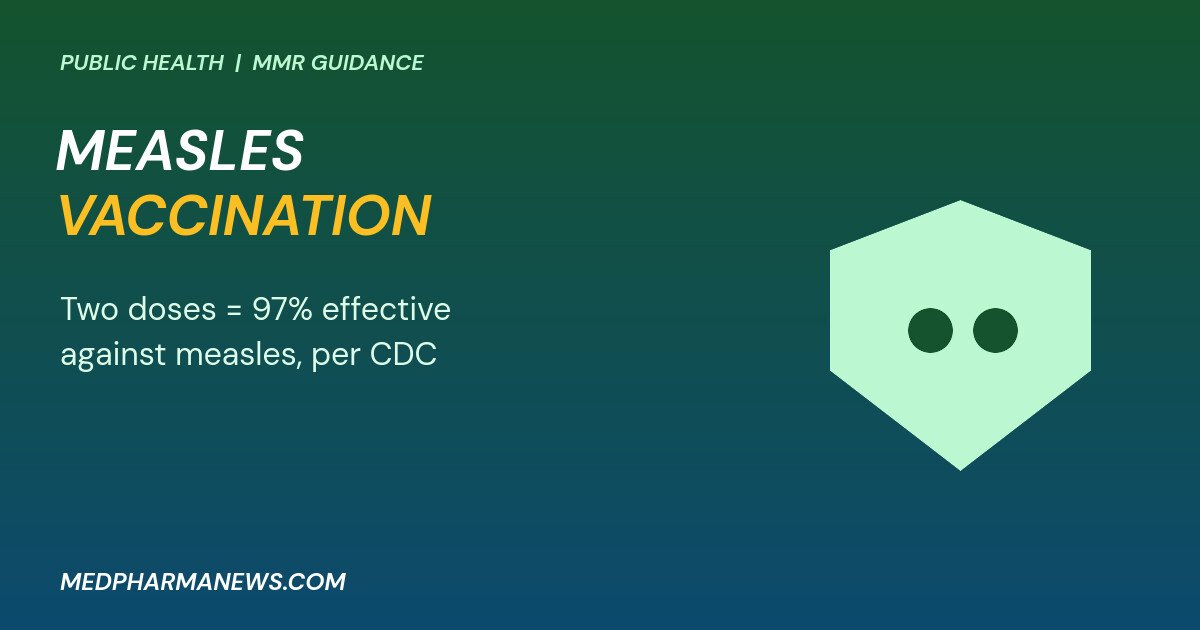
- Two MMR doses are 97% effective against measles and one dose 93%, according to the CDC.
- Children get the first dose at 12 to 15 months and the second at 4 to 6 years.
- Pennsylvania advises an early dose for infants aged 6 to 11 months in counties with sustained community spread; it does not replace the two routine doses.
- Pennsylvania reports that fewer than 1% of its 1,286 cases were among vaccinated people.
- MMR is not given during pregnancy, and pregnancy should be avoided for 28 days afterwards.
The numbers behind the measles vaccination push
The CDC measles data page says 4,410 confirmed measles cases were reported in 2026 as of 15 October, in 47 jurisdictions, with 42 new outbreaks. Reports on 20 October say the CDC has confirmed a third death, though the CDC page we checked, last updated 16 October, listed two. The Pennsylvania Department of Health update of 19 October lists 1,286 cases in 42 counties, five confirmed deaths and 247 hospitalisations, or about 19% of cases by our calculation.
What the CDC says about measles vaccination
According to the CDC vaccine guidance, one dose of MMR is 93% effective against measles and two doses are 97% effective. The recommended schedule is the first dose at 12 to 15 months and the second at 4 to 6 years. Adults who lack evidence of immunity need at least one documented dose, and some higher-risk adults, including healthcare personnel, post-high-school students and international travellers, should have two doses at least 28 days apart. During an outbreak, health authorities may recommend vaccination for infants aged 6 to 11 months who are at risk of exposure.
What Pennsylvania advises on measles vaccination
The state health department says two documented doses give 97% lifetime protection and that people with two doses do not need another. Adults with only one dose, or without records, should consult a provider or pharmacist. In counties flagged for sustained community transmission, infants aged 6 to 11 months should get an early zero dose that does not replace the routine two. Children aged 12 months and older with no doses should receive one now and a second at least 28 days later. Non-immune new mothers should get MMR, which is safe while breastfeeding, and household members are encouraged to be vaccinated.
Where to get measles vaccination
Pennsylvania lists health care providers, county and municipal health departments, state health centres, federally qualified health centres and the Vaccines for Children programme as sources. Readers elsewhere should check with their own provider, pharmacy or local health department, because availability and rules differ by state and country.
Vaccinated cases: how to read them
This section is our analysis. Pennsylvania reports four cases among vaccinated people, less than 1% of 1,286. No vaccine is perfect, and a 97% effective vaccine can still leave some vaccinated people susceptible, which is why a few cases among them are expected in a large outbreak. The far larger point in the data is that the great majority of cases are not vaccinated. The CDC page we reviewed did not show 2026 national vaccination breakdowns, so we do not give a national share.
Questions to ask a provider about measles vaccination
These suggestions are ours. Do I have documented proof of two doses, or should I look for records? If I have only one dose or no records, what do you recommend for me? Is my infant eligible for an early dose where I live? I am planning pregnancy, so what is the right timing? Could I have been exposed, and who should I contact first? Calling ahead before visiting a clinic is wise if measles is suspected so that others are not exposed.
Why measles vaccination is taken seriously
The CDC symptoms page reports that about 1 in 5 unvaccinated people in the United States who get measles are hospitalised, that pneumonia affects as many as 1 in 20 children with the disease, and that 1 to 3 in 1,000 infected children die from respiratory or neurologic complications. Measles can also damage immune cells, raising the risk of other infections for months or longer after recovery. Symptoms begin 7 to 14 days after contact, with fever, cough, runny nose, red eyes and later a rash.
What is not known
- Where and when the reported third death occurred.
- Why the national and Pennsylvania death counts differ.
- How long the Pennsylvania outbreak will last.
Risks and caveats on measles vaccination information
- Guidance can change as outbreaks evolve, so check current official advice.
- The third death is based on reports we could not match to the CDC page.
- Our percentage figures are simple calculations and are labelled.
- This is news reporting and education, not medical advice.
In our assessment, the data and the official guidance point the same way: documented MMR doses are the most effective protection, and the practical task for families is to check their records now and talk to a provider if anything is missing. See also CDC Measles Outbreak Response: Critical Epi-Aid Boost. More in our wellness coverage.
What to watch next on measles vaccination
- The CDC’s next weekly case and death update.
- Further Pennsylvania guidance on early infant doses.
- Any change in vaccination advice for other states.
Frequently asked questions
How effective is MMR against measles?
The CDC says one dose is 93% effective and two doses are 97% effective.
When should children get MMR?
The first dose at 12 to 15 months and the second at 4 to 6 years, per the CDC.
Can pregnant women have MMR?
No. MMR should not be given during pregnancy, and pregnancy should be avoided for 28 days after vaccination.
How we reported this: we relied on the CDC measles data, vaccine and symptoms pages, the Pennsylvania Department of Health update of 19 October 2026 and reports of 20 October. Our own calculations are labelled. Last updated: 20 October 2026. This article is news reporting and not medical advice.