
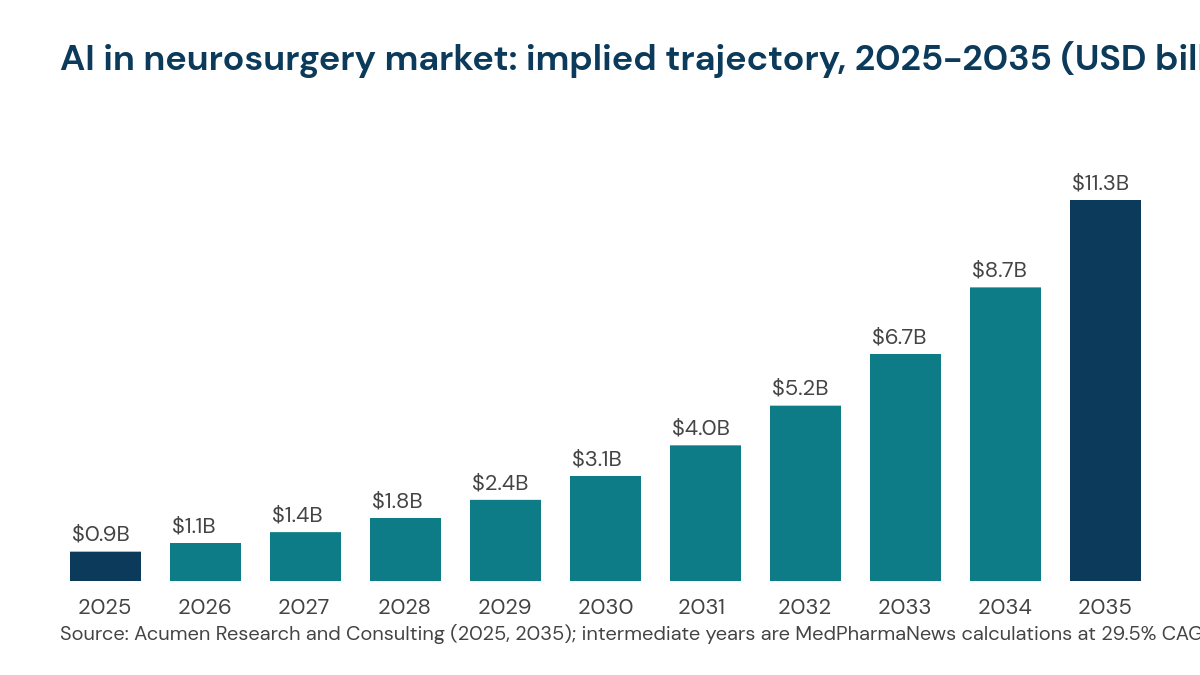
The AI in neurosurgery market was worth about $850 million in 2025 and is forecast to reach $11.3 billion by 2035, a compound annual growth rate (CAGR) of 29.5%, according to a market report from Acumen Research and Consulting. The firm names North America as the leading region and software as the leading component. These figures are analyst projections rather than audited results, and this article explains what sits behind them and how far readers should rely on them.
Key Takeaways
- Acumen estimates the AI in neurosurgery market at about $850 million in 2025, rising to $11.3 billion by 2035.
- The forecast implies a 29.5% CAGR over the 2026-2035 period.
- North America is reported as the largest regional market, and software as the leading component.
- Our own calculation from the stated growth rate puts 2026 at roughly $1.1 billion. We do not use the separate 2026 figure shown on the report page, which does not match its own CAGR.
- Growth depends on clinical validation, regulatory clearance and hospital budgets, not on technology alone.
What Is AI in Neurosurgery?
AI in neurosurgery describes machine-learning software and AI-enabled systems used across the surgical pathway. Before an operation, algorithms can segment MRI and CT scans, outline a tumour or vascular lesion, and help a surgeon plan the safest route to it. During surgery, they can support navigation, instrument tracking and image-guided decisions. Afterwards, predictive models estimate recovery, complication risk and the likelihood that a condition will return.
The category overlaps with several neighbouring technologies, including surgical navigation, robotic assistance and intraoperative imaging. Most products reach hospitals as software licences, as modules built into navigation or robotic platforms, or as cloud-based planning services. That delivery model is one reason analysts expect software to dominate revenue: it can be added to existing equipment without replacing it. Readers following the wider AI in healthcare market will recognise the same pattern in other specialties.
AI in Neurosurgery Market at a Glance
| Metric | Figure |
|---|---|
| Market size, 2025 | About $850 million (Acumen) |
| Market size, 2035 | About $11.3 billion (Acumen) |
| CAGR, 2026-2035 | 29.5% (Acumen) |
| Leading region | North America (Acumen) |
| Leading component | Software (Acumen) |
| 2026 estimate | About $1.1 billion (our calculation from the CAGR) |
Market Size and Growth Outlook
A 29.5% CAGR would multiply the AI in neurosurgery market roughly thirteenfold in ten years. Forecasts at this pace are common for early-stage medical AI categories, where a small starting base inflates percentage growth. The 2025 figure of about $850 million is modest next to the broader surgical equipment market, which gives a sense of how much room the segment has to grow if adoption follows the forecast.
The chart below shows the trajectory implied by Acumen headline figures. Intermediate years are our own arithmetic, applying the stated CAGR to the 2025 base, and are not figures published by the research firm. The straight-line compounding is a simplification: real markets move in steps as products win regulatory clearance and hospitals set budgets.
Because the report page is a marketing summary, the underlying assumptions, such as which products and services are counted, are not fully visible. Anyone using these numbers in a business case should request the full methodology from the publisher before relying on them.
What Is Driving Demand
Several forces are commonly cited as supporting adoption of AI in neurosurgery, and they reinforce one another.
- Imaging volume and complexity: neurosurgical decisions depend on dense scan data, and AI can segment structures and quantify changes faster than manual review. This links the segment closely to the AI in medical imaging market.
- Precision and safety goals: brain and spine surgery leave little margin for error, so tools that standardise planning and reduce variability attract clinical interest.
- Specialist shortages: software that supports planning can help less experienced teams and extend expert knowledge to smaller centres.
- Platform investment: manufacturers are building AI into navigation, robotic and visualisation systems, which spreads the cost of development across larger product lines.
Restraints and Challenges
The same forecast also rests on assumptions that may not hold evenly. Four constraints stand out.
- Clinical evidence: many tools have been validated on retrospective data, and prospective studies showing better patient outcomes remain thinner. Surgeons and payers tend to wait for that proof.
- Regulation: software that influences surgical decisions generally needs clearance as a medical device. The US Food and Drug Administration publishes a running list of AI-enabled devices it has authorised, and clearance timelines can delay launches.
- Cost and integration: capital budgets, IT integration and staff training slow uptake, particularly outside large academic hospitals.
- Data and bias: models trained on limited or unrepresentative datasets may perform differently across hospitals and patient groups, which raises validation burdens.
Segment and Regional Insights
By component
Acumen identifies software as the leading component. That fits the way most neurosurgical AI is sold: planning, segmentation and decision-support tools layered over imaging and navigation hardware. Hardware and services still matter, since robotic arms, sensors and implementation support are needed to bring software into the operating room, but software carries the recurring licence revenue that analysts typically favour in their forecasts.
By region
North America is reported as the largest regional market. Analysts usually link that to advanced hospital infrastructure, concentrated specialist centres, a large installed base of navigation systems and a regulatory path that suppliers know well. Europe and Asia-Pacific are generally described as growing as hospitals digitise and invest in surgical technology, although the public summary does not give regional figures that we can verify here.
How Hospitals Evaluate These Tools
Procurement teams rarely buy neurosurgical AI on market-growth arguments. They tend to ask a short set of practical questions before committing budget.
- Does the tool have regulatory clearance for the specific use, such as tumour segmentation or trajectory planning, in the hospital country?
- Is there published evidence from centres similar in size and patient mix, rather than only vendor-run studies?
- Does it integrate with existing imaging archives, navigation systems and electronic records without extra manual steps?
- What are the total costs, including licences, training, maintenance and data security obligations, over several years?
Suppliers that answer these questions clearly are likely to win early contracts, which in turn builds the real-world evidence that later buyers ask for. That feedback loop is the mechanism by which a forecast like Acumen could come true, and also the reason it could fall short if the first wave of deployments disappoints.
Where the Opportunities Are
Likely openings include AI-assisted tumour margin detection, tools that predict outcomes or complications, remote planning services that let smaller hospitals draw on specialist expertise, and simulation platforms for training. Related fields such as the neurotech devices market and neurovascular device deals show how quickly the surrounding neuro-focused device landscape is changing. Vendors that can demonstrate measurable gains in accuracy, procedure time or complications, and that fit into existing hospital workflows, are best placed to turn interest into purchases.
What the Forecast Means: Our Assessment
In our assessment, the direction of travel is credible but the precise numbers deserve caution. Market-research forecasts depend on assumptions that public summaries rarely disclose, and the interim-year figure on this report page is inconsistent with its stated growth rate. A 29.5% CAGR is plausible only if clinical evidence, reimbursement and regulatory approvals keep pace with the technology.
For hospitals, the practical question is not market size but whether a tool improves care and fits the workflow. For investors and developers, peer-reviewed outcome data and regulatory milestones are firmer signals than any projection. Professional bodies such as the American Association of Neurological Surgeons publish guidance and research that surgeons draw on when judging new technology, and those sources are a useful complement to analyst reports.
Frequently Asked Questions
How big is the AI in neurosurgery market?
Acumen Research and Consulting estimates the AI in neurosurgery market at about $850 million in 2025.
How fast is it expected to grow?
The firm forecasts a 29.5% CAGR, taking the market to about $11.3 billion by 2035.
Which region and segment lead?
North America is reported as the leading region and software as the leading component.
What could slow growth?
Limited prospective outcome data, regulatory clearance timelines, high capital and integration costs, and concerns about data bias are the main constraints discussed above.
Is the forecast reliable?
It is an analyst projection built on assumptions that are not fully disclosed. Treat it as an indicator of direction, not a guaranteed outcome, and check the full methodology before using it for decisions.
How we reported this: figures come from the public market page of Acumen Research and Consulting and are company-reported projections; the 2026 estimate and yearly chart values are our own calculations. Last updated 2 October 2026. This article is for information only and is not medical, investment or business advice.