Two inherited eye diseases that have long had no approved treatment shared the stage in Vienna this month. AAVantgarde Bio presented clinical data for AAVB-081, a gene therapy for Usher syndrome type 1B, and preclinical data supporting AAVB-039 for Stargardt disease, at the 26th EURetina Congress (1 to 4 October 2026), according to the company announcement. The headline from the clinic: seven of 12 evaluable patients gained at least one line of best-corrected visual acuity, with no serious adverse events.
Key Takeaways
- AAVB-081 is being tested in the Phase 1/2 LUCE-1 trial (NCT06591793). Of 15 patients enrolled across three dose cohorts, 12 with at least six months of follow-up were analysed for efficacy, according to the company.
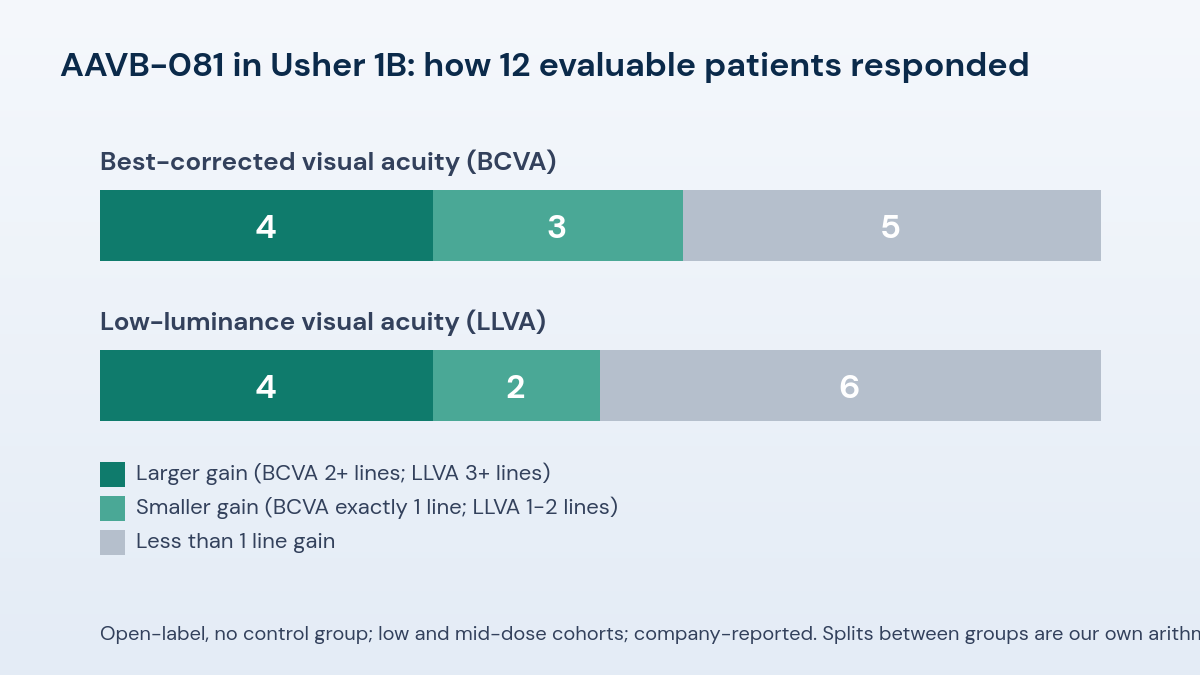
- In those 12 patients, from the low and mid-dose cohorts, 7 gained at least one line of best-corrected visual acuity (BCVA) and 4 gained at least two lines. For low-luminance visual acuity (LLVA), 6 gained at least one line and 4 gained at least three.
- With a data cutoff of 3 August 2026, the company reports no serious adverse events, no dose-limiting toxicities and no discontinuations. Ocular inflammation was limited and responded to corticosteroids.
- AAVB-039 for Stargardt disease is supported by preclinical data in mice, pigs and non-human primates, and is in the Phase 1/2 CELESTE trial (NCT07161544).
- The data are open-label, from a very small group and a short follow-up, so they are early signals and not proof of benefit.
Why These Diseases Are So Hard to Treat
Usher syndrome type 1 combines profound hearing loss from birth with progressive vision loss from retinitis pigmentosa. Type 1B is caused by mutations in the MYO7A gene. Stargardt disease is the most common inherited form of juvenile macular degeneration and results from mutations in the ABCA4 gene, causing a build-up of fatty deposits in the retina and loss of central vision. Both genes are large, roughly 6.7 kilobases for MYO7A and 6.8 for ABCA4 according to the company, which is more than a standard adeno-associated virus (AAV) vector can carry in one piece.
How the Dual-AAV Approach Works
AAV vectors are small, and the usual rule of thumb is that they can package about 4.7 kilobases of DNA. AAVantgarde’s answer is to split the gene across two vectors that join once inside the cell. For AAVB-039 it uses dual AAV8 vectors with intein-mediated protein trans-splicing, a method by which two half-proteins are stitched together into a full-length protein. The company says that in preclinical work this reconstituted full-length ABCA4 in mouse, pig and non-human primate models, with expression at 100% or more of endogenous levels in pigs, a reduction in lipofuscin, and 76% to 99% co-transduction of photoreceptors across the retinal area analysed in primates.
What Did the Clinical Data Show?
| Measure | Reported result (12 evaluable patients) |
|---|---|
| Trial | LUCE-1, Phase 1/2, open-label dose escalation (NCT06591793) |
| Enrolled / analysed | 15 enrolled; 12 with at least 6 months follow-up analysed |
| BCVA gain of 1 line or more | 7 of 12 |
| BCVA gain of 2 lines or more | 4 of 12 |
| LLVA gain of 1 line or more | 6 of 12 |
| LLVA gain of 3 lines or more | 4 of 12 |
| Safety (cutoff 3 Aug 2026) | No serious adverse events, no dose-limiting toxicities, no discontinuations |
| Cohorts in efficacy set | Low and mid dose |
A BCVA line is five letters on the standard eye chart, and the test has natural variability, so a gain of one line can partly reflect noise. That is why gains of two lines or more, and consistent improvement across several measures, carry more weight. The company also reports supportive signals in fixation stability and microperimetry but gave no numbers in the announcement.
How to Read Early Gene Therapy Data
Early-phase gene therapy trials are designed first to test safety and find a workable dose, and efficacy readouts are a bonus. With no placebo or untreated comparison group, every improvement has to be weighed against the possibility of test variability, patient expectation and the natural course of the disease, which in retinal degenerations is usually decline, not recovery. A pattern of stable or improved vision where decline would be expected is therefore encouraging, but only a controlled study can show that the therapy is the reason. The fact that the efficacy analysis used only the low and mid-dose cohorts also means the highest dose has not yet been summarised publicly.
What About the Stargardt Programme?
AAVB-039 has FDA clearance of its investigational new drug application and is now in the CELESTE Phase 1/2 trial, which the company says is recruiting in the US, UK and Europe. Alongside it, a natural history study called STELLA has enrolled 150 patients, which will give the programme a reference for how the disease progresses without treatment. The presented data on AAVB-039 are preclinical, and no human efficacy has been reported. The company’s chief executive, Jayashree Sahni, said the presented data support continued development of AAVB-081 in Usher syndrome type 1B.
What We Do Not Yet Know
- Whether the visual gains are durable beyond the short follow-up, and how they compare with untreated eyes.
- Results for the high-dose cohort, which were not included in the efficacy analysis.
- Whether the effect is large enough to matter in daily life for patients with advanced disease.
- The regulatory path and timing for AAVB-081 and AAVB-039.
- Long-term safety, including inflammation over years of follow-up.
Related Coverage
For more on biotech news, see our reports on Terumo Neuro’s Arsenal Medical deal, Ensera’s alliance network and Samfara’s first buyout.
Our Assessment
In our assessment, the most interesting thing about this readout is the platform: showing that a dual-vector system can deliver a large gene and produce functional protein in a human retina is a real technical milestone. But 12 patients, no control group and a short follow-up mean we cannot yet separate treatment effect from variability. The next data to watch are higher-dose results, longer follow-up and a controlled study.
Frequently Asked Questions
What is AAVB-081?
An investigational dual-AAV gene therapy for Usher syndrome type 1B, caused by MYO7A mutations, in the Phase 1/2 LUCE-1 trial.
What did the latest data show?
Of 12 evaluable patients, 7 gained at least one line of BCVA and 4 gained at least two lines, with no serious adverse events, according to the company.
What is AAVB-039?
An investigational dual-AAV8 gene therapy for Stargardt disease (ABCA4), supported by preclinical data and now in the CELESTE Phase 1/2 trial.
Are these therapies approved?
No. Both are investigational.
Why does the gene need two vectors?
MYO7A and ABCA4 are too large to fit in a single AAV vector, so the gene is split across two vectors and reassembled in the cell.
How we reported this: details come from AAVantgarde’s announcement of data presented at EURetina 2026. Efficacy and safety figures are company-reported, from an open-label early-phase study, and have not been peer reviewed. This is not medical advice. Last updated 6 October 2026.