Most hospital visits involve a needle, a syringe or a catheter that nobody notices until it is missing. That everyday plumbing is the subject of a major manufacturing pledge. BD (Becton, Dickinson and Company) announced a partnership with the US government on 6 October 2026, committing to invest $19 billion in the United States over several years, of which $3 billion is directed to manufacturing expansion. The BD $3 billion manufacturing investment is linked in the company’s release to relief from future Section 232 tariffs, and a separate presidential statement said more than $1 billion would go to Nebraska.
Key Takeaways
- BD says it will invest $19 billion in the US over several years, including capital, operational and supply chain investments, and direct $3 billion of that to US manufacturing expansion.
- The company says the plan would add about 5 billion essential medical consumables a year and lift its share of domestically supplied essential consumables to roughly 80%.
- In return, the agreement provides relief from future Section 232 tariffs on covered BD products and inputs, subject to final scope and BD meeting agreed milestones.
- The “more than $1 billion in Nebraska” figure comes from the US president’s statement. BD’s release lists Columbus and Broken Bow, Nebraska, among its sites but does not attach a dollar figure to the state.
- No job numbers or detailed rollout timeline were disclosed.
What Did BD Actually Commit To?
The company release sets out three commitments. First, the $19 billion headline, covering capital, operations and supply chain, over several years. Second, $3 billion of that earmarked for US manufacturing expansion at strategic production sites. Third, an output goal: roughly 5 billion more essential medical consumables a year made end to end in the US, which BD says would take its domestic supply share to about 80%. The company also says all BD needles used in the US would be made domestically from American steel. The release describes BD consumables as used in approximately 90% of US hospital visits.
| Item | Detail |
|---|---|
| Company | BD (Becton, Dickinson and Company), Franklin Lakes, New Jersey |
| Release date | 6 October 2026 |
| Total US investment | $19 billion over several years (capital, operational, supply chain) |
| Manufacturing expansion | $3 billion |
| Output goal | About 5 billion more essential consumables a year; about 80% domestic supply share |
| Needles | All BD needles used in the US to be made domestically with American steel (company) |
| Tariff element | Relief from future Section 232 tariffs on covered products and inputs, subject to milestones |
| Nebraska | Columbus and Broken Bow named; "$1 billion-plus" figure from presidential statement |
| Not disclosed | Jobs, site-by-site split, timetable |
Where Does the “$1 Billion in Nebraska” Come From?
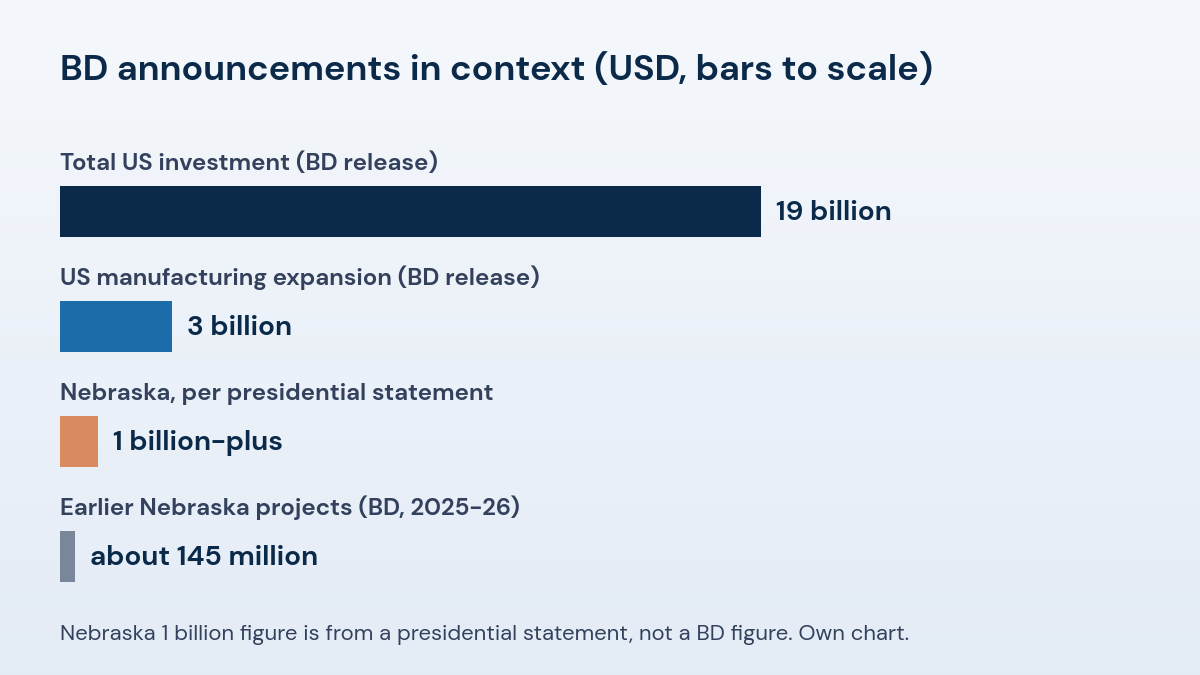
The Nebraska number was announced by the US president in a social media post on Monday 5 October, a day before BD’s own release. The president said more than $1 billion would go to Nebraska to expand medical-product production, including needles made with US steel, and tied the decision to what he called strong medical device tariffs due by the end of the year. BD’s release names two Nebraska sites, Columbus and Broken Bow, but gives no state-level figure, so we treat the $1 billion as a government statement that the company has not itself spelled out.
For scale, BD announced a $110 million expansion of prefillable syringe production at Columbus, Nebraska, in January 2026, adding about 120 jobs, and an earlier $35 million project at the same campus for prefilled flush syringes, adding about 50 jobs. Together that is about $145 million. By our own calculation, a Nebraska figure above $1 billion would be roughly seven times that, which would make it a very large step up, but only the company can say how the sums are allocated.
Why the Tariff Link Matters
The deal is as much about trade policy as about factories. The US Department of Commerce opened a Section 232 national-security investigation into medical devices in September 2025, and the administration has said it expects tariffs on the sector by year-end. The US Department of Commerce has not published a final decision that we could find. BD’s release says its relief is conditional on the final scope of any future action and on hitting milestones, so the company is committing capital in return for protection against a rate and product list that do not yet exist.
For hospitals, the question is whether more domestic capacity reduces shortages or simply shifts costs. We covered the earlier debate in our report on US medical device tariffs and healthcare costs. Higher input costs from tariffs can be passed on, while domestic capacity can add resilience. Both could be true.
Which Sites Are Involved?
BD lists eight US locations in the release: Columbus and Broken Bow in Nebraska; Canaan, Connecticut; Añasco, Puerto Rico; Sandy, Utah; El Paso, Texas; Covington, Georgia; and Sumter, South Carolina. The company did not say how the $3 billion is split between them. Its chairman, chief executive and president, Tom Polen, said the administration recognises the importance of a stronger, more secure healthcare supply chain and that BD is uniquely positioned to help deliver it.
What We Do Not Yet Know
- The split of the $3 billion by state and site, including the actual Nebraska figure.
- How many jobs will be created, and over what period.
- Which products and inputs the Section 232 relief covers, and the milestones BD must meet.
- Whether capacity additions will lower prices or only improve supply security.
- How competitors will respond, and whether similar agreements will follow.
Related Coverage
For more on medical device manufacturing and deals, see our reports on Terumo Neuro’s Arsenal Medical deal and Ensera’s alliance network for combination products.
Our Assessment
In our assessment, the useful way to read this is as a trade: capital now for tariff certainty later. The $3 billion is a fraction of the $19 billion headline (about 16%, by our own calculation), and the rest is a broad mix of capital, operating and supply chain spending that is harder to verify. The real test will be capacity actually installed and milestones actually met, not the size of the announcement. Hospital buyers should watch for supply reliability and pricing, not slogans.
Frequently Asked Questions
How much is BD investing in the United States?
BD says $19 billion over several years, with $3 billion directed to US manufacturing expansion.
How much will go to Nebraska?
The US president said more than $1 billion. BD’s release names Columbus and Broken Bow but gives no figure.
Why is BD making this investment?
BD’s release frames it as strengthening US healthcare supply chains; the president tied it to planned medical device tariffs. BD would receive relief from future Section 232 tariffs if it meets agreed milestones.
What products are involved?
Essential medical consumables, including needles made with US steel. Reports also cite syringes and lab products.
Will it create jobs?
Job numbers were not disclosed.
How we reported this: details come from BD’s company release dated 6 October 2026, its earlier Nebraska announcements and the president’s statement as reported. Company figures are company-reported; statements by officials are attributed. This is not investment advice. Last updated 6 October 2026.