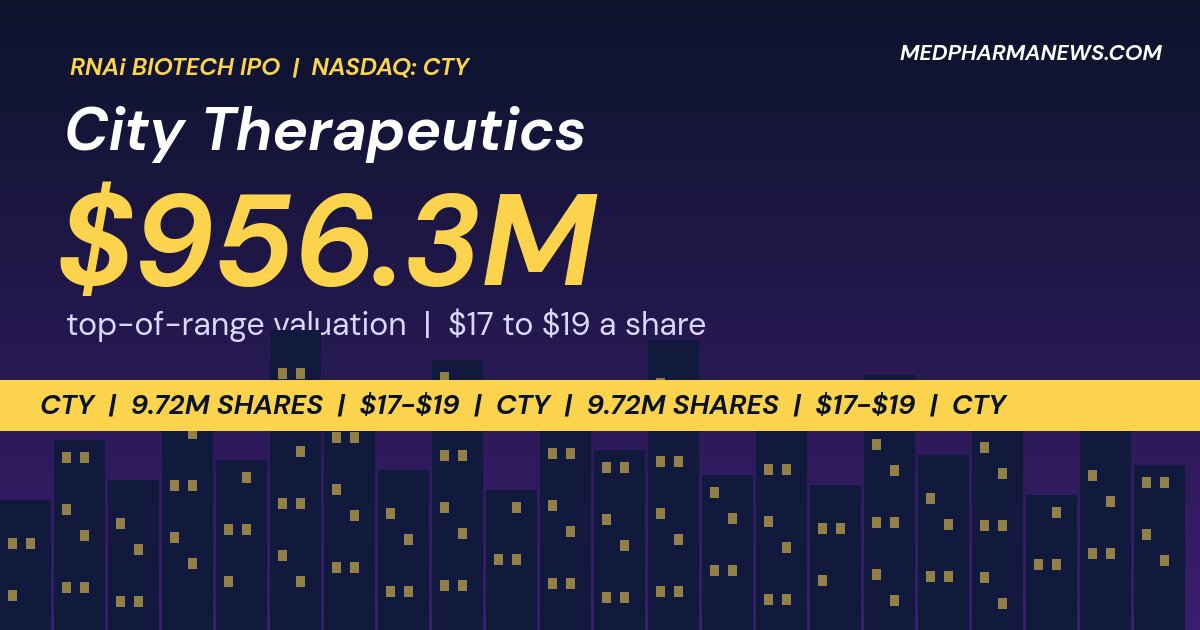
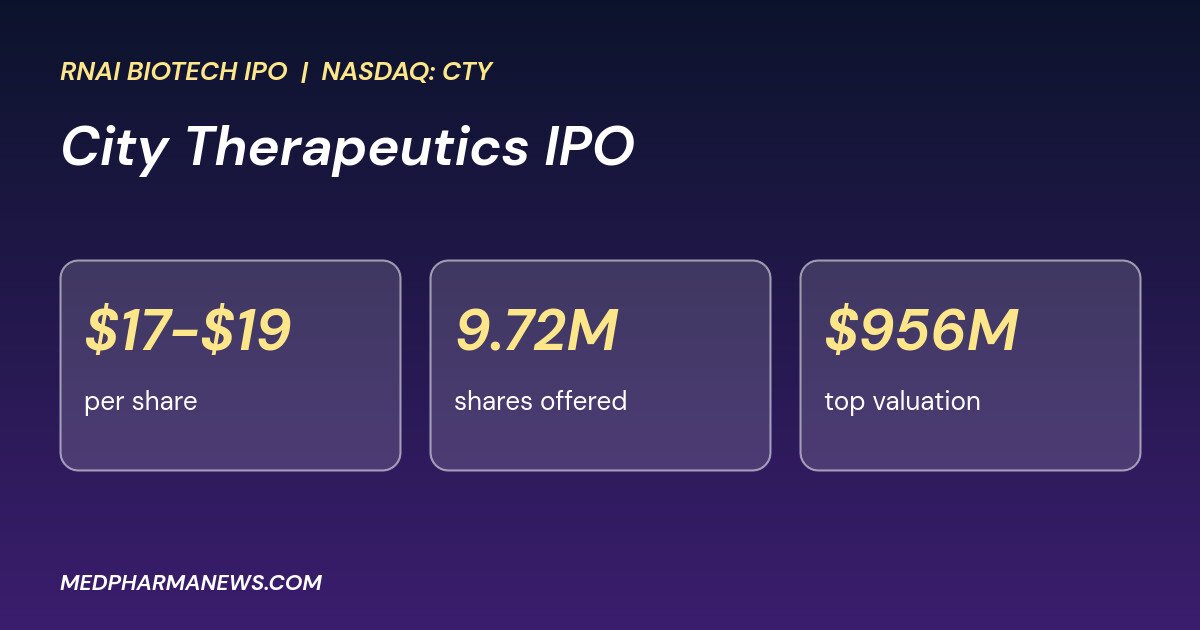
The City Therapeutics IPO now has a price tag. In an amended registration filed on 9 October 2026, City Therapeutics, a Cambridge, Massachusetts developer of RNA interference (RNAi) medicines, set terms to sell about 9.72 million shares at $17 to $19 each on the Nasdaq under the proposed ticker CTY. At the top of that range, the company would be valued at up to about $956.3 million, and the offering would raise roughly $185 million.
The company was founded only in July 2023 and has no approved products, so the valuation rests on its pipeline and on a push by biotech companies to list while investors are still buying. This report sets out the terms, the numbers behind the valuation, the science and the risks, using the filing as summarised in public reports.
City Therapeutics IPO: the terms
- Shares offered: about 9.72 million.
- Price range: $17.00 to $19.00 per share.
- Proceeds: about $174.96 million at the $18 midpoint.
- Valuation: about $905.98 million at the midpoint, rising to about $956.3 million at the top of the range.
- Exchange and ticker: Nasdaq, proposed symbol CTY.
- Joint book-runners: Goldman Sachs, Jefferies, Stifel and Oppenheimer & Co.
- Pricing date: not stated in the reports we reviewed; the offering has not priced.
The numbers behind the City Therapeutics IPO valuation
The figures hang together. The $956.3 million top-of-range valuation is about 5.5% above the $905.98 million midpoint, which matches the move from $18 to $19 a share. By our calculation, that implies roughly 50 million shares outstanding, a valuation of about $856 million at the bottom of the range, and proceeds of about $185 million at the top. The 9.72 million shares offered would then be roughly 19% of the company. These are our own estimates from the reported terms, not figures disclosed by the company.
On the financial side, one summary of the filing reports a net loss of $87.67 million and collaboration revenue of $14.34 million for the 12 months to 30 June 2026. Another summary rounds the revenue to $14 million and does not give the net loss, so readers should check the figures in the filing itself. The company is not profitable, which is normal for a clinical-stage biotech.
What City Therapeutics makes ahead of its IPO
RNAi drugs work by silencing the messenger RNA that carries the instructions for a specific protein, so that less of the protein is made. City says its medicines are designed to silence disease-relevant proteins, and its liver-targeted programmes use GalNAc conjugation, a chemical attachment that helps small interfering RNA (siRNA) reach liver cells. The company is led by chief executive Andy Orth, with John Maraganore, the former chief executive of Alnylam, as executive chair.
The company says it has three clinical-stage candidates:
- CITY-FXI: a GalNAc-conjugated siRNA against Factor XI, the lead programme, aimed at preventing thromboembolic events such as secondary stroke and clots linked to a type of atrial fibrillation. Phase 1 data are expected in late 2026, and a Phase 2 study in total knee arthroplasty is expected to start in mid-2027.
- CITY-RBP4: an siRNA against RBP4, the main carrier of vitamin A from the liver to the eye, for Stargardt disease, the most common inherited macular degeneration in children and young adults, which has no approved therapy. The company website says it is also being explored for geographic atrophy.
- CITY-TFR2: an siRNA against TFR2 to lower hepcidin, for anaemia of chronic disease, initially anaemia associated with myelofibrosis, with possible expansion to chronic kidney disease and inflammatory bowel disease.
City Therapeutics IPO lead programme: why Factor XI
Factor XI is a protein in the blood clotting cascade. The scientific idea is that blocking it reduces harmful clots while leaving more of the normal bleeding response intact than today’s anticoagulants, which carry bleeding risk. The company says reducing Factor XI activity while limiting bleeding risk is the goal. Several large drugmakers are pursuing the same target with other drug types, so City’s siRNA would enter a competitive field.
Early data reported for CITY-FXI come from the single-ascending-dose part of the Phase 1 study in healthy volunteers. According to a public summary of the filing, the drug was generally well tolerated, with Factor XI knockdown above 60% at 15 mg, close to 80% at 50 mg, and 85% three weeks after a 150 mg dose. These are company-reported pharmacodynamic results in healthy people: they show the drug lowers its target, not that it prevents clots or is safe over time.
City Therapeutics IPO partnerships
City has collaboration and licence agreements with Bausch + Lomb and Biogen. The reports we reviewed did not detail the terms of either, other than that collaboration revenue was $14.34 million in the latest 12 months. The Bausch + Lomb link fits with the Stargardt programme, but we have not seen confirmation of which programme each partner covers.
Why the City Therapeutics IPO matters: the biotech listing push
Reports describe a push by biotech companies to list, and City made its public filing around the same time as another RNAi company, ADARx Pharmaceuticals. For investors, an RNAi company with a lead programme in a hot target, two further programmes in rare and chronic disease, and partnerships looks like a familiar profile. In our assessment, the open question is valuation: roughly $0.9 billion for a company three years old and still in early clinical trials leaves little room for disappointment. For comparison, see our report on the AAVantgarde gene therapy data in Usher syndrome and Stargardt disease, or browse more industry insights.
Risks in the City Therapeutics IPO
- Early clinical data from healthy volunteers do not show efficacy in patients.
- Factor XI is a crowded field with well-funded rivals.
- The company has a net loss and will need more capital after the IPO.
- Newly listed biotech shares can be volatile.
- The prospectus, available through the SEC’s EDGAR database, is the authoritative source for risk factors and use of proceeds.
What to watch next for the City Therapeutics IPO
- Pricing of the offering and first-day trading.
- Late-2026 Phase 1 data for CITY-FXI.
- Start of the Phase 2 knee arthroplasty study in mid-2027.
- Progress of the Stargardt and anaemia programmes.
Bottom line on the City Therapeutics IPO
The City Therapeutics IPO sets terms of $17 to $19 a share on the Nasdaq, with a valuation of up to about $956 million at the top of the range. In our assessment, the City Therapeutics IPO is best read as a test of investor appetite for early-stage RNAi companies.
Frequently asked questions
What is the City Therapeutics IPO valuation?
Up to about $956.3 million at the top of the $17 to $19 range, and about $906 million at the midpoint.
How much will the City Therapeutics IPO raise?
About $175 million at the midpoint, from about 9.72 million shares.
What does City Therapeutics develop?
RNAi medicines for thromboembolic disease, Stargardt disease and anaemia of chronic disease.
What is its ticker?
CTY, proposed, on the Nasdaq.
Is the City Therapeutics IPO stock available yet?
No. The offering has not priced.
How we reported this: we relied on public summaries of City Therapeutics’s amended registration filing dated 9 October 2026 and on the company’s website. We did not read the filing itself. Figures labelled as ours are our own calculations. Last updated: 9 October 2026. This article is news reporting and not investment advice.