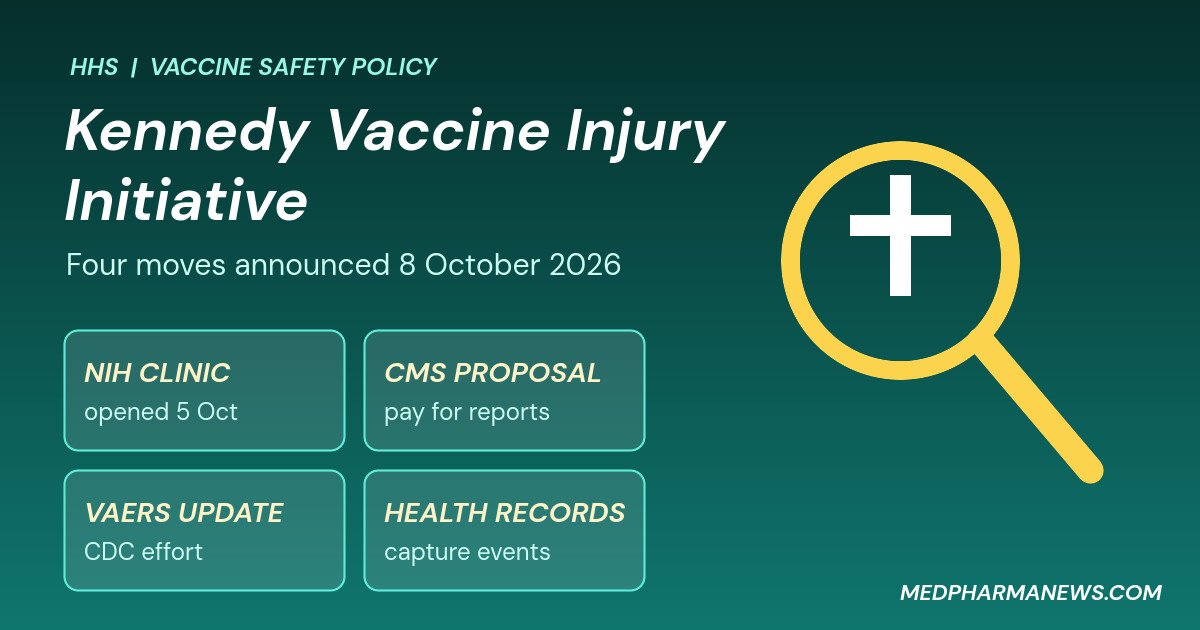
The vaccine injury initiative announced on 8 October 2026 by US Health Secretary Robert F. Kennedy Jr. is an agency-wide effort to study and document health problems that people report after vaccination. The US Department of Health and Human Services (HHS) said the programme centres on a clinic that opened on Monday, 5 October, at the National Institutes of Health (NIH) to treat and study patients who report such problems, and it adds changes to how adverse events are reported and recorded across the federal health system.
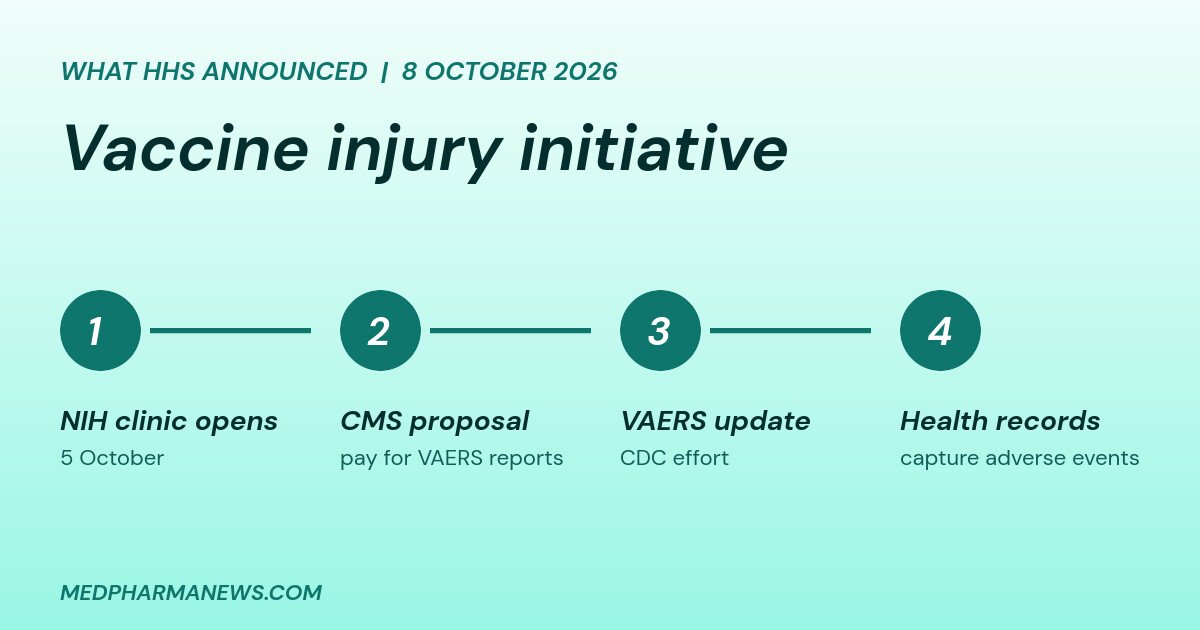
The vaccine injury initiative lands in the middle of a long dispute over vaccine policy, a court fight over the vaccine advisory committee and a measles resurgence. This report sets out what was announced, what remains unstated, the background on the existing compensation system, and what the medical establishment says.
At a glance: the vaccine injury initiative
- What: an HHS-wide push to study and document health problems reported after vaccination.
- When: announced Thursday 8 October 2026; the NIH clinic opened Monday 5 October.
- Four moves: an NIH clinic, a CMS proposal to pay doctors for reporting suspected injuries, an update of VAERS, and a requirement that electronic health records capture vaccine-related adverse events.
- Not disclosed in the reports we reviewed: budget, timeline, study design and who leads the research.
Vaccine injury initiative: the four moves
1. An NIH clinic for people who report problems
The centrepiece is a clinic at the NIH that opened this week to treat and study patients who report health problems after vaccination. HHS describes it as part of a wider effort to document those problems. The reports we reviewed did not say how patients are referred, what counts as eligibility, how many people the clinic can see, or what outcomes the researchers will measure. Those details decide whether the clinic produces findings that other scientists can test.
2. Payments for reporting suspected injuries
The Centers for Medicare & Medicaid Services (CMS) has proposed to pay physicians for reporting suspected vaccine injuries to the Vaccine Adverse Event Reporting System (VAERS), the CDC-run system that accepts reports from anyone. A proposal is not yet a rule, and the reports did not state the payment level or when the proposal would take effect. VAERS is a signal-detection tool: a report there means that someone described a health event after a vaccine, not that the vaccine caused it.
3. An update to VAERS
The CDC is working to update VAERS. Again, no specifics were given about what will change. Public health experts have long said VAERS data are hard to interpret on their own because reports are unverified and because some events would happen by chance in a large vaccinated population.
4. Adverse events in electronic health records
HHS also plans a requirement that electronic health records capture vaccine-related adverse events. Records-based surveillance can, in principle, link a vaccination to later diagnoses more reliably than voluntary reports, because it covers everyone who was vaccinated and not just those who chose to report. Whether the new requirement is designed that way is not yet clear.
How the existing compensation system works
The United States already has a no-fault route for people who believe a vaccine harmed them: the Vaccine Injury Compensation Program, run by the Health Resources and Services Administration. Claimants file against the government, not against vaccine makers. The federal Vaccine Injury Table lists 14 compensable injuries across 16 vaccine types. Since 1988, the programme has awarded roughly $5 billion across about 12,300 injury and death claims, according to the figures reported with the announcement.
By our calculation, that works out at about $400,000 for each of those claims, a crude average that assumes both figures describe the same set of compensated claims and that mixes injury and death awards. It is our own arithmetic, not an official statistic. The reports did not say whether the vaccine injury initiative would change the Vaccine Injury Table or the compensation programme, so readers should not assume it will.
Why the vaccine injury initiative is contested
Kennedy spent years questioning vaccine safety and founded an anti-vaccine group before taking office. He has said that American children receive too many vaccines, citing up to 90 doses before age 18, a claim that President Donald Trump has echoed. He has also argued that chemicals in vaccines are dangerous. Public coverage of the announcement notes that experts have found no evidence supporting that last claim.
The American Academy of Pediatrics says childhood vaccines are tested in placebo-controlled and comparison-group trials and are monitored for safety after approval. That is the mainstream position, and it is the standard against which any new study will be judged. In our assessment, the NIH clinic and better adverse-event data in the vaccine injury initiative are not controversial in themselves, since every regulator wants good safety surveillance. The dispute is over how the findings will be framed and whether the design can separate coincidence from cause.
The policy backdrop
Several earlier decisions explain why scientists are watching closely:
- In his first year at HHS, Kennedy fired all 17 independent members of the CDC’s Advisory Committee on Immunization Practices (ACIP) and appointed new members, many of whom share his views.
- In January, the CDC revamped the childhood schedule, dropping universal recommendations for influenza, rotavirus, hepatitis A, birth-dose hepatitis B, some meningitis vaccines and respiratory syncytial virus (RSV).
- In March, a federal court issued a preliminary injunction blocking key parts of those changes, finding that Kennedy and HHS violated federal law in reshaping ACIP. The injunction keeps ACIP from meeting to make recommendations on vaccines that are often needed for insurance coverage.
- Kennedy’s changes to the childhood schedule remain under legal challenge.
Why the vaccine injury initiative matters for public health
Public health experts are worried about falling immunisation rates, especially for measles, which has resurged in the United States since last year. A state-level example is our report on the Allegheny County measles case, and the same week brought a new global roadmap on hypertension in pregnancy that shows how safety work is usually done: with defined endpoints and published methods. More analysis is in our industry insights section.
The practical test for the vaccine injury initiative will be transparency. If HHS publishes the clinic’s protocol, the criteria for deciding that an injury is vaccine-related, and the data, outside scientists can assess it. If it does not, the programme will be read mainly as a signal of policy direction.
What we do not know yet about the vaccine injury initiative
- How much money the initiative has and where it comes from.
- Who runs the NIH clinic and who reviews its findings.
- Whether patients, doctors or both can refer people to the clinic.
- Whether the CMS proposal will be finalised, and at what payment level.
- What the VAERS update will change and when.
- Whether the vaccine injury initiative will feed into the compensation table.
What to watch next on the vaccine injury initiative
- The CMS proposed rule text and its public comment period.
- Any published protocol or first findings from the NIH clinic.
- The next steps in the court case over ACIP.
- Statements from medical societies on the new reporting requirements.
Frequently asked questions
What is the new HHS vaccine injury initiative?
It is an agency-wide effort announced on 8 October 2026 to study and document health problems reported after vaccination, built around an NIH clinic, VAERS changes, a CMS payment proposal and electronic health record reporting.
Does a VAERS report prove a vaccine caused harm?
No. VAERS accepts unverified reports of events after vaccination. It is used to spot possible safety signals that are then investigated by other methods.
What does the Vaccine Injury Compensation Program cover?
It is a no-fault system that compensates for injuries listed on the Vaccine Injury Table, which names 14 injuries across 16 vaccine types, and it has paid roughly $5 billion since 1988.
What do paediatricians say about childhood vaccine safety?
The American Academy of Pediatrics says childhood vaccines are tested in placebo-controlled and comparison-group trials and monitored after approval.
Has funding for the vaccine injury initiative been announced?
Not in the reports we reviewed.
How we reported this: we relied on public summaries of the 8 October 2026 HHS announcement and on the official HHS, VAERS and HRSA pages linked above. We did not see the HHS press materials in full, so details not stated here may exist. Figures labelled as ours are our own calculations. Last updated: 9 October 2026. This article is news reporting and not medical advice.