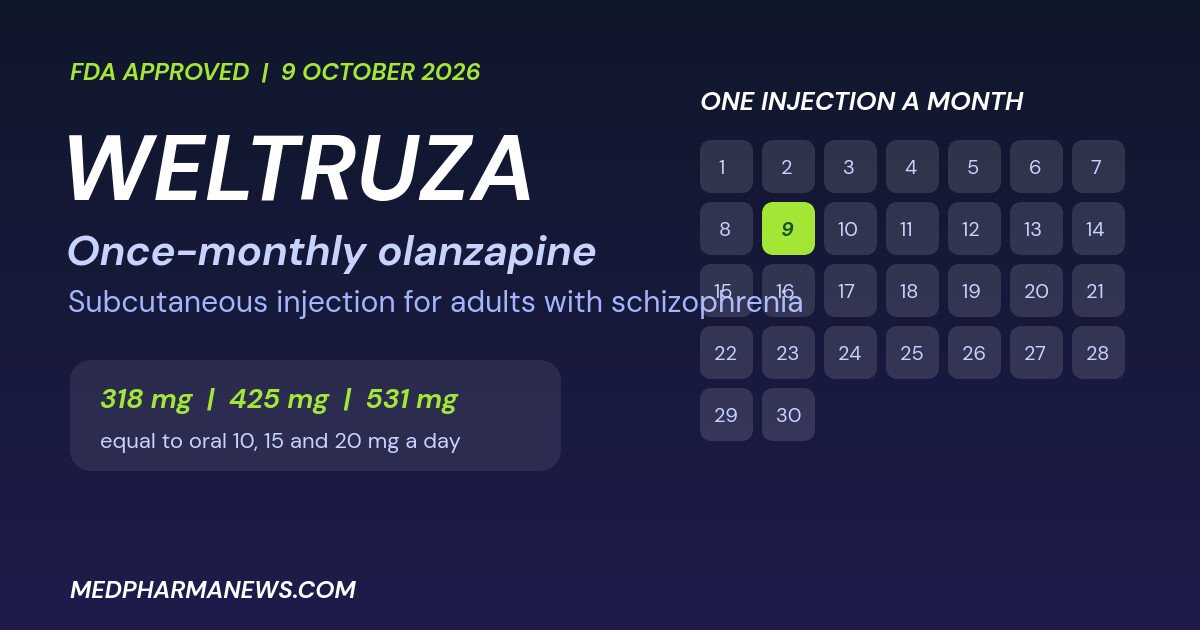
The Weltruza FDA approval gives people with schizophrenia a new long-acting option built around one of the most widely used antipsychotics. On 9 October 2026, Teva Pharmaceuticals announced that the US Food and Drug Administration (FDA) has approved Weltruza (olanzapine) extended-release injectable suspension for adults with schizophrenia. Teva describes it as the first and only once-monthly subcutaneous long-acting injectable olanzapine, requiring no loading doses, no oral supplementation and no post-injection monitoring.
US availability is expected in the coming weeks. Below we set out the dosing, the evidence behind the approval, the safety information, and the questions that the company announcement leaves open.
Weltruza FDA approval at a glance
- Drug: olanzapine extended-release injectable suspension, given under the skin (subcutaneously) once a month.
- Indication: schizophrenia in adults.
- Strengths: 318 mg, 425 mg and 531 mg, corresponding to oral olanzapine 10 mg, 15 mg and 20 mg a day.
- Technology: SteadyTeq, a copolymer system proprietary to Medincell, for controlled release.
- Launch: expected in the US in the coming weeks.
- Other regions: the European Medicines Agency accepted the marketing application in May 2026; it is not yet approved in the EU.
Why the Weltruza FDA approval matters: a monthly olanzapine injection
Teva notes that olanzapine is the most widely prescribed atypical antipsychotic for schizophrenia in its daily oral form, and that difficulty taking medicine every day raises the risk of instability and relapse. Long-acting injectables address that by replacing daily tablets with a single scheduled injection. About 2.1 million people in the United States are diagnosed with schizophrenia, according to the company, so even a niche share of that group is a substantial market.
Olanzapine itself is effective but is also associated with weight gain and metabolic effects, which has long complicated its use. That is why the safety data matter as much as the convenience claim.
A monthly schedule also changes the relationship between patient and clinic. A scheduled injection gives the care team a regular point of contact, makes missed doses visible, and removes the daily decision about whether to take a tablet. For some patients that predictability is the main attraction; for others, the idea of a depot injection that cannot easily be stopped is a concern, which is why shared decision-making between patient and prescriber remains central.
How the Weltruza FDA approval compares with the existing olanzapine injection
The only other long-acting olanzapine injection on the US market, Zyprexa Relprevv, is given into muscle every two to four weeks. As background, it carries a boxed warning for post-injection delirium/sedation syndrome (PDSS), a rare but serious reaction, and patients must be observed in a healthcare setting for several hours after each injection. Weltruza’s selling point is that it avoids that requirement. Teva says there is no post-injection monitoring. The safety information in the approval announcement still lists PDSS and notes it is unknown whether it occurs with Weltruza, so the practical position is that none was seen in trials, rather than proven impossible. The release does not say whether the label contains a boxed warning for PDSS.
The SOLARIS trial behind the Weltruza FDA approval
- Design: an 8-week, multinational, randomised, double-blind, placebo-controlled study in adults aged 18 to 64 with schizophrenia, followed by a 48-week open-label period.
- Size: 675 patients randomised 1:1:1:1 to low, medium or high-dose Weltruza, or placebo.
- Endpoints: the primary endpoint was the PANSS total score, a standard measure of symptom severity; key secondary endpoints were CGI-S (clinician-rated severity) and PSP (personal and social functioning).
- Result: Teva reports improvement on all three measures. The approval announcement gives no numbers.
Earlier topline reports on SOLARIS in 2024 put the placebo-adjusted PANSS improvement at roughly 9.7 to 11.3 points across the three doses, all statistically significant. We have not checked those against the final label, and they come from company announcements and press coverage, not a peer-reviewed paper.
Safety data behind the Weltruza FDA approval
In the approval announcement, the most common adverse events were increased weight, sleepiness (somnolence), headache, constipation and injection-site reactions. Discontinuations because of common adverse events were 5% and 4%, which Teva describes as consistent with placebo. Long-term data released by Medincell, covering up to 56 weeks, reported no suspected or confirmed PDSS events across 3,470 injections, weight increase in 36% of participants, and a mean weight gain of 5.6 kg among the 137 participants treated for at least 48 weeks. Those long-term figures are company data on file.
The Important Safety Information lists the usual class warnings, including increased mortality in elderly patients with dementia-related psychosis, stroke in elderly patients, neuroleptic malignant syndrome, DRESS, metabolic changes, tardive dyskinesia, orthostatic hypotension and falls, low white blood cell counts, swallowing problems, seizures and raised prolactin. Pregnancy and breastfeeding risks are also described.
In our assessment of the Weltruza FDA approval
The approval is clinically meaningful if the no-monitoring claim holds in everyday practice, because the biggest barrier to the older olanzapine injection has been logistics rather than efficacy. The trade-off is the usual one for olanzapine: a mean weight gain of 5.6 kg over a year is substantial, and clinicians will need to monitor weight, glucose and lipids. For Teva, which already sells a long-acting risperidone injection, Uzedy, this extends its position in long-acting antipsychotics to a second major molecule. Commercial success will depend on payer coverage, price relative to existing injections and real-world safety.
For related drug-delivery coverage, see our report on Ensera’s alliance network for drug-device combination products, or browse more pharmaceutical news.
What to watch next after the Weltruza FDA approval
- The US launch date, price and payer coverage.
- The final label wording on PDSS and any monitoring requirements.
- Real-world weight and metabolic data from early users.
- The European Medicines Agency decision.
Bottom line on the Weltruza FDA approval
The Weltruza FDA approval gives adults with schizophrenia a once-monthly subcutaneous olanzapine injection from Teva. In our assessment, the Weltruza FDA approval matters most for the extra choice it adds among long-acting treatments, and prescribers will want the full label for dosing and safety.
Frequently asked questions
What is Weltruza?
A once-monthly subcutaneous olanzapine extended-release injectable suspension for adults with schizophrenia, approved by the FDA on the basis of announcements dated 9 October 2026.
How often is it given?
Once a month, in one of three strengths: 318 mg, 425 mg or 531 mg.
Does it need loading doses or monitoring after injection?
Teva says it requires no loading doses, no oral supplementation and no post-injection monitoring.
What are the main side effects?
Weight gain, sleepiness, headache, constipation and injection-site reactions.
When will it be available?
Teva expects US availability in the coming weeks.
How we reported this: we relied on Teva’s announcement of 9 October 2026 and on company reports of the SOLARIS trial. Background on the older injection is general knowledge. Our commentary is labelled. Last updated: 9 October 2026. This article is news reporting and not medical advice.