Ovarian cancer that stops responding to platinum chemotherapy is among the hardest situations in gynaecologic oncology, and treatment options narrow quickly. On 3 October 2026, Genmab reported late-breaking data on Rina-S (rinatabart sesutecan) in that setting: 45.9% of 109 patients had a confirmed objective response, with responses lasting a median of 12.1 months. The results were presented in a late-breaking oral session at the International Gynecologic Cancer Society (IGCS) congress in Montreal, according to the company announcement.
Key Takeaways
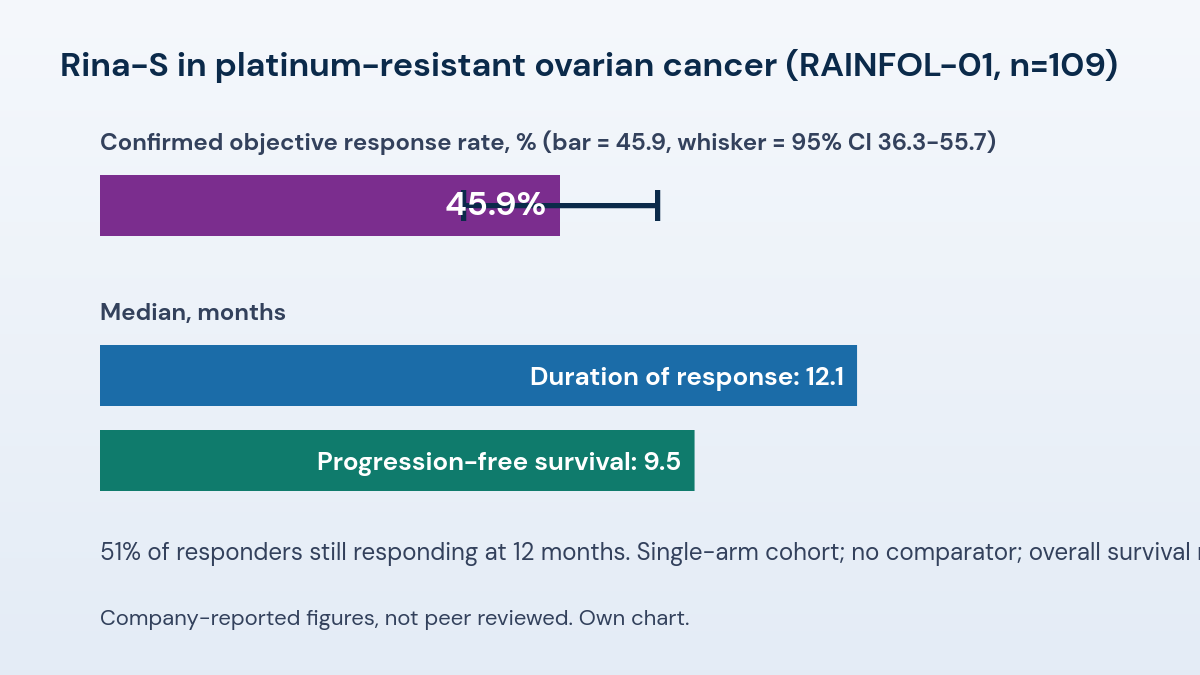
- In the Part C cohort of the RAINFOL-01 study, Rina-S at 120 mg/m² every three weeks produced a 45.9% confirmed objective response rate (95% CI 36.3 to 55.7) in 109 patients with platinum-resistant ovarian cancer, including five complete responses.
- Median duration of response was 12.1 months (95% CI 6.5 to 15.4), and 51% of responders were still responding at 12 months. Median progression-free survival was 9.5 months (95% CI 7.6 to 11.3).
- Genmab says activity was seen regardless of folate receptor alpha (FRα) expression, including in low-expressing and non-expressing tumours, and regardless of prior mirvetuximab.
- Safety was manageable in the company’s account, but about a third of patients had serious adverse events and 5.5% stopped treatment because of them.
- This was a single-arm study with no comparator. Overall survival and quality-of-life data were not part of the announcement.
Why Platinum Resistance Is Such a Hard Problem
Platinum-based chemotherapy is the backbone of first-line treatment for ovarian cancer. Most patients respond at first, but many relapse, and when the cancer returns within about six months of the last platinum dose it is called platinum-resistant. At that point the cancer is less sensitive to further chemotherapy, responses tend to be short, and each additional line of treatment usually does less than the last. That is why even a modest improvement in response and durability can matter to patients, and why new options such as antibody-drug conjugates are being studied so intensively.
What Was Reported?
| Measure | Reported result |
|---|---|
| Study | RAINFOL-01, Part C cohort (Phase 1/2), single arm |
| Patients | 109 with platinum-resistant ovarian cancer |
| Dose | Rina-S 120 mg/m² every 3 weeks |
| Confirmed ORR | 45.9% (95% CI 36.3 to 55.7); 5 complete responses |
| Median duration of response | 12.1 months (95% CI 6.5 to 15.4) |
| Responders still responding at 12 months | 51% |
| Median PFS | 9.5 months (95% CI 7.6 to 11.3) |
| Serious adverse events | About 33% |
| Discontinuation for adverse events | 5.5% |
| Presented | IGCS 2026, Montreal, 3 October 2026 (late-breaking oral) |
The percentages are company-reported and come from a single-arm cohort, so they describe what happened in these patients and do not prove that Rina-S works better than chemotherapy. That question is the job of the Phase 3 programme. A confirmed response means the tumour shrinkage was seen again on a later scan, which makes the figure more reliable than unconfirmed rates, but it does not tell us how patients felt or how long they lived.
How Does Rina-S Work?
Rina-S is an antibody-drug conjugate, a drug that links a tumour-seeking antibody to a cell-killing payload. The antibody targets FRα, a protein found on many ovarian cancer cells, and the payload is a topoisomerase I inhibitor, exatecan, which damages DNA once the drug is taken up by the cell. A key selling point, according to Genmab, is that responses were not confined to tumours with high FRα levels, which could widen the population who might benefit compared with approaches aimed only at high-expressing disease.
Who Were the Patients?
The patients had received one to three prior lines of therapy, or up to four if mirvetuximab was the last treatment, and 53% had received three or four prior lines. All had previously received bevacizumab and a taxane, 49.5% had a PARP inhibitor, and 33% had mirvetuximab. In other words, this was a heavily pretreated group, which makes a 45.9% response rate notable but also means the numbers should be read in the context of a selected single-arm cohort.
What About Safety?
The most common treatment-emergent adverse events were nausea (67.9%), fatigue (57.8%), anaemia (57.8%), neutropenia (57.8%), vomiting (36.7%) and thrombocytopenia (34.9%). Serious adverse events affected about 33% of participants and 5.5% discontinued because of treatment-related events. Genmab reports no signal of ocular toxicity, peripheral neuropathy, interstitial lung disease or stomatitis, side effects that matter in this drug class. Tahamtan Ahmadi, Genmab’s chief medical officer, said the late-breaking results add an important layer of evidence to the growing clinical experience with Rina-S.
What Happens Next?
Genmab says several Phase 3 studies are advancing: RAINFOL-02 in platinum-resistant ovarian cancer, RAINFOL-03 in endometrial cancer, RAINFOL-04 in platinum-sensitive maintenance and RAINFOL-07 in second-line platinum-sensitive disease. A randomised trial in platinum-resistant disease will be the real test, because it will compare Rina-S with standard chemotherapy on outcomes such as survival.
For background on the disease, the US National Cancer Institute explains how ovarian cancer is staged and treated. Genmab cites more than 320,000 new cases a year worldwide and recurrence in 70% to 90% of patients with advanced-stage disease.
What Is Not Yet Known
- Overall survival, and whether response and progression-free survival translate into longer life.
- How Rina-S compares with chemotherapy or other ADCs in a randomised trial.
- Long-term safety, including late toxicities after extended dosing.
- Regulatory plans and timing, which were not given in the announcement.
Related Coverage
For more on antibody-drug conjugates and deal-making, see our reports on the AstraZeneca, Daiichi Sankyo and Summit deal, Terumo Neuro’s Arsenal Medical deal and Samfara’s first buyout.
Our Assessment
In our assessment, the headline number is strong for a heavily pretreated population, and the apparent independence from FRα levels is the most commercially interesting finding. But a response rate from one arm of a Phase 1/2 study is the start of the case, not the end. We would watch the overall survival data and the first randomised results before drawing conclusions, and we would treat cross-trial comparisons with other drugs with caution.
Frequently Asked Questions
What is Rina-S?
Rinatabart sesutecan, an investigational FRα-targeted antibody-drug conjugate carrying a topoisomerase I inhibitor payload.
What response rate did Rina-S achieve in platinum-resistant ovarian cancer?
45.9% confirmed objective response rate in 109 patients, including five complete responses.
How long did responses last?
The median duration of response was 12.1 months, and 51% of responders were still responding at 12 months.
Does Rina-S work only in tumours with high FRα?
According to Genmab, responses occurred regardless of FRα expression, including in low-expressing and non-expressing tumours.
Is Rina-S approved?
No. It is investigational, and Phase 3 trials are under way.
How we reported this: details come from Genmab’s announcement of results presented on 3 October 2026. Efficacy and safety figures are company-reported, from a single-arm cohort, and have not been peer reviewed. This is not medical advice. Last updated 6 October 2026.