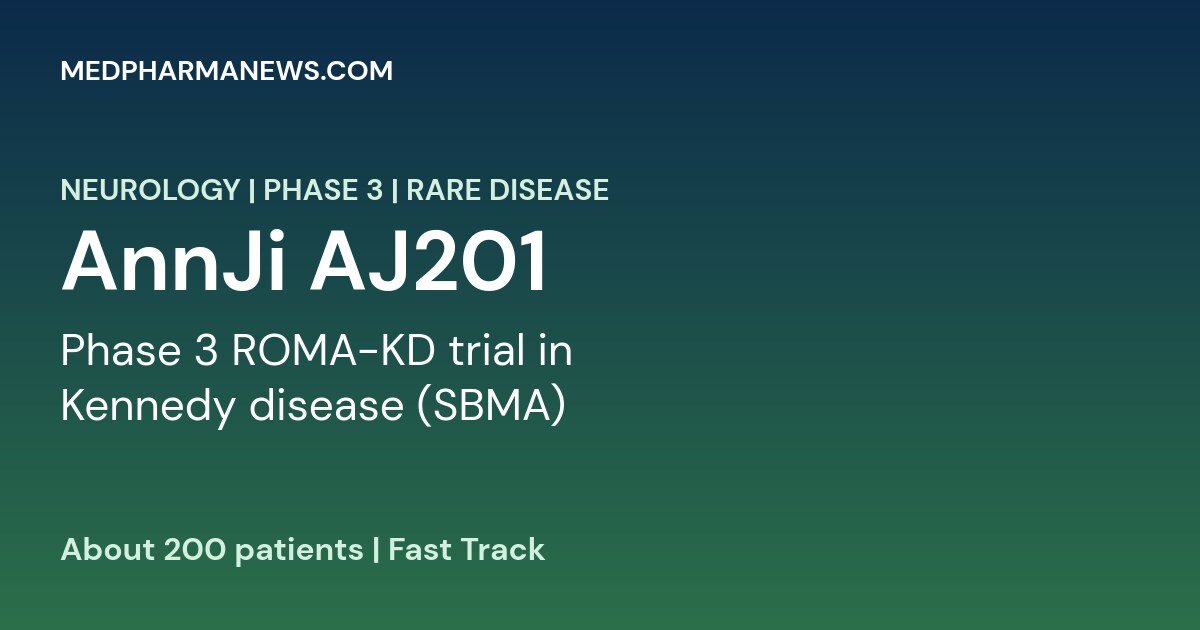
For people with Kennedy’s disease, the illness is felt in everyday moments, a staircase that becomes harder to climb, as AnnJi Pharmaceutical’s chair and chief executive, Dr Wendy Huang, put it in the company announcement. This week the Taipei-based company said it is moving AJ201 (rosolutamide) into the pivotal Phase 3 ROMA-KD trial for spinal and bulbar muscular atrophy (SBMA), the formal name of Kennedy’s disease. There is currently no FDA-approved treatment for the condition, according to the company.
Key Takeaways
- ROMA-KD is a global, multicentre, randomised, double-blind, placebo-controlled Phase 3 trial planned to enrol about 200 ambulatory people with symptomatic SBMA, with the United States as a key region.
- AJ201 is an investigational oral small molecule that, the company says, promotes clearance of the mutant androgen receptor protein and activates cellular stress-response pathways including Nrf1, Nrf2 and HSF1.
- It holds US FDA Fast Track Designation and Orphan Drug Designation in the US and EU.
- Reports of the earlier Phase 1/2 study describe exploratory, not-powered-for-efficacy signals on walking distance, function and the target protein; the Phase 3 is designed to test whether those signals translate into clinical benefit.
- Enrolment is reported to be expected from late 2026. The announcement did not state the primary endpoint or trial duration.
What Is Kennedy’s Disease?
SBMA, also called Kennedy’s disease, is a rare inherited neuromuscular condition. It is X-linked, so it mainly affects men, and is caused by an expanded repeat in the androgen receptor gene. The mutant receptor protein accumulates in nerve cells that control muscles, causing progressive weakness and wasting in the limbs and in the muscles used for speaking and swallowing. Patient resources such as the Kennedy’s Disease Association and the US National Library of Medicine page on spinal and bulbar muscular atrophy describe the course in detail. Progression is usually slow, which makes it hard to show a drug effect in a short trial and is one reason endpoint choice will matter in ROMA-KD.
How Is AJ201 Meant to Work?
Most approaches to hormone-related disease try to block the androgen receptor. In SBMA the problem is different: the receptor is mutated and toxic when it clumps inside cells, especially when activated by male hormones. AJ201, also known as JM17, is described by AnnJi as promoting the clearance of the pathogenic mutant protein while switching on the cell’s own stress-response systems, which help cells cope with misfolded proteins and oxidative stress. If that works in people, it would act on a root cause of the disease and not merely on its symptoms. This is the company’s mechanism of action; the Phase 3 will test whether it changes outcomes.
What Did the Earlier Study Show?
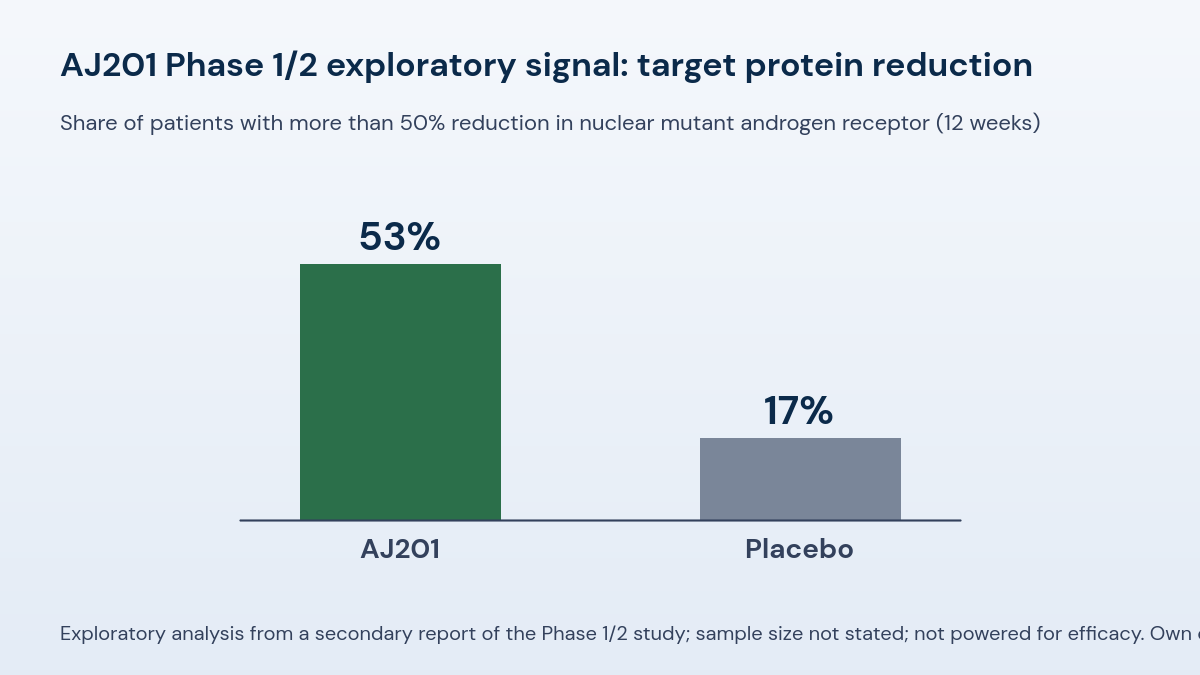
AnnJi announced Phase 2 results in May 2025, calling them encouraging. Reports of the exploratory 12-week analysis say patients on AJ201 gained about 17.6 metres on the six-minute walk test relative to placebo and about 0.8 points on the SBMA Functional Rating Scale, and that 53% of treated patients had more than a 50% reduction in nuclear mutant androgen receptor compared with 17% on placebo. We have not seen the underlying paper, the sample size was not given in the material we reviewed, and the study was not powered to detect efficacy, so these figures are best read as hypothesis-generating.
The ROMA-KD Trial at a Glance
| Feature | Detail |
|---|---|
| Sponsor | AnnJi Pharmaceutical (Taipei; TPEx: 7754) |
| Drug | AJ201 (rosolutamide; JM17), oral small molecule |
| Trial | ROMA-KD, pivotal Phase 3 |
| Design | Global, multicentre, randomised, double-blind, placebo-controlled |
| Size | About 200 ambulatory patients with symptomatic SBMA |
| Key region | United States |
| Designations | FDA Fast Track; Orphan Drug (US and EU) |
| Enrolment | Reported to be expected from late 2026 |
| Not disclosed | Primary endpoint, duration, dose, sites |
A Fast Track designation allows more frequent interaction with the FDA and, if the criteria are met, rolling review of an application. Orphan Drug Designation provides incentives such as development support and market exclusivity for drugs aimed at rare conditions. Neither designation means the drug works or will be approved.
Who Is AnnJi?
AnnJi Pharmaceutical is a clinical-stage company headquartered in Taipei and listed on the Taipei Exchange under the code 7754. It develops treatments in neurology, dermatology and immune-inflammatory diseases. A pivotal trial is a big step for a company of this size, and the cost and speed of enrolment in a rare disease will be among the practical challenges.
What We Do Not Yet Know
- The primary and key secondary endpoints, and how long patients will be treated.
- The trial sites and dose, and when the first patient will be dosed.
- The full Phase 2 data, including safety, in a peer-reviewed form.
- Whether a roughly 200-patient trial is large enough to show a difference in a slowly progressing disease.
- How the company plans to fund the trial.
Related Coverage
For more on rare-disease and pharma deal news, see our reports on the AstraZeneca, Daiichi Sankyo and Summit deal, Ensera’s alliance network and Samfara’s first buyout.
Our Assessment
In our assessment, the move into Phase 3 is encouraging for a community with no approved therapy, and the biological target is well chosen. The open question is endpoints. In a slowly progressing disease, a placebo-controlled study of this size can succeed only if the chosen measures move within the trial period, and the earlier results were exploratory. We will be looking for the endpoint details and for the first enrolment news.
Frequently Asked Questions
What is AJ201?
AJ201, also called rosolutamide or JM17, is an investigational oral small molecule for SBMA that promotes clearance of mutant androgen receptor protein, according to AnnJi.
What is Kennedy’s disease?
It is spinal and bulbar muscular atrophy (SBMA), a rare inherited neuromuscular disease that mainly affects men.
What is the ROMA-KD trial?
A global Phase 3 randomised, double-blind, placebo-controlled study planned in about 200 ambulatory patients with symptomatic SBMA.
Is there an approved treatment for SBMA?
According to the company, there is currently no FDA-approved treatment.
Does AJ201 have regulatory designations?
Yes: US FDA Fast Track Designation and Orphan Drug Designation in the US and EU.
How we reported this: details come from AnnJi Pharmaceutical’s recent announcement and related reports. Trial design, mechanism and earlier-study figures are company-reported or from secondary reports and have not been peer reviewed. This is not medical advice. Last updated 6 October 2026.