The New York measles outbreak has reached the point where Governor Kathy Hochul’s office says the state cannot manage it alone. On 7 October 2026, a spokesperson said the governor will make a “detailed and specific request for assistance from the federal government,” including from the US Department of Health and Human Services (HHS) and the Centers for Disease Control and Prevention (CDC). The state had declared a statewide disaster emergency earlier the same week to widen vaccination access and contain the spread.
The request is politically charged, because the federal health secretary has questioned measles deaths reported by states and some governors have been wary of asking Washington for help. This report sets out the case numbers, what the federal government has and has not offered, how the outbreak compares with other states, and what families can do now.
The New York measles outbreak in brief
- Cases: 108 measles cases in New York through 3 October 2026.
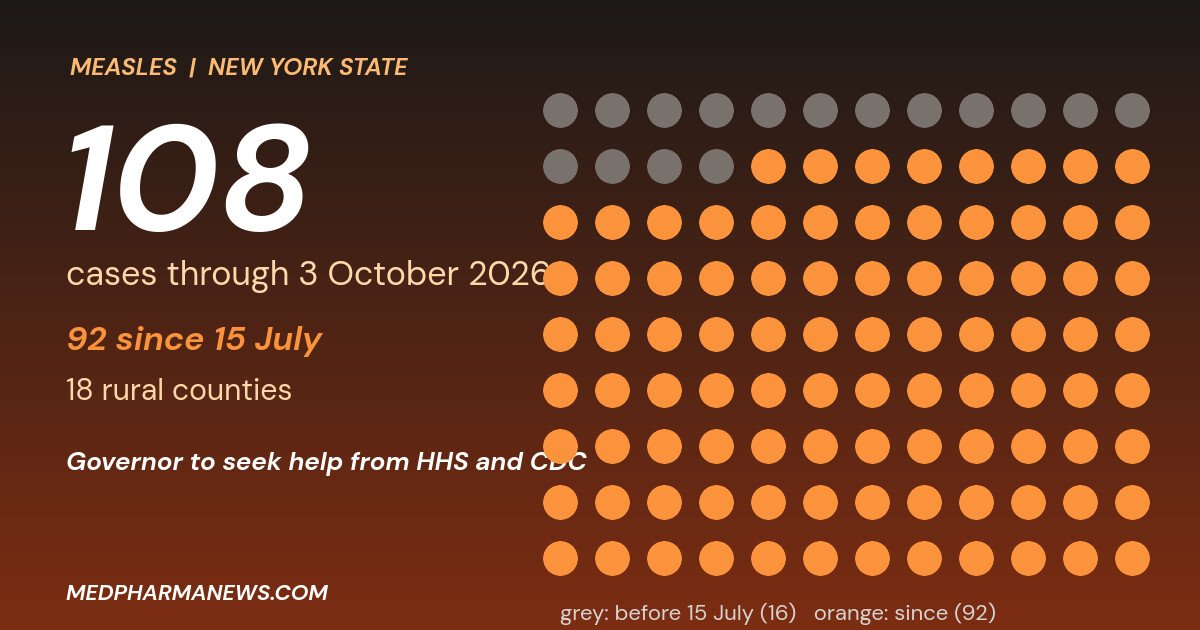
- Recent surge: 92 of them reported since 15 July, in under-immunised rural communities across 18 counties.
- The ask: a detailed request to HHS and the CDC, according to the governor’s spokesperson, Nicolette Simmonds.
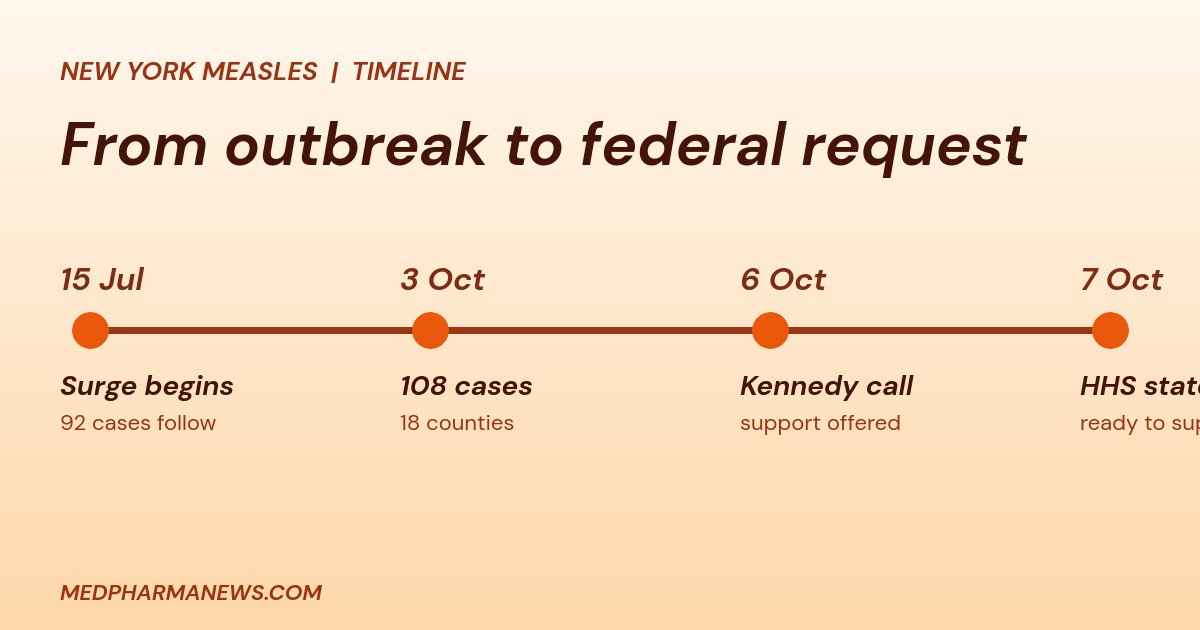
- The federal reply so far: HHS Secretary Robert F. Kennedy Jr. offered support in a call on Tuesday 6 October and put the governor in touch with CDC Director Erica Schwartz.
- Still unknown: what specific help New York will ask for, and what Washington will provide.
New York measles outbreak: what the numbers show
Through 3 October, the New York measles outbreak had reached 108 cases. Most of them are recent: 92 have been reported since 15 July. By our calculation, that is about 85% of all cases in under 12 weeks, or roughly eight new cases a week on average, which implies only about 16 cases before mid-July. Those are our own estimates from the reported totals, not figures published by the state, and an average hides the fact that outbreaks move in bursts.
The cases are concentrated in rural communities with low vaccination coverage, spread across 18 counties. That geography matters. Measles needs a very high level of community immunity to stay out, and pockets of under-immunised children let the virus find each other even when statewide averages look reasonable. Rural areas can also have fewer clinics, longer travel to a doctor and fewer pharmacies offering vaccine, which makes catch-up harder.
New York measles outbreak: the emergency declaration
New York’s declaration of a statewide disaster emergency, issued earlier in the week of 5 October, is meant to expand access to vaccination and speed up containment. A disaster emergency lets a governor adjust rules quickly, for example to widen who can give vaccines and where, and to move resources between agencies. We have not seen the full text of the order. The New York State Department of Health publishes case counts, exposure notices and guidance on its measles page, and that is the place to check for the order’s terms and for local clinics.
New York measles outbreak: what was said about federal help
The governor’s spokesperson said: “No state can address this on its own,” and that the governor would partner with anyone who can support the effort. Kennedy offered federal support in a call with Hochul on Tuesday 6 October, according to the reports we reviewed, and connected her with Schwartz at the CDC. On Wednesday 7 October, HHS said federal health officials stand ready to support New York’s response.
Schwartz, speaking at a health conference the same day, said Hochul had contacted Kennedy and that he had given Hochul her contact information. She gave no further details about what help would follow, and recommended the measles, mumps and rubella (MMR) vaccine. The state health department had not responded to a request for comment in the reports we reviewed. In short, what is confirmed is the intention to ask and a federal offer to help, not a signed deal or a deployment of staff.
Why a request to the CDC is sensitive
Kennedy has questioned measles-related deaths reported by states, which makes CDC assistance politically charged. Pennsylvania, which has recorded more than 1,000 cases this year, has resisted seeking CDC help after Kennedy disputed the virus’s role in deaths there in an exchange on social media with Governor Josh Shapiro. Texas and Virginia, by contrast, have sought CDC assistance. In the New York measles outbreak, the state has now chosen to ask, which is a notable choice for a large state. We covered an earlier local case in our report on the Allegheny County measles case in Pennsylvania.
The dispute over deaths is a factual one that public health agencies settle by reviewing death certificates and clinical records. Readers should note that counts of deaths differ between state officials and the CDC in some reports, and that we have not tried to resolve them here.
What federal help means in the New York measles outbreak
In general, CDC support to a state can include epidemiologists who help trace contacts, laboratory testing, guidance on exposure control, and vaccine supply planning. The CDC generally works in a state at the state’s request, which is why the governor’s request matters. Which of these New York will seek has not been published. In our assessment, the most useful assistance for the New York measles outbreak is likely to be contact-tracing capacity and vaccination outreach, but that is our view, not an announced plan.
What measles does, and why vaccination matters
According to the Centers for Disease Control and Prevention (CDC), measles is one of the most contagious diseases known: up to nine in ten unprotected people who are exposed to an infected person will catch it, and the virus can linger in the air for up to two hours after the person has left a room. Complications are most common in babies and young children, and about one in five unvaccinated people who get measles is hospitalised. The CDC says that between one and three in every 1,000 children with measles die.
The vaccine is the best protection. Two doses of MMR are about 97% effective against measles and one dose about 93%. The CDC recommends a first dose at 12 to 15 months and a second at 4 to 6 years, and earlier doses are possible for infants travelling or in outbreak settings. Our recent coverage of public health systems, including a new push on vaccine injuries from the US health secretary, shows how closely vaccine policy and outbreak response are now linked.
What families can do during the New York measles outbreak
- Check your children’s records and confirm both MMR doses.
- Adults born in 1957 or later with no proof of immunity can ask a doctor about vaccination.
- Call ahead before visiting a clinic or emergency room if you suspect measles, so staff can isolate you.
- Watch for fever, cough, runny nose, red eyes and a rash that begins on the face, and stay home if unwell.
- Follow the health department’s exposure notices for your county.
What to watch next in the New York measles outbreak
- The content of New York’s formal request and the federal response, including any CDC team deployment.
- Weekly case counts from the state, to see whether the pace of about eight cases a week slows.
- Whether other states follow Texas, Virginia and New York in seeking CDC help.
- Vaccination uptake in the 18 affected counties after the emergency declaration.
- More analysis in our industry insights section.
Frequently asked questions
How many cases are in the New York measles outbreak?
108 cases through 3 October 2026, with 92 reported since 15 July across 18 counties.
Is the New York measles outbreak prompting a federal request?
Yes. The governor’s office said she will make a detailed and specific request to HHS and the CDC, after Kennedy offered support on 6 October.
Has federal help arrived?
Not as far as the reports we reviewed show. HHS said officials stand ready to support the response.
How effective is the MMR vaccine?
Two doses are about 97% effective against measles, according to the CDC.
Where can I find local measles updates?
On the New York State Department of Health measles page and your county health department website.
How we reported this: we relied on public reports of statements made on 6 and 7 October 2026 by the governor’s office, HHS and the CDC director, and on the official health department and CDC pages linked above. We did not see the emergency order or the formal federal request. Figures labelled as ours are our own calculations. Last updated: 9 October 2026. This article is news reporting and not medical advice.