For the Gilead cancer drug pipeline, the new Vir Biotechnology agreement is a low-cost option on three early programmes. On 14 October 2026, Vir Biotechnology announced that Gilead has an exclusive license to advance three dual-masked T-cell engager candidates against solid-tumour antigens. Headline value is up to about $1.88 billion, but the guaranteed money is $90 million upfront, and the candidates have not yet been tested in people.
This report reads the deal as a piece of portfolio strategy: how it is structured, what each side takes on, and what we do and do not know about Gilead’s plans.
Gilead cancer drug pipeline: key takeaways
- Vir designs and optimises three T-cell engager candidates. Gilead holds the exclusive license to nominate, develop, make and sell them.
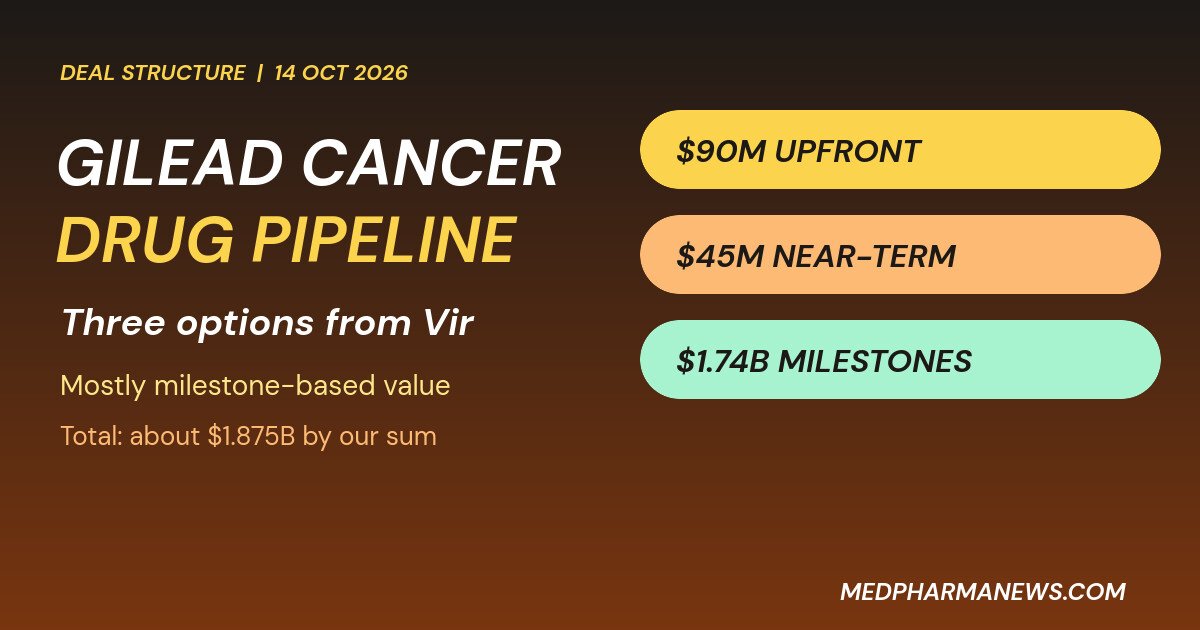
- Upfront: $90 million ($65 million cash and a $25 million equity investment at a 30% premium).
- Up to $45 million in near-term preclinical milestones and up to $1.74 billion in later milestones, plus royalties from high single digits to low double digits.
- By our sum the total is $1.875 billion, which is why reports say $1.87 billion or $1.88 billion.
- The announcement does not describe Gilead’s wider oncology strategy.
How the Gilead cancer drug pipeline deal is structured
The structure is a classic early-stage licensing deal. The licensor does the discovery work, the licensee takes over once candidates are chosen, and most of the value is paid on milestones. By our arithmetic, the $90 million upfront is about 4.8% of the total, and the $135 million of upfront and near-term money is about 7.2%. That means about 93% of the headline depends on success in development, regulatory approval and sales. For Gilead, the committed outlay is small relative to the potential. For Vir, the headline is large but the cash it can count on is modest.
Part of the upfront payment is equity. Gilead is paying $25 million for Vir shares at a 30% premium, an amount that ties it a little closer to Vir’s fortunes. The announcement does not state the share price used for the premium or the number of shares.
What Gilead is getting for its cancer drug pipeline
Gilead obtains rights to three candidates built on Vir’s PRO-XTEN masking technology. The masks are designed to keep a T-cell engager inactive until enzymes in the tumour remove them, with the aim of lowering toxicity, widening the therapeutic index and potentially allowing less frequent dosing. Vir also contributes its T-cell engager discovery and protein engineering expertise and a platform it calls dAIsY, which uses artificial intelligence to optimise candidates.
The targets are described only as selected solid-tumour antigens. Without the targets or tumour types, outsiders cannot judge how crowded the field is for each programme. We found no statement from Gilead about where these candidates would sit within its existing oncology work, and we do not speculate.
What Vir is getting from the Gilead cancer drug pipeline move
For Vir, the deal brings cash and a major partner for a second collaboration built on the same masking platform. Marianne De Backer, Vir’s president and CEO, said T-cell engagers have a powerful role to play in the future of cancer immunotherapy. Vir keeps its own clinical-stage portfolio, which includes chronic hepatitis delta and multiple dual-masked T-cell engagers, and holds exclusive rights to the platform in oncology and infectious disease. PRO-XTEN is a trademark of Amunix Pharmaceuticals, a Sanofi company. Flavius Martin, Gilead’s executive vice president of research, said the companies seek to bring meaningful innovative therapeutics to patients.
What success would look like for the Gilead cancer drug pipeline
Success in a deal like this comes in stages. The first is practical: Vir delivers candidates that meet the agreed criteria, which unlocks the preclinical milestones of up to $45 million. The second is Gilead’s decision to nominate and advance one or more candidates. The third, and by far the most valuable, is human data showing that a candidate is safe and active. Only then do the large development, regulatory and commercial milestones come into play. Each step is uncertain, and the announcement gives no timetable for any of them.
Why deals like the Gilead cancer drug pipeline bet are popular
Large drugmakers often prefer to license early programmes and pay mostly on milestones, because it lets them test several technologies without paying for all of them upfront. For smaller companies, such agreements fund research and provide external validation. The trade-off is that the smaller company gives up control over later development. For another deal story, see our report on Samfara Makes Debut Buyout With Danish API Maker Chr. Olesen Synthesis and more coverage in pharmaceuticals.
Risks and caveats for the Gilead cancer drug pipeline
- The three candidates are at the discovery stage. Early results often do not predict later ones.
- Milestone payments depend on events that may never occur, and Gilead can choose not to advance a candidate.
- Neither company has named the targets or tumour types.
- The announcement includes standard warnings about preclinical and clinical data, delays, manufacturing, regulation, competition and litigation. More detail is in Vir’s filings with the SEC’s EDGAR database.
In our assessment, the sensible reading is modest: a platform has won a respected licensee, and the licensee has bought an inexpensive option. Whether it matters to the Gilead cancer drug pipeline depends on the first nominated candidate and on early human data, which are still some way off.
What to watch next for the Gilead cancer drug pipeline
- Disclosure of targets and Gilead’s first nomination.
- Payment of the first preclinical milestones.
- Details of the equity purchase in regulatory filings.
- First-in-human data from Vir’s own masked T-cell engagers.
Frequently asked questions
What did Gilead agree with Vir?
An exclusive license to develop and commercialise three masked T-cell engagers for solid tumours, designed by Vir, announced on 14 October 2026.
How much will Vir receive upfront?
$90 million, of which $65 million is cash and $25 million is an equity investment at a 30% premium.
How big could the deal become?
About $1.875 billion by our sum of the announced parts, if all milestones are met.
Does the deal change the Gilead cancer drug pipeline right away?
It adds three discovery-stage options. No candidate is in clinical trials.
How we reported this: we relied on Vir Biotechnology’s announcement of 14 October 2026 and the websites of the companies named. Figures labelled as ours are our own calculations. Last updated: 15 October 2026. This article is news reporting and not investment or medical advice.