The race to bring new celiac disease drugs to patients has a fresh data point, and a roadmap to go with it. On 12 October 2026, First Tracks Biotherapeutics (Nasdaq: TRAX) reported positive top-line results from a Phase 1b gluten-challenge study of ANB033, an injected antibody that blocks CD122. In 32 evaluable patients, the company says the drug protected the intestinal lining and prevented a rise in symptoms versus placebo. A late-stage trial is anticipated to start in 2027.
This report takes the business and pipeline view: what the result means for the company’s plans, what milestones come next, and what a small early study cannot prove.
New celiac disease drugs: key takeaways
- The result: statistically significant benefit on three tissue measures and on daily symptom scores in a 14-day gluten challenge, as reported by the company.
- The numbers: 17 patients on ANB033, 15 on placebo; no serious adverse events in either group.
- The plan: more celiac data in the first quarter of 2027 and a late-stage celiac trial anticipated in 2027.
- The status: ANB033 already holds the FDA’s Fast Track designation, which speeds interaction with the agency but does not approve a drug.
- The catch: small, early and company-reported, with the dose undisclosed.
What First Tracks announced about new celiac disease drugs
The company said ANB033 met the goals of Cohort 1 of its Phase 1b study. Participants received three loading doses under the skin and then ate 6 grams of gluten daily for 14 days. At week 6, the villus height to crypt depth ratio fell 0.17 on ANB033 against 0.66 on placebo (p=0.009).
Intraepithelial lymphocyte density, a marker of immune activity in the gut lining, rose 18.83 on placebo and changed by -1.20 on ANB033 (p below 0.001). Symptom scores and the use of relief medicine (47% on placebo, 6% on ANB033) followed the same direction.
On safety, there were no serious adverse events, and the company reports no safety signals to date. Injection-site redness was the one common event that was higher with the drug, at 27.8% versus 12.5% on placebo.
Why the result matters for new celiac disease drugs
The standard approach for celiac disease remains a strict gluten-free diet, as the NIDDK describes. Drug developers are therefore trying to show that a medicine can protect the gut when gluten gets in. A placebo-controlled challenge with both biopsy and symptom data is a cleaner test of that idea than an open-label study, which is why the consistency of the tissue and symptom findings is the heart of this announcement.
Chief medical officer Paul Lizzul said that consistency strengthens the company’s confidence in the underlying biology.
It is still a single small study. The company itself has described it as small, and on the investor call management noted that cross-trial comparisons are limited because there are no head-to-head studies.
How to read the numbers behind new celiac disease drugs
A few details help put the headline in proportion. Thirty-four people were in the safety analysis, but 32 were evaluable, because two randomised participants left before the gluten challenge and had no week-6 biopsy. On the investor call, management said the average baseline ratio was 2.75 in both groups, so the arms started from a similar place.
By our arithmetic, the fall in the villus-to-crypt ratio on ANB033 was roughly a quarter of the fall on placebo (0.17 against 0.66). That is a large relative difference, but it comes from 17 and 15 patients, and a few patients can move an average in a study this size. The company has not disclosed the dose, so the figures cannot yet be matched to a regimen.
The roadmap for ANB033 among new celiac disease drugs
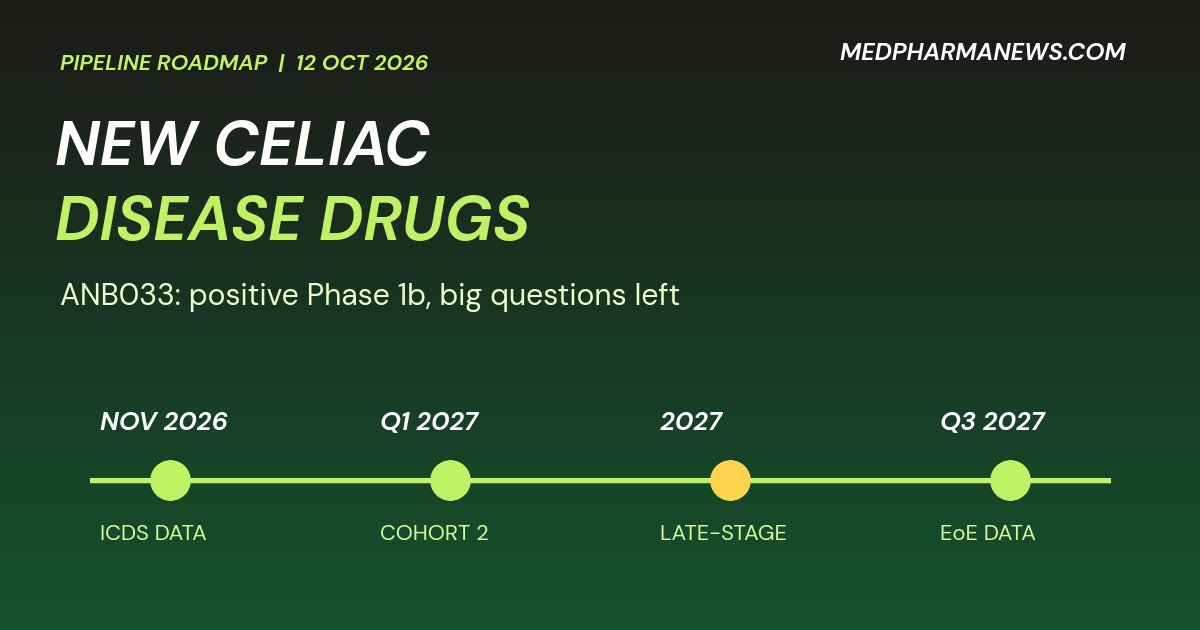
- November 2026: full data at ICDS in Melbourne.
- First quarter of 2027: top-line data from Cohort 2, which tests mucosal healing over 12 weeks in patients with a wide range of damage and symptoms and no gluten challenge.
- 2027: a late-stage celiac trial is anticipated, pending regulator talks. Management said Cohort 2 is not a gating factor.
- First half of 2027: planned Phase 2 starts in vitiligo and one further indication.
- Third quarter of 2027: top-line data from a 50-patient eosinophilic esophagitis cohort.
Beyond ANB033, the company lists rosnilimab, a T-cell depleter for rheumatoid arthritis, and ANB101, a BDCA2 modulator, in its pipeline. For another early-stage immunology trial we covered, see Agomab Doses First Patient in Ontunisertib Crohn’s Disease Phase 2b Trial: A Pivotal Step and our pharmaceuticals section.
What the result does not tell us about new celiac disease drugs
- Durability: a two-week challenge says little about months of benefit.
- Dose: the amount has not been disclosed, and management said higher doses will not be tested, though lower doses with longer intervals may be explored later.
- Translational data, such as IL-2 kinetics, were not yet available.
- Funding: late-stage trials are expensive, and the company lists funding of development as a risk. We did not find a statement of cash runway in the materials we reviewed.
- Market size: management’s estimate of a market above $20 billion for US adult patients is the company’s own projection and is unverified.
In our assessment, the announcement strengthens the case for a late-stage trial but does not decide it. Investors and clinicians will want the full data, the dose and a second cohort before drawing firm conclusions. Standard forward-looking warnings appear in the company’s filings on the SEC’s EDGAR database.
What to watch next for new celiac disease drugs
- Presentation details and any dose disclosure at ICDS.
- The Cohort 2 readout in the first quarter of 2027.
- Alignment with the FDA on the design of the late-stage trial.
Questions about new celiac disease drugs and ANB033
Who is developing ANB033?
First Tracks Biotherapeutics, a clinical-stage company working on antibodies for autoimmune and inflammatory diseases.
Are there approved new celiac disease drugs yet?
The standard approach remains a strict gluten-free diet. ANB033 is investigational and not approved.
What is the next ANB033 milestone?
Cohort 2 top-line data in celiac disease, expected in the first quarter of 2027.
Does Fast Track mean the drug will be approved?
No. It is designed to facilitate development and review, not to guarantee approval.
How we reported this: we relied on First Tracks Biotherapeutics’ announcement of 12 October 2026 and its investor call. Statements about market size and plans are management’s. Last updated: 15 October 2026. This article is news reporting and not investment or medical advice.