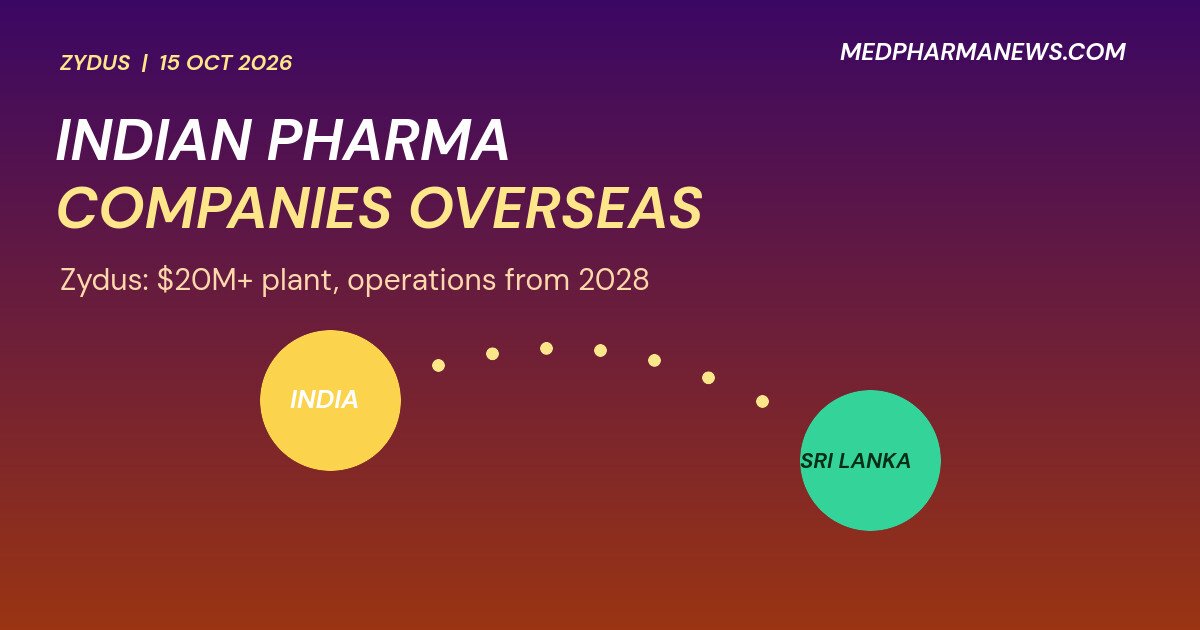
Indian pharma companies overseas are increasingly weighing local plants against exports, and Zydus Lifesciences has just taken a concrete step in that direction. Reports dated 15 October 2026 say Zydus has signed an agreement with the Board of Investment of Sri Lanka for a facility in Horana, Sri Lanka, run through the joint venture Zydus Sunshine Lifesciences.
Planned investment is above $20 million, and commercial operations are expected from 2028. The plant would move Zydus from selling into Sri Lanka to making there, with a local partner.
This report takes the sector view. It sets out the facts of the project, what they say about the strategy behind overseas plants, and what we cannot conclude from one deal.
Indian pharma companies overseas: key takeaways
- The deal: Zydus Lifesciences and Sunshine Healthcare of Sri Lanka are building a plant in the Horana investment zone through a joint venture.
- The size: more than $20 million in phases for the project; a report puts Zydus’s own equity commitment at up to $5 million.
- The timing: commercial operations expected from 2028, subject to execution and approvals.
- The focus: pharmaceutical products for the Sri Lankan retail market; a report says phase one is tablets and capsules.
- The limit: this is one company and one market, so it does not show a sector-wide trend.
What Zydus and Sunshine announced to Indian pharma companies overseas
In the joint-venture announcement of 26 June 2026, the partners said they would build a pharmaceutical manufacturing facility in Sri Lanka and laid a foundation stone the same day. Zydus Lifesciences’ managing director, Dr Sharvil Patel, said “strong local capabilities are key to resilient healthcare ecosystems.”
Sunshine Holdings’ group chief executive, Shyam Sathasivam, called it “a strategic investment in Sri Lanka’s healthcare security and industrial growth.” Reports say the October agreement with the Board of Investment was signed on 13 October 2026.
The partners list technology transfer, local capability, jobs, reduced import dependence and better access to medicines as goals. Zydus contributes manufacturing expertise, and Sunshine contributes local distribution and retail strength; Patel said Sunshine has marketed products in Sri Lanka for over 30 years. More on the partner is on Sunshine Holdings.
Why Indian pharma companies overseas build local plants
The partners’ own reasons are about supply security and local capability. Beyond that, the following is our analysis, not company statements. A local plant can put a manufacturer closer to patients and regulators, support pricing and registration in a market that favours domestic production, and give a partner more control over supply.
The trade-offs are capital tied up in a small market, regulatory exposure and the work of running a plant abroad. For a venture like this one, where reports say there is no government buy-back guarantee, demand has to come from the private retail market.
What this deal shows about Indian pharma companies overseas
Taken alone, the Sri Lanka project shows three things. First, the structure is a joint venture rather than a wholly owned subsidiary, which spreads capital and local risk. Second, the product scope is modest: oral solid dosage forms for one market. Third, the timing is long: about two years from announcement to expected commercial operations. It would be a mistake to draw a trend from this single case, and we have not seen data in these announcements about other companies’ overseas plans.
The plant also sits under the oversight of Sri Lanka’s investment board, with the National Medicines Regulatory Authority and the Ministry of Health as stakeholders. Products are to comply with the regulator’s rules and applicable pricing frameworks, which sets limits on how the venture can price.
The road from agreement to production for Indian pharma companies overseas
The company text gives no stage-by-stage schedule, so what follows is our general reading of how such projects usually proceed, not a Zydus plan. After the agreement come site works and construction, then equipment installation and qualification, then product registration with the national regulator, and finally commercial batches.
Each stage can slip, and the expected 2028 start is explicitly subject to project execution and regulatory clearances. A reader tracking this project should therefore treat the date as a target, not a commitment, until construction milestones are announced.
Risks and caveats for Indian pharma companies overseas
- Execution: the plant is not built yet, and the 2028 date depends on construction and approvals.
- Undisclosed details: capacity, the full product list and revenue targets have not been published.
- Scale: a venture with no turnover to date is a long way from contributing to group results.
- Source gaps: ownership detail and the equity figure come from reports of the exchange disclosure, which we could not read directly.
In our assessment, this is a sensible and carefully sized step among Indian pharma companies overseas, and it is best read as a regional supply play rather than a signal about the whole industry. The real test is whether the plant ships products on schedule and at prices that work for the local market. For another cross-border manufacturing deal we covered, see Samfara Makes Debut Buyout With Danish API Maker Chr. Olesen Synthesis and our pharmaceuticals section.
What to watch next for Indian pharma companies overseas
- Construction and approval milestones in Sri Lanka.
- A product list and capacity numbers.
- Final shareholding details and equity subscription.
- Whether other Indian drugmakers announce local plants in nearby markets. We have no information that they will.
Questions on Indian pharma companies overseas and the Zydus plant
Who is building the Sri Lanka plant?
Zydus Sunshine Lifesciences, a joint venture between Zydus Lifesciences and Sunshine Healthcare.
How much will it cost?
More than $20 million is planned for the project. Zydus’s own equity commitment is reported at up to $5 million.
When will it open?
Commercial operations are expected from 2028.
Does this mean more Indian pharma companies are going overseas?
One deal cannot show a trend. It is an example of one company choosing local manufacturing with a local partner.
How we reported this: we relied on the Zydus Lifesciences and Sunshine Healthcare announcement of 26 June 2026 and on reports of the October agreement and exchange disclosure. Sections marked as our analysis are opinion. Last updated: 15 October 2026. This article is news reporting and not investment advice.