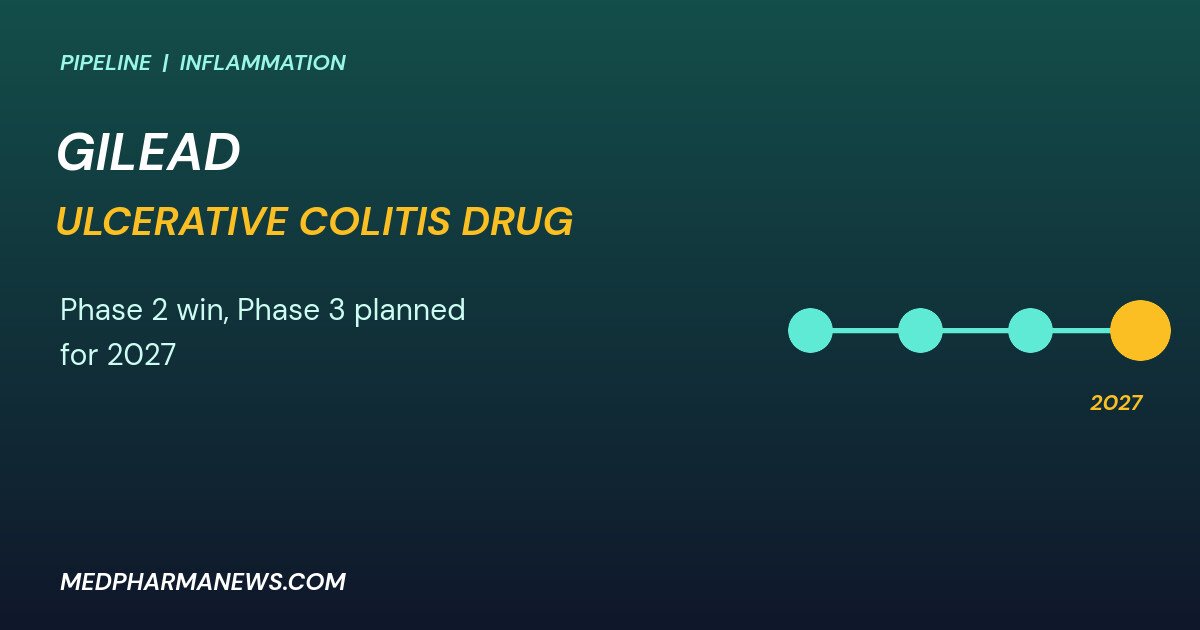
The Gilead ulcerative colitis drug emvistegrast has cleared its first major hurdle, and the company’s next steps say as much about its inflammation strategy as the data do. On 19 October 2026 Gilead reported that the once-daily oral pill met the primary endpoint of the Phase 2 SWIFT study, with 66% of people on the 200 mg dose showing a clinical response at week 12 versus 37% on placebo. The company plans a Phase 3 monotherapy study in 2027 and sees the drug as a possible backbone for combinations. This report covers the data, the plan and the open questions. It is not investment advice.
Gilead ulcerative colitis drug: key takeaways
- Emvistegrast is investigational, once-daily and oral, and was discovered and developed internally at Gilead, per the company.
- It met the SWIFT primary endpoint: 66% clinical response on 200 mg versus 37% on placebo at week 12.
- Gilead plans a Phase 3 monotherapy study in 2027 and sees the drug as a potential backbone for combination approaches.
- Only the 200 mg dose is reported against placebo, and maintenance data are pending.
- The drug is not approved anywhere, and no financial guidance was given.
The data behind the Gilead ulcerative colitis drug
According to the Gilead statement, SWIFT randomised 238 adults with moderately to severely active ulcerative colitis to emvistegrast 200 mg, 75 mg, 25 mg or placebo. In the 12-week induction phase, clinical response on 200 mg was 39 of 59 (66%) versus 22 of 60 (37%) on placebo, with a nominal p-value below 0.001. Clinical remission was 31% versus 8%, and mucosal healing 24% versus 10%. Adverse events were 36% on the drug versus 37% on placebo, per Gilead. The trial registry entry lists the study as GS-1427.
The Gilead ulcerative colitis drug strategy: what the company said
Swati Tole, senior vice president of clinical development for inflammation, said Gilead plans to start a Phase 3 monotherapy study in 2027 and sees emvistegrast as a potential backbone for future combination approaches. Wenjun Ouyang, senior vice president of inflammation research, stressed that the drug was discovered and developed internally and reflects the company’s medicinal chemistry and immunology expertise. The release adds that Gilead has several complementary inflammation programmes. It does not name them, so we do not speculate about which might be combined.
Why a backbone matters for the Gilead ulcerative colitis drug
This is our general explanation. A backbone drug is one that forms the base of a treatment regimen, to which other medicines can be added. In chronic inflammatory disease, doctors sometimes combine therapies when one is not enough. For a company, a drug that is safe and effective on its own and that combines well could anchor several development paths. Whether emvistegrast can play that role is unknown, because the release gives no data on combinations or on long-term safety.
The target and the competitive field
Gilead describes the alpha-4 beta-7 pathway as a clinically validated target in inflammatory bowel disease, and says emvistegrast is a once-daily oral inhibitor of it. The release does not compare the drug with other treatments, and we do not map competitors or rank the data against other programmes, because no comparable head-to-head information has been published. Cross-trial comparisons are unreliable in any case, since populations and designs differ.
The Gilead ulcerative colitis drug: Phase 2 to Phase 3 hurdles
General background: a Phase 3 study is larger, runs longer and is designed to give regulators the evidence they need to decide on approval. Drugs that look promising in Phase 2 can fall short there, for example if the placebo response is larger, if benefits fade over time or if rarer side effects emerge. Gilead has said the SWIFT study will continue through maintenance, which will give an early read on durability before Phase 3 begins. The company has not set out the Phase 3 design, so details such as size and endpoints remain open.
What partners and clinicians will look for
This section is our analysis, not a company statement. Clinicians will want to see whether responders keep their response through week 52, whether remission rates rise or fade, and how patients who had tried an earlier advanced therapy fared compared with those who had not, since Gilead says 22% had failed one or two. Industry readers will watch the safety record as exposure grows and whether the lower doses add information on dose choice. The release offers none of these cuts yet, and we do not infer them.
What the study does not yet show about the Gilead ulcerative colitis drug
Results for the 75 mg and 25 mg doses are not reported in the statement. Maintenance outcomes through week 52 and an extension to week 116 are still to come. The p-values are nominal, the placebo response was substantial and the safety database is small. Gilead says serious adverse events occurred in 4 of 178 people on the drug, all judged unrelated, and that 3 of 238 participants stopped because of side effects.
What is not disclosed
- Efficacy data for the lower doses.
- Design, size and endpoints for the Phase 3 study.
- Any plan for combination studies and timing.
- Financial expectations or investment levels for the programme.
Risks and caveats on the Gilead ulcerative colitis drug
- Data come from a company statement and a late-breaking conference abstract.
- Phase 2 success often does not carry over to Phase 3.
- Our explanation of backbone therapy is general background.
- This is news reporting, not investment, medical or legal advice.
In our assessment, the Gilead ulcerative colitis drug gives the company a credible oral candidate to carry into Phase 3 in 2027, and the combination ambition will matter only if the monotherapy data hold up through maintenance. See also AstraZeneca Pays $40 Million Upfront in AI Pact With insitro. More in our pharmaceuticals coverage, and company background is on the Gilead website.
What to watch next on the Gilead ulcerative colitis drug
- SWIFT maintenance and extension results.
- Disclosure of the lower-dose data.
- Start and design of the Phase 3 monotherapy study in 2027.
Frequently asked questions
What is emvistegrast?
An investigational once-daily oral alpha-4 beta-7 integrin inhibitor from Gilead for ulcerative colitis.
What are Gilead’s next steps?
A Phase 3 monotherapy study is planned for 2027, and the company sees the drug as a potential backbone for combinations.
Is it approved?
No. It is investigational and not approved anywhere.
How we reported this: we relied on Gilead’s statement of 19 October 2026 and the trial registry. Our analysis is labelled. Last updated: 20 October 2026. This article is news reporting and not investment, medical or legal advice.