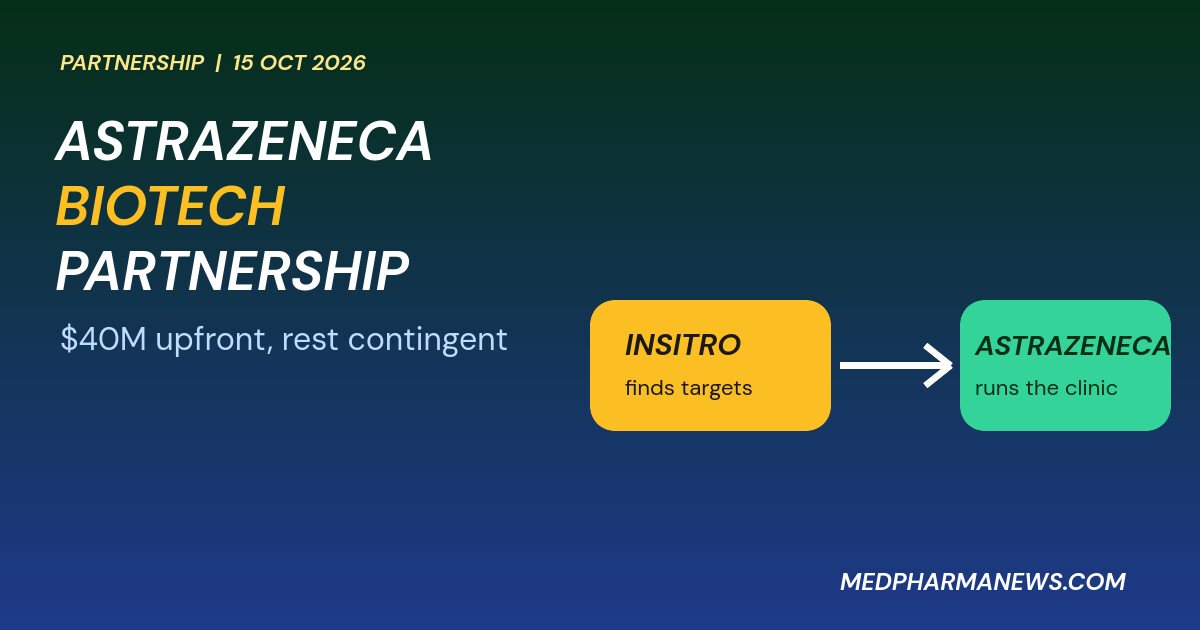
The AstraZeneca biotechnology partnership with insitro is a clear example of how large drugmakers now buy access to early science: a small upfront payment, a long list of contingent milestones and exclusive rights to the best results. In its release of 15 October 2026, AstraZeneca said it will pay insitro $40 million upfront, with up to approximately $1.46 billion more in development and commercial milestones and potential royalties, to find treatments for metabolic dysfunction-associated steatohepatitis (MASH) and cardiomyopathies. This report looks at the economics and the structure.
The headline total of about $1.5 billion is a ceiling. The sections below separate what is paid now from what may never be paid.
AstraZeneca biotechnology partnership: key takeaways
- Paid now: $40 million upfront to insitro.
- Contingent: up to approximately $1.46 billion in development and commercial milestones, plus potential single-digit royalties on global sales.
- Control: AstraZeneca holds exclusive worldwide rights to advance selected programmes.
- Division of labour: insitro finds targets and takes AstraZeneca-nominated targets to a development candidate; AstraZeneca brings clinical and regulatory expertise.
- Unknowns: the length of the collaboration, the number of programmes and any candidate names.
How the AstraZeneca biotechnology partnership is built
The release describes a strategic drug-discovery collaboration and licensing agreement. insitro will apply its Virtual Human platform, which combines large-scale human and cellular data with AI, to identify causal disease biology in MASH and cardiomyopathies. It will then advance targets nominated by AstraZeneca from discovery to a development candidate. AstraZeneca then takes over the clinical and regulatory work for the programmes it selects, using its development and regulatory expertise.
Sharon Barr, AstraZeneca’s executive vice president and head of BioPharmaceuticals R&D, said “one of the most critical decisions in R&D is selecting the right target.” That sentence explains why the company is willing to pay for platform access: target choice is where much of the risk in drug development sits.
The economics of the AstraZeneca biotechnology partnership, in our arithmetic
By our arithmetic, the $40 million upfront is about 2.7% of the roughly $1.5 billion total, so about 97% is contingent. For comparison, in the Vir Biotechnology and Gilead agreement we covered, the $90 million upfront was about 4.8% of a total we calculated at $1.875 billion; see Gilead Cancer Drug Pipeline Gets Bold Bet With Vir. Both are our own sums from announced figures and the structures are not identical, but they show the same pattern: the guaranteed share is small and the rest depends on development success.
For insitro, the upfront funds work now and the milestones reward success. For AstraZeneca, the cost of testing a platform is limited, and the downside is capped if programmes fail early.
How to read the $1.5 billion headline
Headlines that round upfront and milestone payments into a single number can mislead. Here the $1.5 billion is our sum of $40 million and the “up to approximately” $1.46 billion in milestones, and the second figure is a ceiling that assumes every development and commercial trigger is met. A more useful way to read the deal is in two parts: a modest payment that is certain, and a large option that is not. Readers should also note that the release gives no breakdown of which milestones come first, so the timing of any further payments is unknown.
Who carries the risk in the AstraZeneca biotechnology partnership
In a structure like this, the risk is divided unevenly. insitro carries the scientific risk, because its payments depend on programmes reaching later stages. AstraZeneca carries the cost of whatever it chooses to take into the clinic, which is where development spending rises sharply, though the release does not say how those costs will be shared. Investors in either company should therefore watch for programme selection decisions, because that is when AstraZeneca commits more money and when milestone payments may be triggered. We have not seen financial guidance from either company on this deal, and nothing in the announcement suggests it will change reported results soon.
Why these diseases for an AstraZeneca biotechnology partnership
The release places the collaboration within AstraZeneca’s cardiovascular, renal and metabolism work, which it describes as focused on links between the heart, kidneys, liver and pancreas. MASH and cardiomyopathies are described as complex and heterogeneous diseases with significant unmet need. insitro’s founder and chief executive, Daphne Koller, said “MASH and cardiomyopathies are prevalent, underdiagnosed diseases.” AstraZeneca is a global company headquartered in Cambridge, UK, with medicines sold in more than 125 countries, as its investor relations pages note.
AstraZeneca’s therapy areas include oncology, rare disease and BioPharmaceuticals, which covers cardiovascular, renal and metabolism and respiratory and immunology. Placing a discovery deal in the metabolic and cardiac space fits that stated focus, though the release does not say whether further partnerships are planned.
What the release does not say about the AstraZeneca biotechnology partnership
- How long the collaboration runs and how many programmes it covers.
- Which cardiomyopathies are in scope, or any candidate names.
- How the later clinical trials will be paid for. Some summaries say AstraZeneca will lead and fund them; the official text we read describes AstraZeneca’s role as contributing clinical development and regulatory expertise, so we have not stated who funds trials.
- Technical performance measures of the platform.
Risks and caveats for the AstraZeneca biotechnology partnership
- Most of the value is contingent and may not be paid.
- Early-stage programmes often fail before reaching human trials.
- AI-guided target selection is unproven in these diseases until clinical data arrive.
- The totals are ceilings. They are not guaranteed revenue for insitro or guaranteed spending for AstraZeneca.
In our assessment, the structure is typical and sensible, and the real news is the choice of disease areas and the confidence AstraZeneca is placing in AI-guided target selection. Whether that confidence is justified will not be known for years. More deal coverage is in our pharmaceuticals section.
What to watch next in the AstraZeneca biotechnology partnership
- The first candidate nominations under the collaboration.
- Disclosure of programme numbers and duration.
- Any milestone payments reported by either company.
Frequently asked questions
What is the upfront payment?
$40 million, paid to insitro.
Is the $1.5 billion guaranteed?
No. About $1.46 billion is potential milestone payments tied to development and commercial events.
What rights does AstraZeneca get in the AstraZeneca biotechnology partnership?
Exclusive worldwide rights to advance selected programmes arising from the collaboration.
Which diseases are involved?
MASH and cardiomyopathies.
How we reported this: we relied on AstraZeneca’s release of 15 October 2026 and our earlier coverage. Percentages are our own arithmetic. Last updated: 16 October 2026. This article is news reporting and not investment advice.