The Medtronic hypertension device, the Symplicity Spyral renal denervation system, received two pieces of news on 3 November 2026: six-month data from the SPYRAL AFFIRM real-world study, and an FDA-approved labelling update. Office systolic blood pressure fell by 18.2 mmHg on average in the reported US cohort. For Medtronic, the question is how far strong evidence translates into adoption, since the labelling update leaves the indication for use unchanged.
Key takeaways on the Medtronic hypertension device
- Six-month results: office systolic BP -18.2 mmHg, home BP -9.4 mmHg, 24-hour ambulatory BP -9.7 mmHg, with no increase in medications.
- Nearly nine in ten patients met a prespecified clinical-benefit measure; 86.1% per a conference report.
- The FDA approved a labelling update adding data for isolated systolic hypertension, chronic kidney disease up to stage 3b and type 2 diabetes; the indication is unchanged.
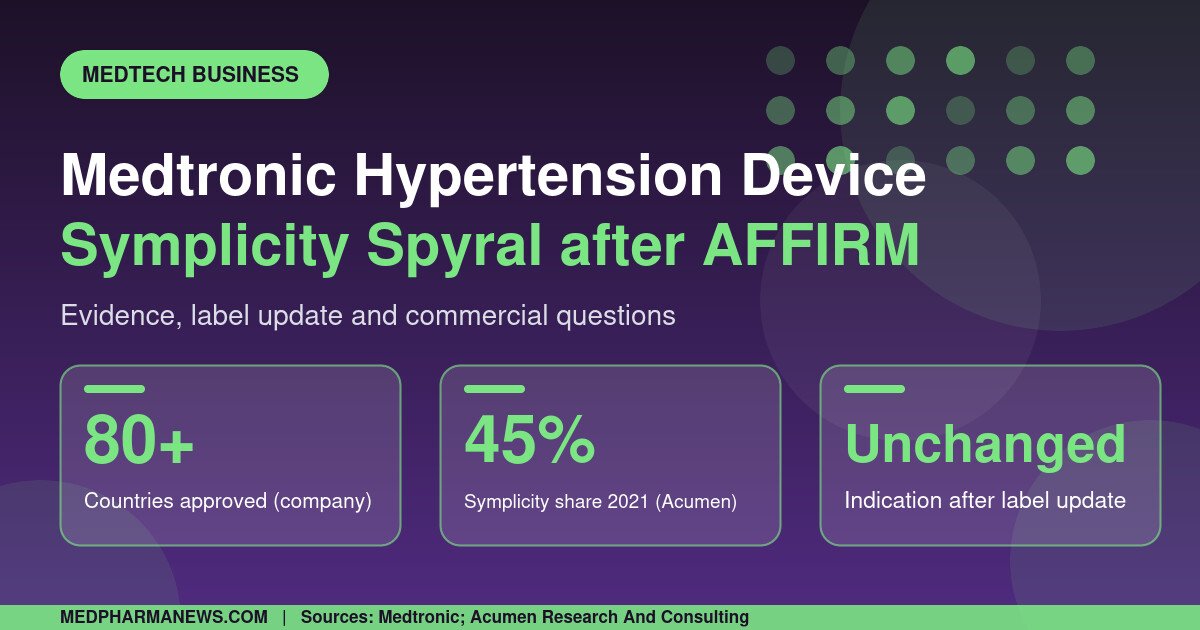
- Medtronic says Symplicity is approved for commercial use in more than 80 countries.
- No revenue, pricing or sales-guidance figures were disclosed in the announcement.
What the SPYRAL AFFIRM results mean for Medtronic
Evidence drives adoption of a procedure like renal denervation, because hospitals and payers need confidence that it works in the patients they treat. SPYRAL AFFIRM adds a large, post-approval, real-world dataset: a US cohort of 594 patients at 73 sites, according to a conference report. Medtronic’s Jason Weidman described the aim, in an earlier release, as building the most robust body of real-world evidence in the field, and Lara Barghout of Medtronic said broad and diverse evidence is central to the mission.
The caveat is that the study is single-arm and the data are six-month results. Payers and guideline bodies often want long-term outcomes and controlled comparisons before changing coverage. The announcement does not say how the data will be used in coverage discussions.
The numbers in a table
| Measure | Six-month result |
|---|---|
| Office systolic BP | -18.2 mmHg |
| Home BP | -9.4 mmHg |
| 24-hour ambulatory BP | -9.7 mmHg |
| Average antihypertensive drugs | 3.6, unchanged |
| Composite safety endpoint | 2.1% |
| Clinical-benefit responders | Nearly nine in ten (86.1% per a conference report) |
The safety line needs care. Medtronic reports a composite safety endpoint of 2.1%, while a conference report describes fewer than 1% of patients having adverse events. These may be different measures, and until the full paper is read we do not treat either as the complete safety picture.
The labelling update: commercial significance without a new indication
A labelling update that adds clinical data can help sales teams and physicians discuss the device with patients who have particular conditions, such as diabetes or kidney disease, because the product information now describes how they fared. It does not change who the device is approved for. Medtronic states the indication for use is unchanged, so we do not suggest that a new indication has been granted. Details of the regulator’s device framework are on the FDA medical devices pages.
How hospitals and payers weigh evidence like this
The following is our general framing of the decision process, not a description of any specific payer. A hospital deciding whether to build a renal denervation programme looks at clinical benefit, procedure time, staffing, reimbursement and referral volume. A payer looks for evidence that the benefit is meaningful and durable, and that the cost is justified against drugs that are already inexpensive. A single-arm, six-month study speaks mainly to the first of these. It is helpful for physicians choosing among patients, and less decisive for coverage policy.
The patient mix matters commercially too. A cohort that includes older adults, women, Black and Hispanic patients, and people with kidney disease or diabetes is closer to the population that hospitals actually see. Medtronic can point to that breadth when it discusses the device, although numerical subgroup results were not provided.
Three scenarios to watch (our framing)
- Steady adoption: clinicians use the new labelling data to select patients, and volumes grow with referrals and training.
- Coverage-led acceleration: longer follow-up or controlled data prompt payers and guideline groups to broaden support.
- Slow progress: absent new coverage decisions, use stays concentrated in specialist centres.
The announcement does not indicate which is likely, and we make no forecast.
Timeline
- Earlier in 2026: Medtronic cites a pooled analysis reporting similar benefit at three years.
- 3 November 2026: SPYRAL AFFIRM six-month data presented at TCT 2026.
- Same period: FDA labelling update approved; date not stated.
Competitive and commercial questions
These are our framing of questions analysts and hospital buyers typically raise; the announcement does not address them. How broad is payer coverage for renal denervation, and could new data widen it? How does procedure volume compare with expectations? What is the competitive position of other renal denervation systems? How much of the benefit depends on physician training and patient selection? In the absence of figures from Medtronic, we cannot say.
Market context: renal denervation
According to Acumen Research And Consulting, the global renal denervation market was USD 198.1 million in 2021 and is projected to reach USD 4,464.6 million by 2030, a compound annual growth rate of 41.5%. Europe held over 70% share in 2021, North America was expected to follow, Asia-Pacific is the fastest-growing region and Symplicity held over 45% of overall share.
The projection is aggressive and dated. The page was last updated in October 2022, its stated growth rate fits 2021 to 2030 rather than the named 2022 to 2030 period, and its hypertension statistic looks implausible. If the market grows as projected it would be around 22 times larger in nine years, which we regard as a publisher’s scenario and not a forecast we endorse. The figures are not Medtronic sales.
Our analysis
In our assessment, the SPYRAL AFFIRM data support Medtronic’s position as the incumbent in renal denervation by adding breadth, including more diverse patients than earlier trials. The commercial constraint is not clinical signal but access: coverage decisions, training and referral pathways. The unchanged indication also means growth will come from deeper use within the approved population and not from a wider label. We make no forecast of sales or share price.
What is not disclosed
- Procedure volumes, revenue or pricing for Symplicity Spyral.
- The date of the FDA labelling approval.
- Payer coverage plans linked to the new data.
- Full safety breakdown and subgroup numbers.
Risks and caveats
- Single-arm, six-month data from the manufacturer and a conference report.
- Market projections are dated third-party estimates.
- The labelling update does not add an indication.
- This article is not investment or medical advice.
What to watch next
- Coverage and guideline decisions on renal denervation.
- Longer follow-up from SPYRAL AFFIRM.
- Medtronic commentary on renal denervation in its next results.
- Competitor data and launches.
General background
Company information is on the Medtronic website, and general guidance on high blood pressure is available from the American Heart Association. More coverage is in our medical devices section.
Questions readers are asking about the Medtronic hypertension device
Did the FDA approve a new use for Symplicity Spyral?
No. The labelling update adds data; the indication for use is unchanged.
How did blood pressure change?
Office systolic pressure fell by 18.2 mmHg at six months on average.
Will this raise Medtronic sales?
The announcement gives no sales estimate.
FAQ
What is the Symplicity Spyral system?
A catheter-based renal denervation system with a multi-electrode design.
Is it implanted?
No implant is left behind.
Where were the data presented?
At TCT 2026, with publication in Circulation: Cardiovascular Interventions.
How we reported this: details come from Medtronic’s announcements and a conference report; market figures are attributed to Acumen Research And Consulting. Last updated 4 November 2026. This is news reporting and not investment or medical advice.