Boston Scientific cardiovascular devices drew attention on 2 November 2026 with the release of SIMPLAAFY, a randomised study of post-implant drug regimens for the WATCHMAN FLX Pro left atrial appendage closure device. The company reports positive results for two lighter regimens, which remain investigational. For the business, the data may support clinician confidence in WATCHMAN, but no labelling change, financial guidance or revenue figure was announced.
Key takeaways on Boston Scientific cardiovascular devices and SIMPLAAFY
- 1,857 patients at 86 US sites were randomised; aspirin alone and a reduced-dose anticoagulant each met six-month noninferiority against dual antiplatelet therapy.
- Both lighter regimens showed less bleeding; rates were not given.
- Device-related thrombus at 45 days: 0.9% with reduced-dose anticoagulant versus 3.4% with the comparator (P=0.01).
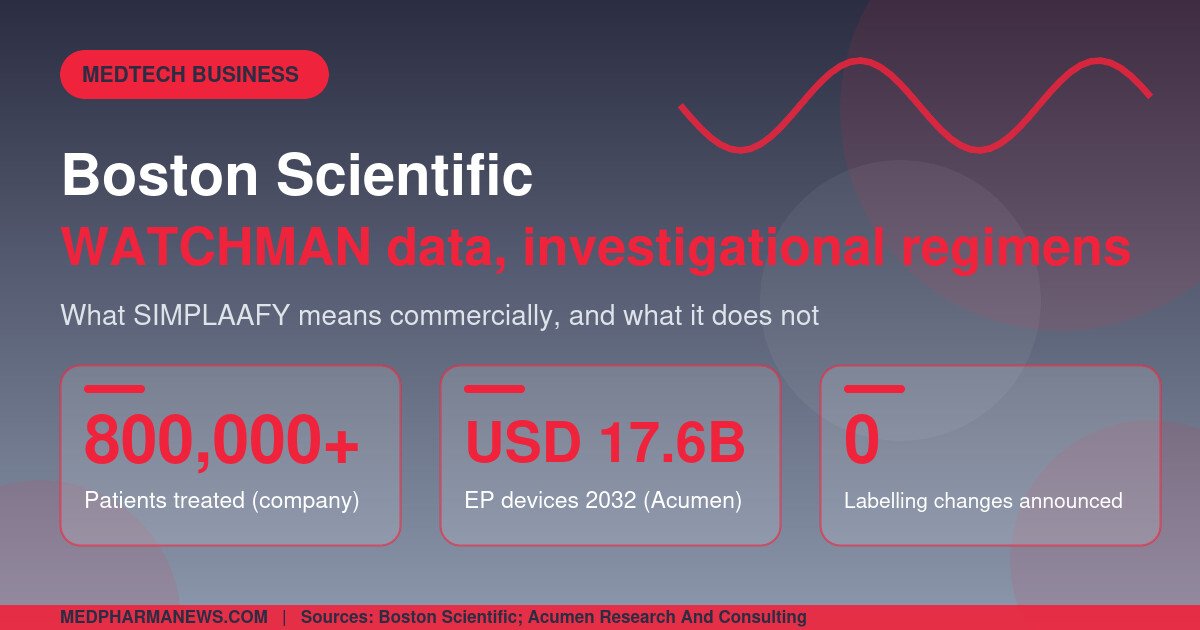
- WATCHMAN FLX Pro was FDA-approved in 2023; the company says WATCHMAN has been used in more than 800,000 patients.
- The regimens tested are investigational, and no label change was announced.
Why post-implant treatment is a commercial question
A closure device is meant to let selected patients avoid long-term blood thinners, so the drugs they must take immediately after implant influence how attractive the procedure looks to patients and referring physicians. Heavy regimens can deter people who were considered for closure because of bleeding concerns. If lighter regimens prove safe, the procedure could become easier to recommend. That is our reading of the logic; the company has not provided volume or growth estimates tied to the trial.
The trial in a table
| Arm | Regimen | Status |
|---|---|---|
| Aspirin alone | Aspirin only | Investigational |
| Reduced-dose anticoagulant | NOAC for 3 months, then aspirin | Investigational |
| Comparator | Aspirin plus clopidogrel for 6 months, then aspirin | Reference |
What the company has and has not said
Dr Brad Sutton, Boston Scientific’s chief medical officer for Atrial Fibrillation Solutions, and trial co-chair Dr Saibal Kar are quoted in the release. The company also noted the start of the Elite AF trial of its next-generation device in 2026. It did not state whether it will seek a labelling change, how it expects practice to shift or what effect the data may have on sales.
How hospitals and referring physicians might weigh the data (our framing)
The following is general analysis, not a description of any named hospital. A structural heart programme considers clinical outcomes, procedure volumes, imaging follow-up requirements and the staffing needed to manage patients after discharge. A simpler post-implant regimen could, in principle, ease follow-up and make the procedure easier to explain to patients. It would not change the core costs of the implant or the procedure itself, and it does not address who qualifies for closure in the first place.
Referring cardiologists and electrophysiologists may also look at whether the trial population resembles their own patients. The study enrolled people with non-valvular atrial fibrillation at 86 US sites, so US practice patterns are well represented. Whether the findings would carry over to other health systems is a question the announcement does not address.
Franchise context
WATCHMAN is Boston Scientific’s left atrial appendage closure franchise, and the company says it has been used in more than 800,000 patients. In 2026 the company began the Elite AF trial of a next-generation device. We read these as signs that the company is investing in both clinical evidence and product development around the franchise, but the announcement offers no revenue, growth rate or margin figures, so we cannot size the franchise or the contribution of this trial.
Timeline
- 2023: FDA approval of WATCHMAN FLX Pro.
- 2026: Elite AF trial begins.
- 2 November 2026: SIMPLAAFY presented at TCT 2026 and published in JAMA.
- Next: 12-month follow-up.
Adoption factors (our framing)
- Guideline support: cardiology societies may need to review the full paper before changing recommendations.
- Label status: until the regimens are in the approved labelling, use would be physician judgement outside it.
- Payer view: lower bleeding could matter to payers, but the announcement gives no cost data.
- Competition: other closure approaches exist, but the announcement does not compare them.
Market context: electrophysiology devices
Acumen Research And Consulting does not publish a report dedicated to appendage closure, so we cite its Electrophysiology Devices Market report as adjacent. It puts the global market at USD 6.3 billion in 2022 and USD 17.6 billion by 2032, a compound annual growth rate of 10.9% for 2023 to 2032. North America held over 38% share, Asia-Pacific about 12%, atrial fibrillation was over 32% of 2022 revenue and hospitals over 54% of end use.
The page dates from May 2023, wrongly describes 2032 as an increase of USD 17.6 billion (about USD 11.3 billion by our arithmetic) and lists a company twice. It is a broad category figure, not a measure of WATCHMAN sales.
Our analysis
In our assessment, SIMPLAAFY is supportive for the WATCHMAN franchise but not a catalyst we can size. The commercial value rests on whether clinicians change practice and whether the label follows, neither of which has happened. We make no forecast of revenue or share price, and note that a promotional release is not a substitute for the peer-reviewed paper.
What is not disclosed
- Bleeding rates and noninferiority margins.
- Plans for regulatory submissions.
- Revenue or volume effects.
- Competitor comparisons.
Risks and caveats
- Investigational regimens; no approved label change.
- Source is a company release.
- Market data are adjacent and dated.
- Not investment or medical advice.
What to watch next
- 12-month data.
- Guideline updates.
- Any regulatory filing.
- Company commentary in its next results.
General background
The company is at Boston Scientific. Regulatory framework: FDA medical devices pages. Patient information: American Heart Association. See also our report on Abbott’s spin-offs and the medical devices section.
Questions readers are asking about Boston Scientific cardiovascular devices
Is aspirin alone now approved after WATCHMAN?
No. The regimens are investigational.
Will this lift sales?
The company gave no estimate.
When is the next data?
Twelve-month follow-up is planned.
FAQ
What is WATCHMAN FLX Pro?
A left atrial appendage closure device, FDA-approved in 2023.
What was compared?
Aspirin alone and a short reduced-dose anticoagulant course against aspirin plus clopidogrel.
Where were results published?
In JAMA, with the TCT 2026 presentation.
How we reported this: details come from Boston Scientific’s announcement of 2 November 2026; market figures are attributed to Acumen Research And Consulting. Last updated 4 November 2026. This is news reporting and not investment or medical advice.