Structural heart devices are a core growth area for Edwards Lifesciences, and on 2 November 2026 the company reported results from CLASP II TR, a randomised trial of its PASCAL system for tricuspid regurgitation. Edwards says the device improved health status versus medical therapy alone and that it received FDA approval for tricuspid repair in October 2026, a claim we have not independently verified. The data also include a numerically higher mortality rate with PASCAL that the company release does not discuss.
Key takeaways on structural heart devices and CLASP II TR
- 450 symptomatic patients were randomised 2:1: PASCAL plus medical therapy (302) versus medical therapy alone (148).
- Primary endpoint at six months: win ratio 1.98 (95% CI 1.47 to 2.67; p below 0.001), driven mainly by health status.
- Valve leakage reduced to moderate or less in 80% versus 30% at one year.
- Mortality 8.8% versus 4.6% (p=0.125, not significant); heart-failure hospitalisation 13.2% versus 12.9%.
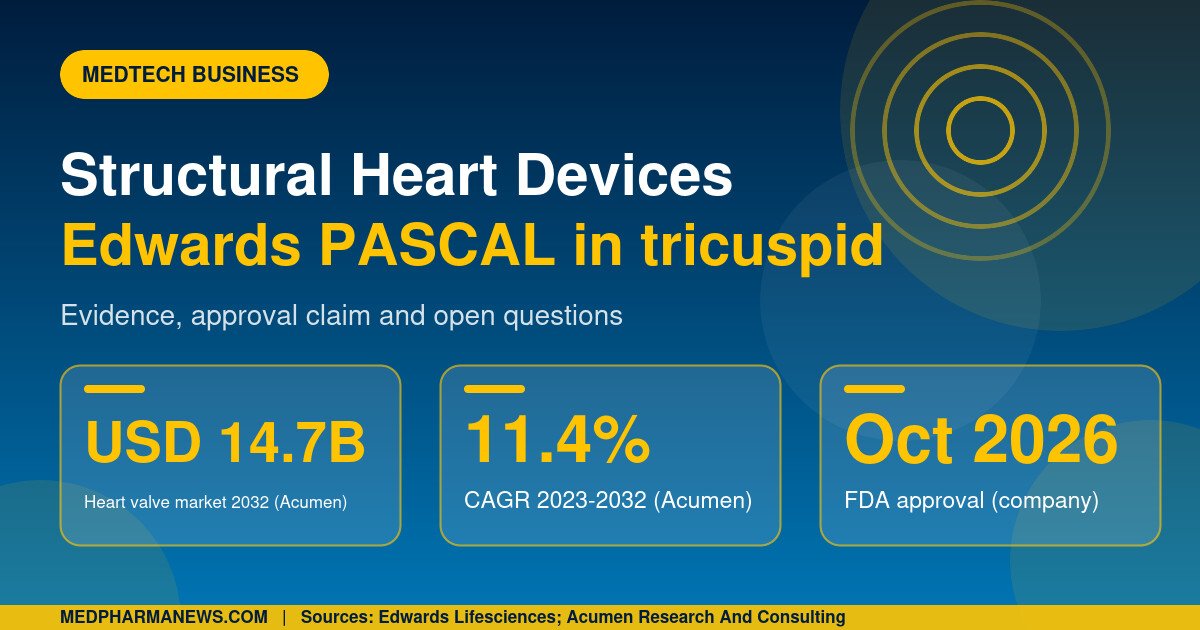
- Edwards says FDA approval for tricuspid repair came in October 2026 and a CE Mark in 2020; neither was independently verified.
- No revenue, pricing or guidance figures were disclosed.
What the trial adds to the Edwards story
Randomised evidence matters commercially because hospitals, physicians and payers weigh new structural heart procedures on the quality of the data. CLASP II TR compares PASCAL with medical therapy in patients who remain symptomatic and are at intermediate or high surgical risk. Daveen Chopra of Edwards and Dr Charles J. Davidson of Northwestern are quoted in the release. The result supports a symptom-led case for treatment, as health status drove the primary endpoint.
The trial title refers to one-year results, but the primary endpoint was assessed at six months; one-year data are additional. We note this because it affects how the headline should be read.
The data in a table
| Measure | PASCAL plus medical therapy | Medical therapy alone |
|---|---|---|
| Patients | 302 | 148 |
| TR moderate or less (1 year) | 80% | 30% |
| Tricuspid interventions | 5.5% | 15.8% |
| All-cause mortality | 8.8% | 4.6% |
| Heart-failure hospitalisation | 13.2% | 12.9% |
The safety question analysts will ask
Mortality was numerically higher with PASCAL, 8.8% against 4.6%, though the difference was not statistically significant (p=0.125). The company release says only that adverse event rates were low at 30 days. Adjudicated composite major adverse events were 6.9% at 30 days and 20.1% at one year, and single leaflet device attachment was 3.4% and 4.8%, but these were not split by arm in the material we reviewed. For a manufacturer, how this is explained in the full paper will matter for physician confidence and coverage discussions.
How centres and payers might respond (our framing)
This is general analysis, not a description of any named hospital or insurer. A centre considering a tricuspid programme looks at the clinical evidence, the imaging and heart-team expertise needed, the volume of eligible patients and the reimbursement it can expect. A payer looks at whether the benefit is meaningful and durable relative to cost. A health-status gain with fewer later tricuspid interventions (5.5% versus 15.8% in the trial) may support a value argument, while the absence of a survival or hospitalisation benefit may limit enthusiasm.
Physician confidence is a separate lever. Interventional cardiologists will want to see the survival curves and the causes of death behind the mortality figures before changing referral habits. The announcement did not provide these, and it does not say how Edwards plans to address the question in discussions with clinicians.
Timeline
- 2020: CE Mark reported by the company.
- October 2026: company says FDA approval received for tricuspid repair.
- 2 November 2026: CLASP II TR results at TCT 2026.
Commercial questions (our framing)
The announcement does not answer the following. How large is the eligible tricuspid patient population in practice? What reimbursement will apply, and will payers accept a health-status benefit without a survival benefit? How will competing tricuspid devices be positioned? How quickly can centres build volume, given the training and imaging expertise needed? We make no forecast.
Market context: transcatheter heart valves
Acumen Research And Consulting has no tricuspid-specific report. Its Transcatheter Heart Valve Replacement Systems Market report is adjacent: USD 5.1 billion in 2022, rising to USD 14.7 billion by 2032, a compound annual growth rate of 11.4% for 2023 to 2032. North America was about USD 1.9 billion, Asia-Pacific is projected to grow at above 12%, and transcatheter aortic valve replacement was about USD 4.3 billion.
The page dates from February 2024, calls the tricuspid valve the left-side valve and mentions coronary valves. By our calculation, 11.4% compounded from USD 5.1 billion for ten years gives about USD 15.0 billion, a little above the stated figure. Aortic replacement dominates the numbers, so tricuspid repair is a small part of the total, and the report is not a measure of Edwards revenue.
Our analysis
In our assessment, CLASP II TR strengthens the evidence base for Edwards in a new part of the heart, and the symptom benefit is a credible commercial foundation. It does not remove the need to explain the mortality signal, and the lack of survival or hospitalisation benefit may shape how payers and guideline writers respond. We make no forecast of sales or share price.
What is not disclosed
- Revenue, pricing and guidance for the tricuspid indication.
- Safety events by treatment arm.
- Causes of death.
- Details and date of the FDA approval.
Risks and caveats
- Numerically higher mortality with PASCAL.
- Company-reported approval claims not independently verified.
- Market data are adjacent and dated.
- Not investment or medical advice.
What to watch next
- The full publication of CLASP II TR.
- Longer-term survival data.
- Payer coverage decisions.
- Edwards commentary in its next results.
General background
Company information: Edwards Lifesciences. Regulatory framework: FDA medical devices pages. See also our report on Abbott’s spin-offs and the medical devices section.
Questions readers are asking about structural heart devices
Did PASCAL improve survival?
Not shown. Mortality was numerically higher, though not significantly.
Is PASCAL FDA-approved for tricuspid repair?
Edwards says so; we have not independently verified the approval.
Will it raise Edwards sales?
No sales estimate was given.
FAQ
What was the primary endpoint?
A hierarchical win ratio at six months, driven mainly by health status.
How many patients?
450 analysed.
What was the comparator?
Optimal medical therapy alone.
How we reported this: details come from Edwards Lifesciences’ announcement of 2 November 2026 and a conference report; market figures are attributed to Acumen Research And Consulting. Last updated 4 November 2026. This is news reporting and not investment or medical advice.