Healthcare cybersecurity is being tested in a new way by the reported incident at French blood storage sites in early November 2026. According to press reports of statements by the EFS, the French blood establishment, and the health ministry, equipment at three cold-storage sites was affected overnight on 1 and 2 November, but no blood products were lost, no health consequences were recorded and collection and distribution continued. The national cybersecurity agency ANSSI and the ministry are investigating. This business-oriented analysis looks at what the incident means for resilience planning and spending, and it deliberately avoids speculation about the method, the perpetrators or any data exposure, none of which has been established.
Key takeaways on healthcare cybersecurity after the incident
- Impact reported by officials: no health consequences and no blood products lost.
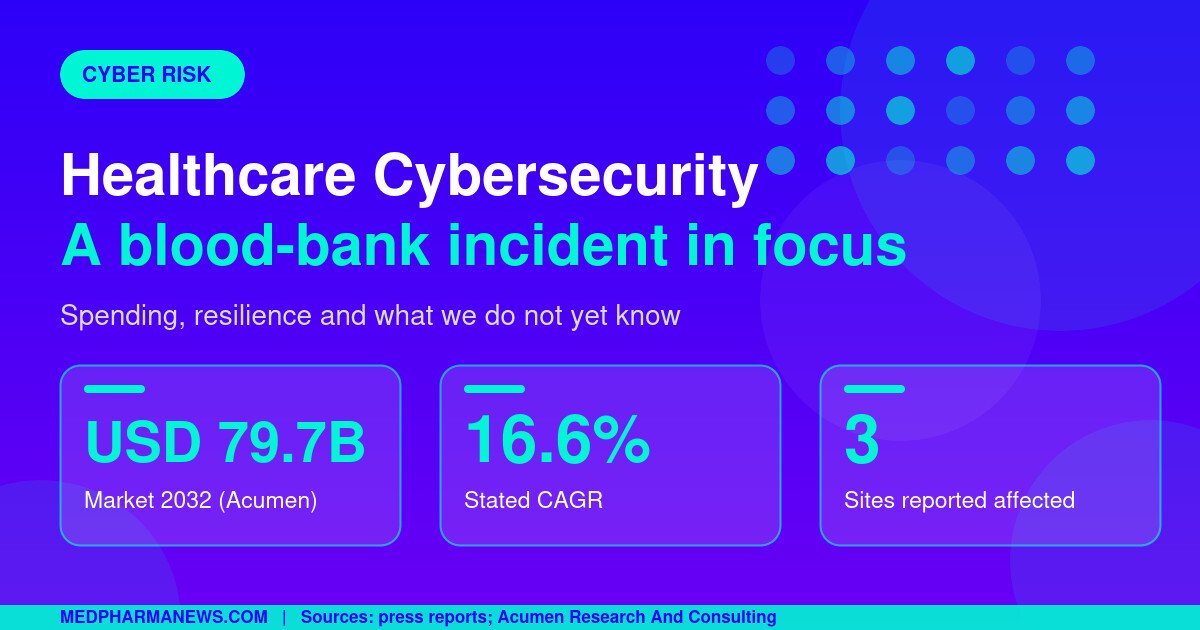
- Scope: three EFS cold-storage sites reportedly affected; investigation by ANSSI and the health ministry is ongoing.
- Not established: method, responsibility, motive, data exposure.
- Business angle: operational technology such as refrigeration is part of healthcare’s risk surface.
- Market: Acumen projects healthcare cybersecurity growing at about 16.6% a year, with caveats on the figures.
Why this incident matters beyond France
Healthcare organisations have invested heavily in protecting patient data, but the equipment that stores medicines, blood and samples has received less attention in public discussion. This incident, as reported, concerned storage equipment and not patient records, and officials say the outcome was benign. For managers, the relevant point is not what happened in detail, which remains under investigation, but that supply chains in healthcare include connected devices whose failure or misuse could disrupt care.
What has been reported, and what has not
The effects described come from press reports quoting the EFS and the health ministry: no health consequences, no products lost, alarms flagged the issue and operations continued. Further technical details have circulated, including specific figures and links to other events, but they are not confirmed, and we do not repeat them. The EFS website carries the establishment’s information, and ANSSI at cyber.gouv.fr publishes national cybersecurity guidance.
The business case for resilience
| Layer | Purpose | Example question for management |
|---|---|---|
| Detection | Spot abnormal conditions quickly | Are alarms independent of the controlled equipment? |
| Response | Limit harm when alarms fire | Are manual procedures rehearsed? |
| Redundancy | Keep supply if one site fails | Can products be moved to other sites? |
| Supplier assurance | Reduce third-party risk | What security terms apply to equipment vendors? |
| Segmentation | Contain compromise | Is storage equipment isolated from other networks? |
This table is our general framework for resilience planning and is not a description of the EFS’s arrangements. Its purpose is to show that spending on prevention is only one part of the picture, and that detection, response and redundancy determine whether an incident becomes a harm.
Costs and incentives
Resilience spending competes with other priorities, and it is hard to justify because its benefit is an event that did not happen. Boards often compare the cost of controls with the potential cost of disruption, which includes lost products, delayed procedures, regulatory scrutiny and reputational harm. In healthcare, one further factor is the duty of care: disruptions to supplies such as blood can affect patients directly, which raises the stakes beyond financial loss. Public bodies such as blood establishments also face budget limits, so the practical choice is often between upgrading monitoring, funding redundancy and training staff. The reported outcome in France suggests that investments in detection and procedure can limit harm, but no cost data were disclosed, and we do not estimate any.
Communication after an incident
How an organisation communicates matters almost as much as how it responds technically. Prompt, specific statements that distinguish confirmed facts from open questions reduce the space for rumour. In this case, officials have reportedly stressed the absence of health consequences while the investigation continues, which is a reasonable approach as long as updates follow. For suppliers and partners, a clear channel for incident information and a shared understanding of responsibilities can shorten response times.
Questions for healthcare boards (our framing)
- Which medical products in our organisation depend on connected storage or monitoring equipment?
- What manual back-up exists if automation fails?
- What are our suppliers’ security obligations and how are they tested?
- How quickly could we move stock to another site?
Timeline
- Overnight 1 to 2 November 2026: incident reportedly affects three EFS sites.
- 2 to 4 November 2026: officials quoted on no health consequences.
- Ongoing: ANSSI and ministry investigation.
Market context
According to Acumen Research And Consulting, the global healthcare cybersecurity market was USD 17.6 billion in 2022 and is projected to reach USD 79.7 billion by 2032, a compound annual growth rate of 16.6% for 2023 to 2032, with North America at about 40% and Asia-Pacific the fastest growing; malware is the largest threat type. By our calculation 16.6% compounded gives about USD 81.8 billion, so the stated endpoints imply about 16.3%. The page was published in July 2024 and has name errors. It does not refer to this incident, and market growth does not show that any one organisation is better protected.
Our analysis
In our assessment, the incident is best treated as a reminder to map dependencies, not as evidence about any particular attacker or technique. The reported outcome suggests that layered safeguards limited harm, which is the case for investing in detection and response as well as prevention. We make no forecast about spending or any company.
What is not disclosed
- Method and scope.
- Responsibility and motive.
- Data exposure.
- Costs or remediation steps.
Risks and caveats
- Reports are of statements and not primary statements.
- Our resilience table is a general framework.
- Market data are indicative.
- This article is not security or investment advice.
What to watch next
- Investigation findings.
- Official guidance to healthcare providers.
- Regulatory responses.
- Supplier security commitments.
General background
Related coverage: an outage affecting UK GP websites. More in the healthcare IT section.
Questions readers are asking about healthcare cybersecurity
Was patient care affected in France?
Officials reportedly said no.
Has the attacker been identified?
No. That has not been established.
Why does this matter for business?
Supply-chain equipment in healthcare is part of the risk surface.
FAQ
What is operational technology?
Equipment that monitors or controls physical processes, such as refrigeration.
What is ANSSI?
The French national cybersecurity agency.
What is supplier assurance?
Checks on the security practices of vendors.
How we reported this: details come from press reports of statements by the EFS and the French health ministry between 2 and 4 November 2026; unattributed details are not repeated; market figures are attributed to Acumen Research And Consulting; calculations marked as ours are our own. Last updated 5 November 2026. This is news reporting and not security or investment advice.